Scuola Internazionale superiore di Studi Avanzati Trieste, Italy.
Front Integr Neurosci. 2011 Oct 24;5:65. doi: 10.3389/fnint.2011.00065. eCollection 2011.
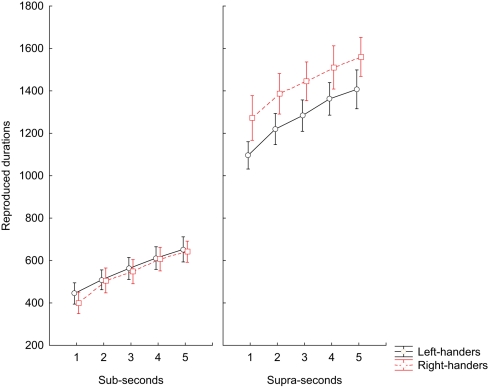
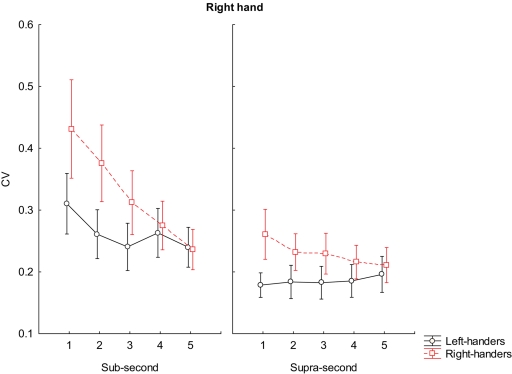
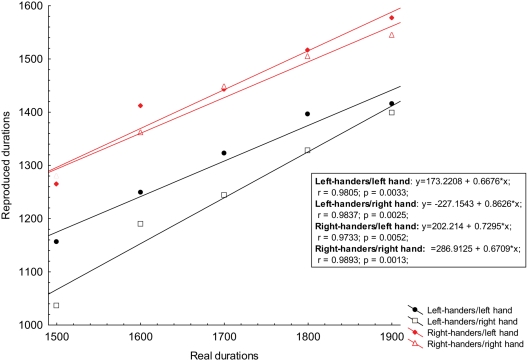
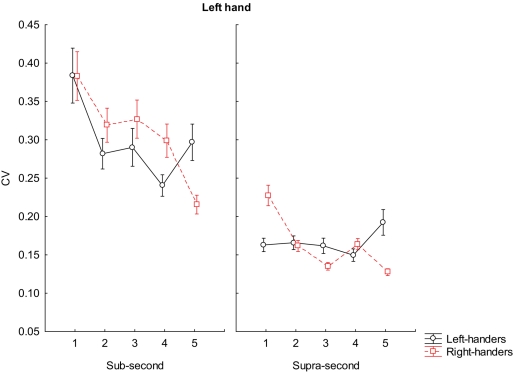
Previous studies exploring specific brain functions of left- and right-handed subjects have shown variances in spatial and motor abilities that might be explained according to consistent structural and functional differences. Given the role of both spatial and motor information in the processing of temporal intervals, we designed a study aimed at investigating timing abilities in left-handed subjects. To this purpose both left- and right-handed subjects were asked to perform a time reproduction of sub-second vs. supra-second time intervals with their left and right hand. Our results show that during processing of the supra-second intervals left-handed participants sub-estimated the duration of the intervals, independently of the hand used to perform the task, while no differences were reported for the sub-second intervals. These results are discussed on the basis of recent findings on supra-second motor timing, as well as emerging evidence that suggests a linear representation of time with a left-to-right displacement.
先前的研究探索了左撇子和右撇子特定的大脑功能,发现了空间和运动能力的差异,这些差异可能可以根据一致的结构和功能差异来解释。鉴于空间和运动信息在时间间隔处理中的作用,我们设计了一项旨在研究左撇子时间能力的研究。为此,我们要求左撇子和右撇子用左手和右手对亚秒和超秒时间间隔进行时间复制。我们的结果表明,在处理超秒时间间隔时,左撇子参与者会低估间隔的持续时间,而与执行任务的手无关,而对于亚秒时间间隔则没有报告差异。这些结果是基于最近关于超秒运动计时的发现以及表明时间具有从左到右位移的线性表示的新兴证据进行讨论的。