Vicario Carmelo Mario, Martino Gabriella, Marcuzzo Alex, Craparo Giuseppe
Dipartimento di Scienze Cognitive, Psicologiche, Pedagogiche e Degli Studi Culturali (COSPECS), Università di Messina, 98121 Messina, Italy.
Department of Clinical and Experimental Medicine, University of Messina, 98122 Messina, Italy.
Brain Sci. 2021 Mar 15;11(3):376. doi: 10.3390/brainsci11030376.
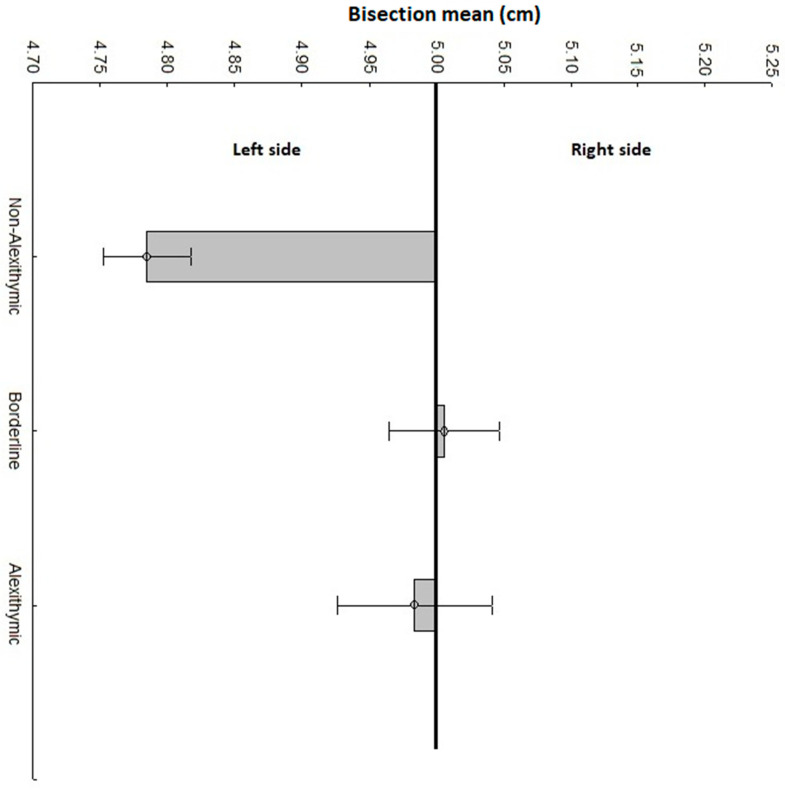
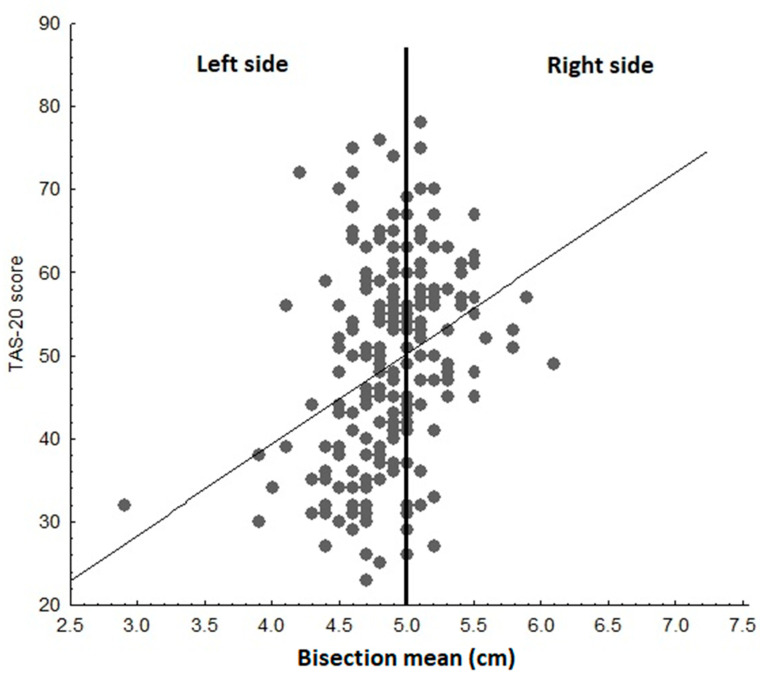
Neuroscience research links alexithymia, the difficulty in identifying and describing feelings and emotions, with left hemisphere dominance and/or right hemisphere deficit. To provide behavioral evidence for this neuroscientific hypothesis, we explored the relationship between alexithymia and performance in a line bisection task, a standard method for evaluating visuospatial processing in relation to right hemisphere functioning. We enrolled 222 healthy participants who completed a version of the 20-item Toronto Alexithymia Scale (TAS-20), which measures alexithymia, and were asked to mark (bisect) the center of a 10-cm horizontal segment. The results document a significant rightward shift in the center of the line in participants with borderline and manifest alexithymia compared with non-alexithymic individuals. The higher the TAS-20 score, the greater the rightward shift in the line bisection task. This finding supports the right hemisphere deficit hypothesis in alexithymia and suggests that visuospatial abnormalities may be an important component of this mental condition.
神经科学研究将述情障碍(即难以识别和描述感受与情绪)与左半球优势和/或右半球功能缺陷联系起来。为了为这一神经科学假设提供行为学证据,我们探究了述情障碍与直线二等分任务表现之间的关系,直线二等分任务是评估与右半球功能相关的视觉空间处理能力的一种标准方法。我们招募了222名健康参与者,他们完成了一个20项的多伦多述情障碍量表(TAS - 20)版本,该量表用于测量述情障碍,然后要求他们标记(二等分)一条10厘米水平线段的中点。结果表明,与非述情障碍个体相比,边缘型和明显述情障碍参与者标记的线段中点显著右移。TAS - 20得分越高,直线二等分任务中的右移就越明显。这一发现支持了述情障碍中的右半球功能缺陷假说,并表明视觉空间异常可能是这种心理状况的一个重要组成部分。