Kodiha Mohamed, Stochaj Ursula
Department of Physiology, McGill University, Montreal, QC, Canada H3G 1Y6.
J Signal Transduct. 2012;2012:208650. doi: 10.1155/2012/208650. Epub 2011 Oct 15.
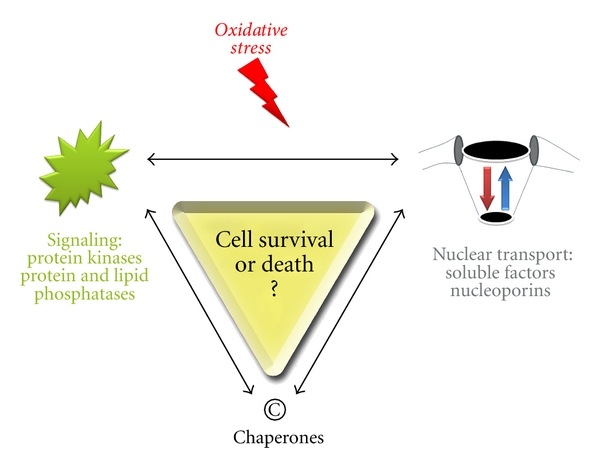
Imbalances in the formation and clearance of reactive oxygen species (ROS) can lead to oxidative stress and subsequent changes that affect all aspects of physiology. To limit and repair the damage generated by ROS, cells have developed a multitude of responses. A hallmark of these responses is the activation of signaling pathways that modulate the function of downstream targets in different cellular locations. To this end, critical steps of the stress response that occur in the nucleus and cytoplasm have to be coordinated, which makes the proper communication between both compartments mandatory. Here, we discuss the interdependence of ROS-mediated signaling and the transport of macromolecules across the nuclear envelope. We highlight examples of oxidant-dependent nuclear trafficking and describe the impact of oxidative stress on the transport apparatus. Our paper concludes by proposing a cellular circuit of ROS-induced signaling, nuclear transport and repair.
活性氧(ROS)生成与清除的失衡会导致氧化应激以及随后影响生理各个方面的变化。为了限制和修复ROS产生的损伤,细胞已发展出多种应对机制。这些应对机制的一个标志是激活信号通路,该通路可调节不同细胞位置下游靶点的功能。为此,必须协调在细胞核和细胞质中发生的应激反应的关键步骤,这使得两个区室之间的正确通讯成为必需。在这里,我们讨论ROS介导的信号传导与大分子跨核膜运输之间的相互依赖性。我们重点介绍了依赖氧化剂的核运输实例,并描述了氧化应激对运输装置的影响。我们的论文最后提出了一个由ROS诱导的信号传导、核运输和修复组成的细胞回路。