Takasu Shinji, Mutoh Michihiro, Takahashi Mami, Nakagama Hitoshi
Division of Cancer Development System, National Cancer Center Research Institute, 5-1-1 Tsukiji, Chuo-ku, Tokyo 104-0045, Japan.
Biochem Res Int. 2012;2012:398697. doi: 10.1155/2012/398697. Epub 2011 Oct 19.
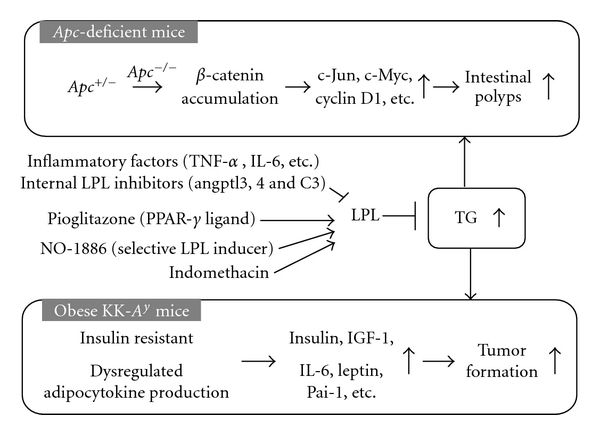
Epidemiological studies have shown that serum triglyceride (TG) levels are linked with risk of development of cancer, including colorectal and pancreatic cancers, and their precancerous lesions. Thus, it is assumed that serum TG plays an important role in carcinogenesis, and the key enzyme lipoprotein lipase (LPL), which catalyzes the hydrolysis of plasma TG, may therefore be involved. Dysregulation of LPL has been reported to contribute to many human diseases, such as atherosclerosis, chylomicronaemia, obesity, and type 2 diabetes. Recently, it has been reported that LPL gene deficiency, such as due to chromosome 8p22 loss, LPL gene polymorphism, and epigenetic changes in its promoter region gene, increases cancer risk, especially in the prostate. In animal experiments, high serum TG levels seem to promote sporadic/carcinogen-induced genesis of colorectal and pancreatic cancers. Interestingly, tumor suppressive effects of LPL inducers, such as PPAR ligands, NO-1886, and indomethacin, have been demonstrated in animal models. Moreover, recent evidence that LPL plays important roles in inflammation and obesity implies that it is an appropriate general target for chemopreventive and chemotherapeutic agents.
流行病学研究表明,血清甘油三酯(TG)水平与包括结直肠癌和胰腺癌及其癌前病变在内的癌症发生风险相关。因此,推测血清TG在致癌过程中起重要作用,催化血浆TG水解的关键酶脂蛋白脂肪酶(LPL)可能也参与其中。据报道,LPL失调会导致许多人类疾病,如动脉粥样硬化、乳糜微粒血症、肥胖症和2型糖尿病。最近,有报道称,LPL基因缺陷,如由于8号染色体p22缺失、LPL基因多态性及其启动子区域基因的表观遗传变化,会增加癌症风险,尤其是前列腺癌风险。在动物实验中,高血清TG水平似乎会促进结直肠癌和胰腺癌的散发性/致癌物诱导发生。有趣的是,在动物模型中已证明LPL诱导剂(如PPAR配体、NO-1886和吲哚美辛)具有肿瘤抑制作用。此外,最近有证据表明LPL在炎症和肥胖中起重要作用,这意味着它是化学预防和化学治疗药物的合适总体靶点。