Department of Ophthalmology and Visual Sciences, University of Illinois at Chicago, College of Medicine, 1855 W Taylor, Chicago, IL 60612, USA.
Virol J. 2011 Oct 26;8:481. doi: 10.1186/1743-422X-8-481.
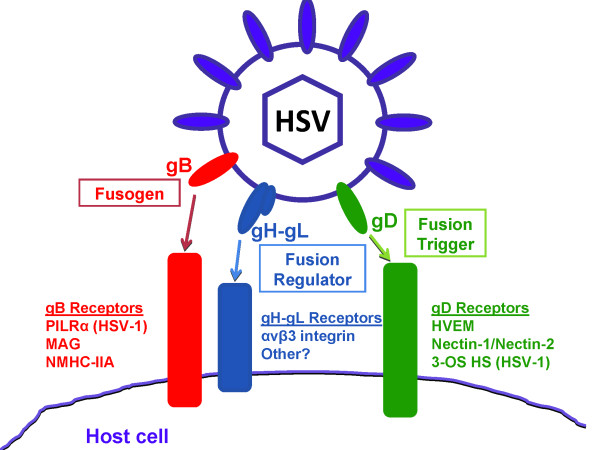
Herpes simplex virus (HSV) type-1 and type-2 have evolved numerous strategies to infect a wide range of hosts and cell types. The result is a very successful prevalence of the virus in the human population infecting 40-80% of people worldwide. HSV entry into host cell is a multistep process that involves the interaction of the viral glycoproteins with various cell surface receptors. Based on the cell type, HSV enter into host cell using different modes of entry. The combination of various receptors and entry modes has resulted in a virus that is capable of infecting virtually all cell types. Identifying the common rate limiting steps of the infection may help the development of antiviral agents that are capable of preventing the virus entry into host cell. In this review we describe the major features of HSV entry that have contributed to the wide susceptibility of cells to HSV infection.
单纯疱疹病毒(HSV)1 型和 2 型已经进化出许多策略来感染广泛的宿主和细胞类型。其结果是该病毒在人类中的流行非常成功,感染了全球 40-80%的人。HSV 进入宿主细胞是一个多步骤的过程,涉及病毒糖蛋白与各种细胞表面受体的相互作用。根据细胞类型的不同,HSV 进入宿主细胞的方式也不同。各种受体和进入模式的结合导致了一种能够感染几乎所有细胞类型的病毒。确定感染的常见限速步骤可能有助于开发能够阻止病毒进入宿主细胞的抗病毒药物。在这篇综述中,我们描述了 HSV 进入的主要特征,这些特征导致了细胞对 HSV 感染的广泛易感性。