Institute of Respiratory Diseases, the Second Hospital of the Third Military Medical University of China, 183 Xinqiao Street, Chongqing 400037, P. R. China.
Respir Res. 2011 Oct 28;12(1):142. doi: 10.1186/1465-9921-12-142.
Salmeterol and fluticasone combination (SFC) has anti-inflammatory effects and improves clinical symptoms in patients with chronic obstructive pulmonary disease (COPD). However, the anti-inflammatory mechanism of SFC remains unclear. In this study, we investigated the inflammatory responses of COPD, as well as the relationship of the inflammatory factors with the levels of CD4+CD25+Foxp3+ regulatory T cells (Foxp3+Tregs) after SFC therapy.
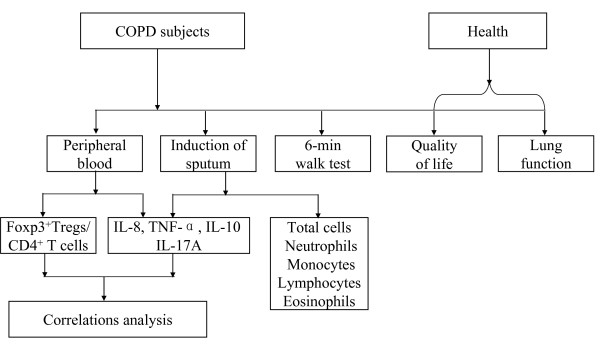
Twenty-one patients with moderate or severe COPD received treatment with 50/500 μg of SFC twice a day for 12 weeks. Before and after treatment, the patients were evaluated using the Modified Medical Research Council (MMRC) dyspnea scale and by conducting a 6-min walk test. The number of neutrophils, monocytes and lymphocytes in induced sputum were counted. Levels of cytokines, including pre-inflammatory IL-8, TNF-α, IL-17A and cytokine IL-10, in the sputum supernatant and peripheral blood were measured by ELISA. The proportion of Foxp3+Tregs in the total CD4+ T cell of the peripheral blood was determined by flow cytometry. The relationship between IL-17A levels and the percentage of Foxp3+Tregs was analyzed by statistical analysis.
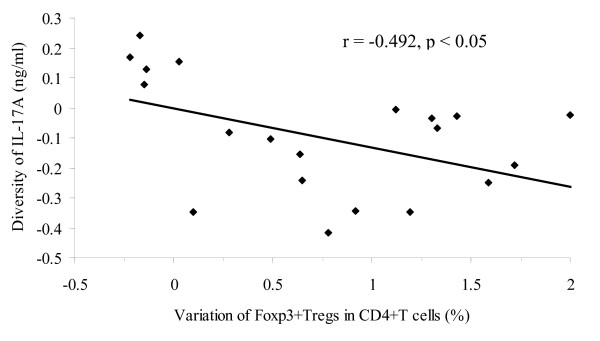
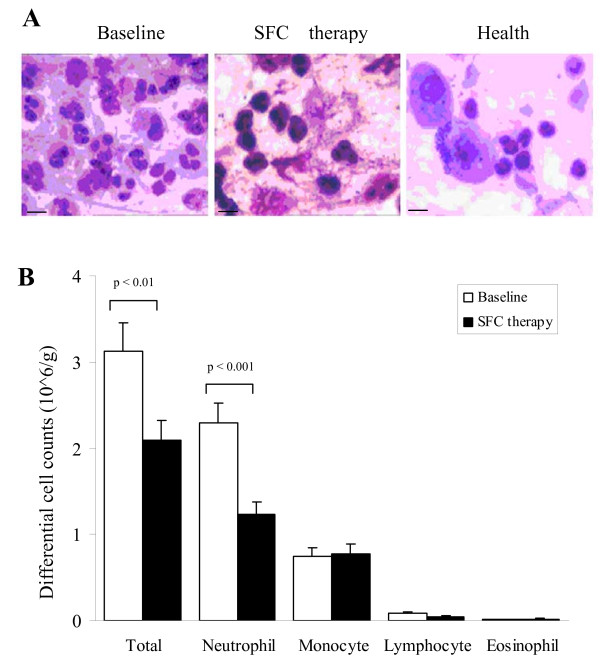
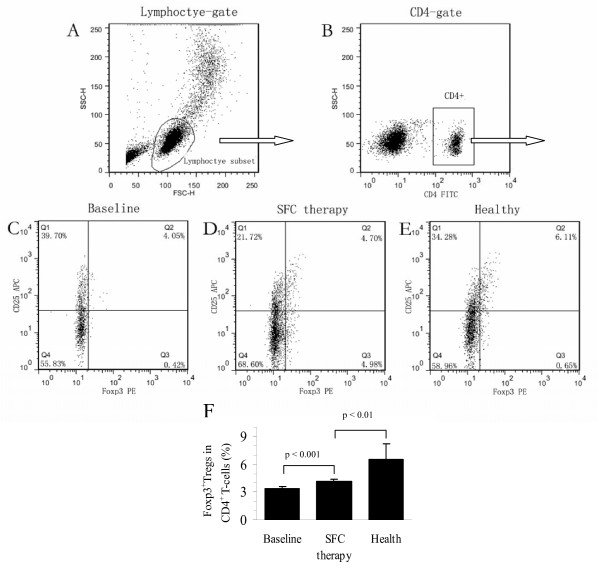
After treatment with SFC, the forced expiratory volume in 1 s as a percentage of predicted values (FEV1%) and the 6-min walk distance in the COPD patients significantly increased, while dyspnea scores decreased. The total number of cells, neutrophils, and the percentage of neutrophils in induced sputum reduced notably, while the proportion of monocytes was significantly increased. Levels of the inflammatory cytokines IL-8, TNF-α, and IL-17A in the sputum supernatant and in the blood were markedly lowered, while IL-10 levels were unchanged. The proportion of Foxp3+Tregs in the total CD4+T cell population in the peripheral blood was drastically higher than that before treatment. The level of IL-17A was negatively correlated with the proportion of Foxp3+Tregs in CD4+T cells.
SFC can reduce the levels of inflammatory factors and improve symptoms of COPD. The levels of inflammatory factors are associated with the variation of Foxp3+Tregs in COPD.
This study was registered with http://www.chictr.org (Chinese Clinical Trial Register) as follows: ChiCTR-TNC-10001270.
沙美特罗氟替卡松(SFC)联合用药具有抗炎作用,并能改善慢性阻塞性肺疾病(COPD)患者的临床症状。然而,SFC 的抗炎机制尚不清楚。在这项研究中,我们研究了 COPD 的炎症反应,以及炎症因子与 SFC 治疗后 CD4+CD25+Foxp3+调节性 T 细胞(Foxp3+Tregs)水平之间的关系。
21 例中重度 COPD 患者接受 50/500μg SFC 每日两次治疗 12 周。在治疗前后,采用改良的医学研究委员会呼吸困难量表(MMRC)和 6 分钟步行试验对患者进行评估。通过诱导痰计数中性粒细胞、单核细胞和淋巴细胞的数量。酶联免疫吸附法(ELISA)检测痰上清液和外周血中前炎症细胞因子白细胞介素-8(IL-8)、肿瘤坏死因子-α(TNF-α)、白细胞介素-17A(IL-17A)和细胞因子白细胞介素-10(IL-10)的水平。通过流式细胞术测定外周血总 CD4+T 细胞中 Foxp3+Tregs 的比例。采用统计学分析方法分析 IL-17A 水平与 Foxp3+Tregs 百分比的关系。
SFC 治疗后,COPD 患者的 1 秒用力呼气量占预计值的百分比(FEV1%)和 6 分钟步行距离明显增加,呼吸困难评分降低。诱导痰中总细胞数、中性粒细胞数和中性粒细胞百分比显著减少,而单核细胞比例显著增加。痰上清液和血液中炎症细胞因子 IL-8、TNF-α和 IL-17A 的水平明显降低,IL-10 水平不变。外周血总 CD4+T 细胞中 Foxp3+Tregs 的比例明显高于治疗前。IL-17A 水平与 CD4+T 细胞中 Foxp3+Tregs 的比例呈负相关。
SFC 可降低炎症因子水平,改善 COPD 症状。炎症因子水平与 COPD 中 Foxp3+Tregs 的变化有关。
本研究在中国临床试验注册中心(http://www.chictr.org)注册,注册号为 ChiCTR-TNC-10001270。