Kozak Darby, Anderson Will, Vogel Robert, Trau Matt
Centre for Biomarker Research and Development, Australian Institute for Bioengineering and Nanotechnology, University of Queensland, Brisbane, Australia 4072, , Tel: 61 7 334 64173.
Nano Today. 2011 Oct 1;6(5):531-545. doi: 10.1016/j.nantod.2011.08.012.
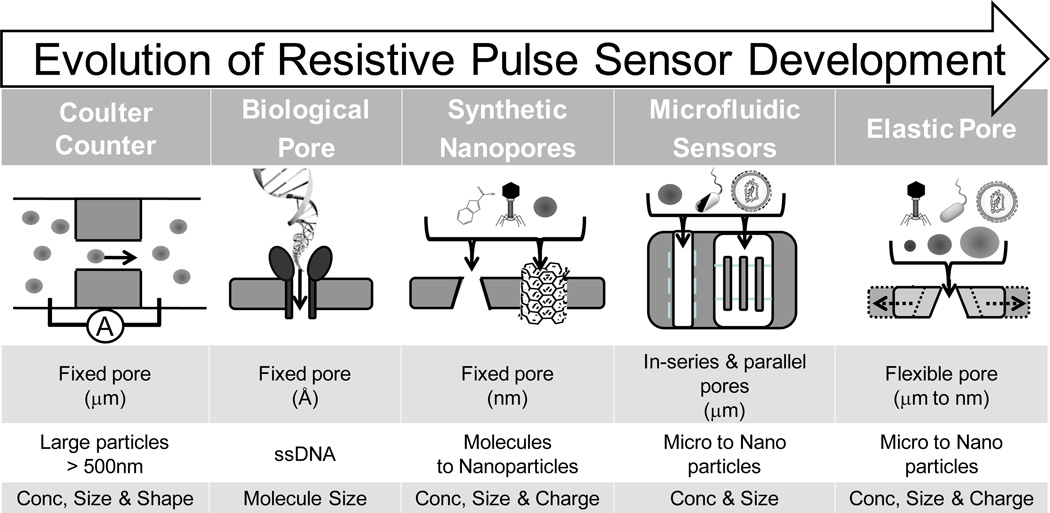
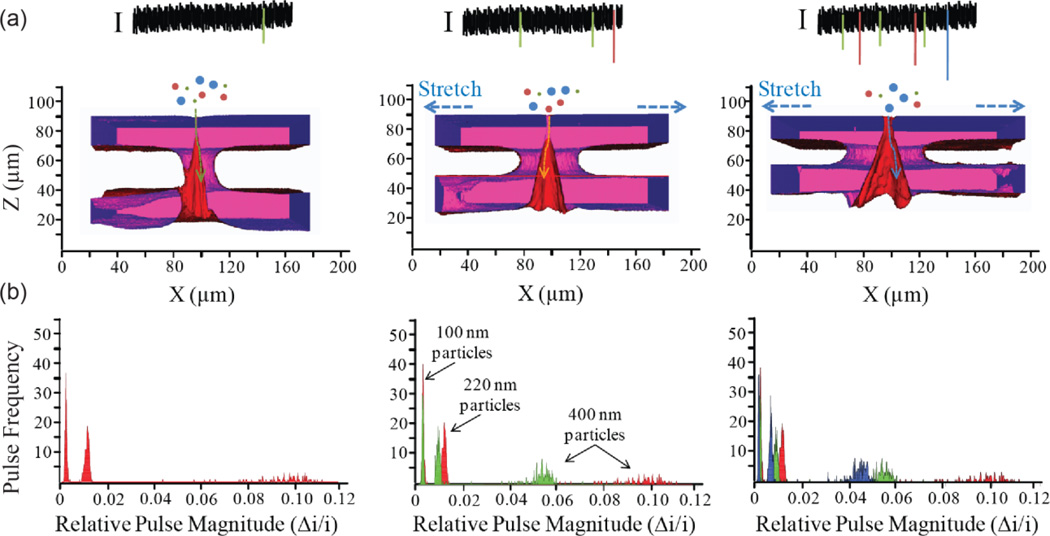
Since the first reported use of a biological ion channel to detect differences in single stranded genomic base pairs in 1996, a renaissance in nanoscale resistive pulse sensors has ensued. This resurgence of a technique originally outlined and commercialized over fifty years ago has largely been driven by advances in nanoscaled fabrication, and ultimately, the prospect of a rapid and inexpensive means for genomic sequencing as well as other macromolecular characterization. In this pursuit, the potential application of these devices to characterize additional properties such as the size, shape, charge, and concentration of nanoscaled materials (10 - 900 nm) has been largely overlooked. Advances in nanotechnology and biotechnology are driving the need for simple yet sensitive individual object readout devices such as resistive pulse sensors. This review will examine the recent progress in pore-based sensing in the nanoscale range. A detailed analysis of three new types of pore sensors - in-series, parallel, and size-tunable pores - has been included. These pores offer improved measurement sensitivity over a wider particle size range. The fundamental physical chemistry of these techniques, which is still evolving, will be reviewed.
自1996年首次报道使用生物离子通道检测单链基因组碱基对差异以来,纳米级电阻脉冲传感器迎来了复兴。这项最初在五十多年前就已概述并商业化的技术的复兴,很大程度上是由纳米制造技术的进步推动的,最终是由快速且廉价的基因组测序及其他大分子表征方法的前景推动的。在这一追求过程中,这些设备用于表征纳米级材料(10 - 900纳米)的其他特性(如尺寸、形状、电荷和浓度)的潜在应用在很大程度上被忽视了。纳米技术和生物技术的进步推动了对诸如电阻脉冲传感器等简单而灵敏的单个物体读出设备的需求。本综述将探讨纳米级范围内基于孔的传感的最新进展。其中包括对三种新型孔传感器——串联孔、并联孔和尺寸可调孔——的详细分析。这些孔在更宽的粒径范围内提供了更高的测量灵敏度。这些技术仍在不断发展的基础物理化学将得到综述。