Influenza Other Respir Viruses. 2012 Jan;6(1):1-5. doi: 10.1111/j.1750-2659.2011.00298.x. Epub 2011 Oct 29.
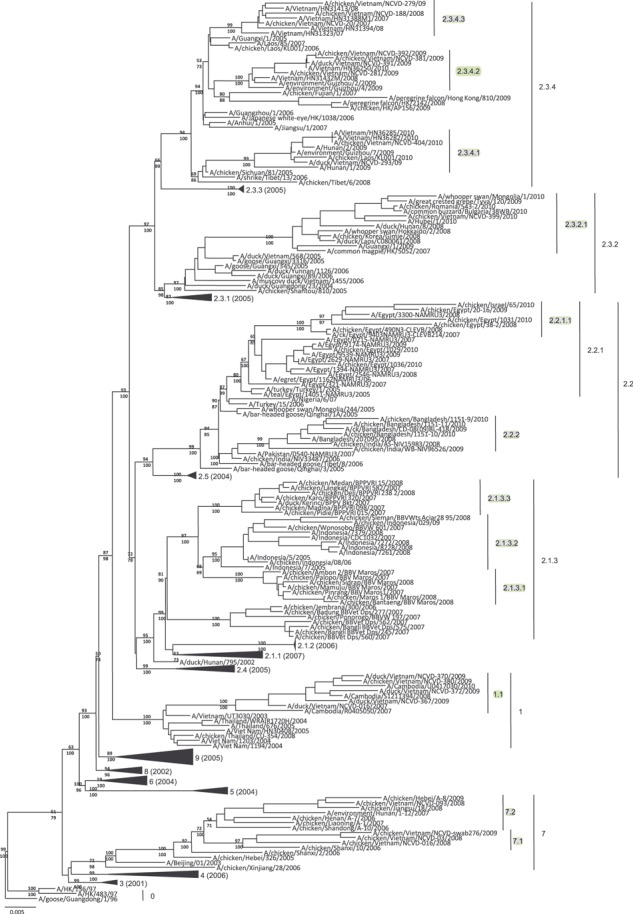
Continued evolution of highly pathogenic avian influenza A (H5N1) throughout many regions of the eastern hemisphere has led to the emergence of new phylogenetic groups. A total of 1637 new H5N1 hemagglutinin (HA) sequences have become available since the previous nomenclature recommendations described in 2009 by the WHO/OIE/FAO H5N1 Evolution Working Group. A comprehensive analysis including all the new data is needed to update HA clade nomenclature.
Phylogenetic trees were constructed from data sets of all available H5N1 HA sequences. New clades were designated on the basis of phylogeny and p-distance using the pre-established nomenclature system (Emerg Infec Dis 2008; 14:e1). Each circulating H5N1 clade was subjected to further phylogenetic analysis and nucleotide sequence divergence calculations.
All recently circulating clades (clade 1 in the Mekong River Delta, 2.1.3 in Indonesia, 2.2 in India/Bangladesh, 2.2.1 in Egypt, 2.3.2, 2.3.4 and 7 in Asia) required assignment of divergent HA genes to new second-, third-, and/or fourth-order clades. At the same time, clades 0, 3, 4, 5, 6, 8, 9, and several second- and third-order groups from clade 2 have not been detected since 2008 or earlier.
New designations are recommended for 12 HA clades, named according to previously defined criteria. In addition, viruses from 13 clades have not been detected since 2008 or earlier. The periodic updating of this dynamic classification system allows continued use of a unified nomenclature in all H5N1 studies.
高致病性禽流感 A 型(H5N1)在东半球许多地区的持续演变导致了新的进化分支的出现。自 2009 年世界卫生组织/动物卫生组织/粮农组织 H5N1 进化工作组提出的上一次命名建议以来,已经获得了 1637 条新的 H5N1 血凝素(HA)序列。需要对所有新数据进行全面分析,以更新 HA 分支命名法。
从所有可用的 H5N1 HA 序列数据集构建系统发育树。根据系统发育和 p-距离,在预先建立的命名系统(Emerg Infec Dis 2008; 14:e1)的基础上指定新分支。对每个循环的 H5N1 分支进行进一步的系统发育分析和核苷酸序列差异计算。
所有最近流行的分支(湄公河三角洲的 1 型、印度尼西亚的 2.1.3 型、印度/孟加拉国的 2.2 型、埃及的 2.2.1 型、2.3.2、2.3.4 和亚洲的 7 型)都需要将分化的 HA 基因分配到新的第二、第三和/或第四级分支。与此同时,自 2008 年或更早以来,没有检测到分支 0、3、4、5、6、8、9 和 2 分支的几个第二和第三级分支。
根据先前定义的标准,建议对 12 个 HA 分支进行新的命名。此外,自 2008 年或更早以来,没有检测到来自 13 个分支的病毒。该动态分类系统的定期更新允许在所有 H5N1 研究中继续使用统一的命名法。