Medina-Armenteros Yordanka, Cajado-Carvalho Daniela, das Neves Oliveira Ricardo, Apetito Akamatsu Milena, Lee Ho Paulo
Centro BioIndustrial, Instituto Butantan and Fundação Butantan, São Paulo 05503-900, SP, Brazil.
Vaccines (Basel). 2024 Sep 12;12(9):1044. doi: 10.3390/vaccines12091044.
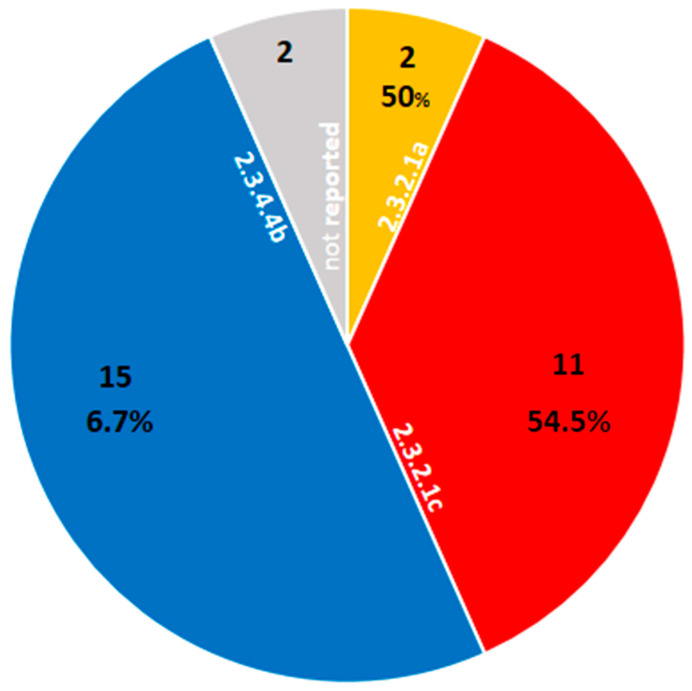
The prevalence of the highly pathogenic avian influenza virus H5N1 in wild birds that migrate all over the world has resulted in the dissemination of this virus across Asia, Europe, Africa, North and South America, the Arctic continent, and Antarctica. So far, H5N1 clade 2.3.4.4.b has reached an almost global distribution, with the exception of Australia and New Zealand for autochthonous cases. H5N1 clade 2.3.4.4.b, derived from the broad-host-range A/Goose/Guangdong/1/96 (H5N1) lineage, has evolved, adapted, and spread to species other than birds, with potential mammal-to-mammal transmission. Many public health agencies consider H5N1 influenza a real pandemic threat. In this sense, we analyzed H5N1 hemagglutinin sequences from recent outbreaks in animals, clinical samples, antigenic prototypes of candidate vaccine viruses, and licensed human vaccines for H5N1 with the aim of shedding light on the development of an H5N1 vaccine suitable for a pandemic response, should one occur in the near future.
高致病性禽流感病毒H5N1在全球迁徙野生鸟类中的流行,导致该病毒在亚洲、欧洲、非洲、南北美洲、北极大陆和南极洲传播。到目前为止,H5N1进化分支2.3.4.4.b几乎已遍布全球,但澳大利亚和新西兰除外,这两个地区没有本土病例。H5N1进化分支2.3.4.4.b源自具有广泛宿主范围的A/Goose/Guangdong/1/96 (H5N1) 谱系,已经进化、适应并传播到鸟类以外的物种,存在潜在的哺乳动物间传播。许多公共卫生机构认为H5N1流感是真正的大流行威胁。从这个意义上说,我们分析了来自近期动物疫情、临床样本、候选疫苗病毒的抗原原型以及已获许可的H5N1人用疫苗中的H5N1血凝素序列,目的是阐明如果在不久的将来发生H5N1大流行,适合应对大流行的H5N1疫苗的研发情况。