Department of Animal Sciences, University of Illinois, Urbana, Illinois, United States of America.
PLoS One. 2011;6(10):e25329. doi: 10.1371/journal.pone.0025329. Epub 2011 Oct 17.
The bovine rumen maintains a diverse microbial community that serves to break down indigestible plant substrates. However, those bacteria specifically adapted to degrade cellulose, the major structural component of plant biomass, represent a fraction of the rumen microbiome. Previously, we proposed scaC as a candidate for phylotyping Ruminococcus flavefaciens, one of three major cellulolytic bacterial species isolated from the rumen. In the present report we examine the dynamics and diversity of scaC-types both within and between cattle temporally, following a dietary switch from corn-silage to grass-legume hay. These results were placed in the context of the overall bacterial population dynamics measured using the 16S rRNA.
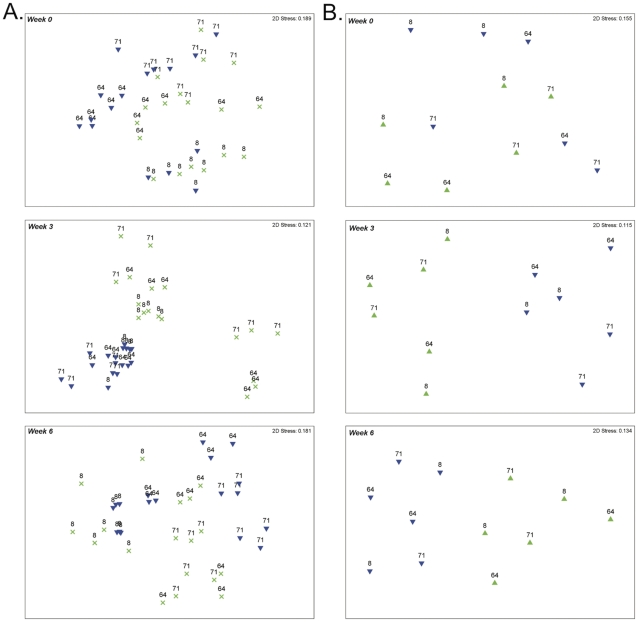
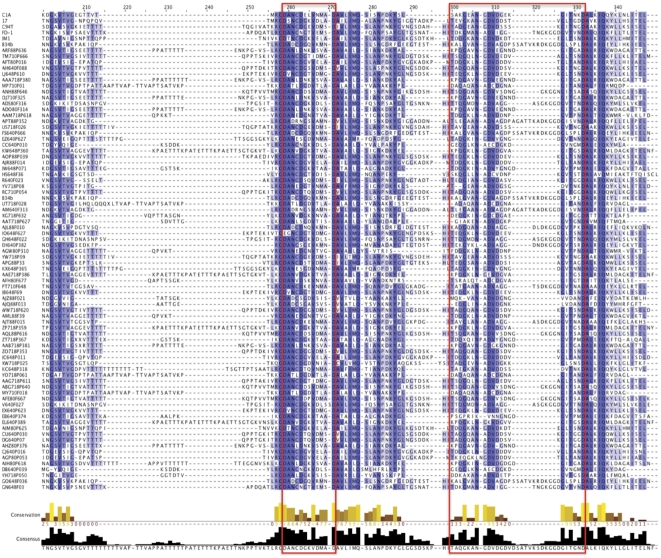
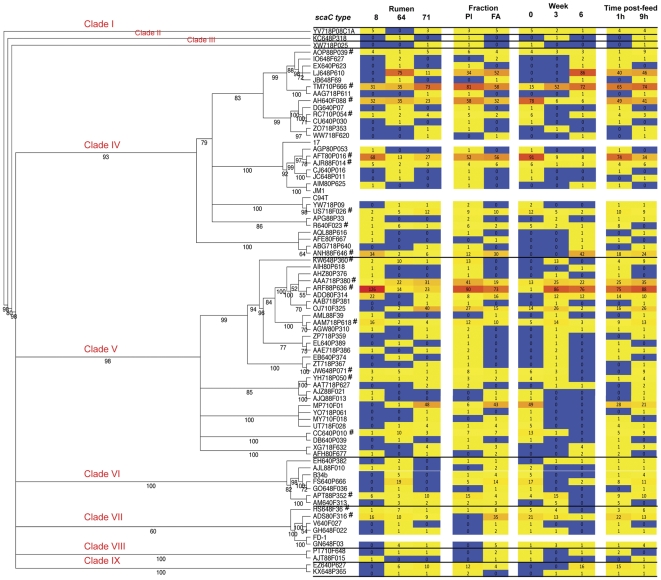
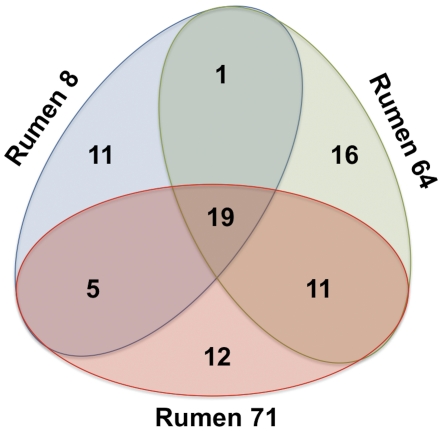
As many as 117 scaC-types were estimated, although just nineteen were detected in each of three rumens tested, and these collectively accounted for the majority of all types present. Variation in scaC populations was observed between cattle, between planktonic and fiber-associated fractions and temporally over the six-week survey, and appeared related to scaC phylogeny. However, by the sixth week no significant separation of scaC populations was seen between animals, suggesting enrichment of a constrained set of scaC-types. Comparing the amino-acid translation of each scaC-type revealed sequence variation within part of the predicted dockerin module but strong conservation in the N-terminus, where the cohesin module is located.
The R. flavefaciens species comprises a multiplicity of scaC-types in-vivo. Enrichment of particular scaC-types temporally, following a dietary switch, and between fractions along with the phylogenetic congruence suggests that functional differences exist between types. Observed differences in dockerin modules suggest at least part of the functional heterogeneity may be conferred by scaC. The polymorphic nature of scaC enables the relative distribution of R. flavefaciens strains to be examined and represents a gene-centric approach to investigating the intraspecific adaptation of an important specialist population.
牛瘤胃维持着一个多样化的微生物群落,有助于分解不可消化的植物基质。然而,那些专门适应降解纤维素的细菌,纤维素是植物生物质的主要结构成分,仅占瘤胃微生物组的一部分。此前,我们提出 scaC 是瘤胃中分离出的三种主要纤维素分解细菌之一的 Ruminococcus flavefaciens 的系统发育分析的候选基因。在本报告中,我们研究了 scaC 型在牛体内和牛之间的动态和多样性,这些牛在从玉米青贮饲料切换到草豆科干草的饮食后,时间跨度为六周。这些结果与使用 16S rRNA 测量的整体细菌种群动态一起进行了分析。
估计有多达 117 种 scaC 型,但在三个测试的瘤胃中每个都只检测到 19 种,这些共同构成了所有存在类型的大多数。在六周的调查过程中,牛之间、浮游生物和纤维相关部分之间以及时间上都观察到 scaC 种群的变化,并且与 scaC 系统发育有关。然而,到第六周,动物之间的 scaC 种群没有明显分离,这表明有限的 scaC 型得到了富集。比较每个 scaC 型的氨基酸翻译揭示了预测的 dockerin 模块内的部分序列变异,但在 N 端(cohesin 模块所在位置)有很强的保守性。
R. flavefaciens 物种在体内包含多种 scaC 型。在饮食切换后以及在不同部分之间,特定 scaC 型的时间上的富集以及与系统发育的一致性表明,不同类型之间存在功能差异。观察到 dockerin 模块的差异表明,功能异质性的至少部分可能由 scaC 赋予。scaC 的多态性使得可以检查 R. flavefaciens 菌株的相对分布,并代表了一种以基因为中心的方法来研究重要专业种群的种内适应。