Arthritis and Clinical Immunology Program, Oklahoma Medical Research Foundation, Oklahoma City, OK 73104, USA.
Arthritis Res Ther. 2011;13(5):245. doi: 10.1186/ar3484. Epub 2011 Oct 31.
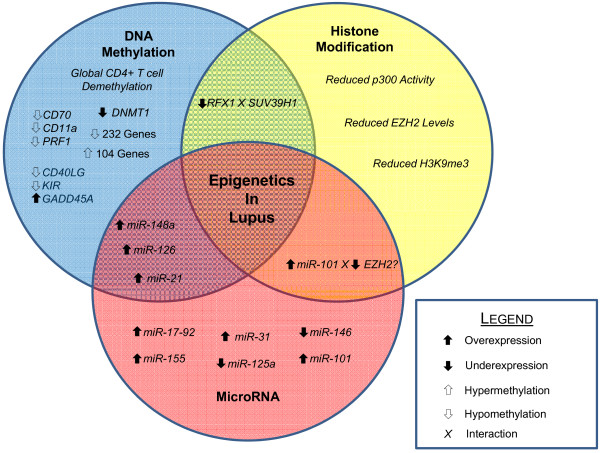
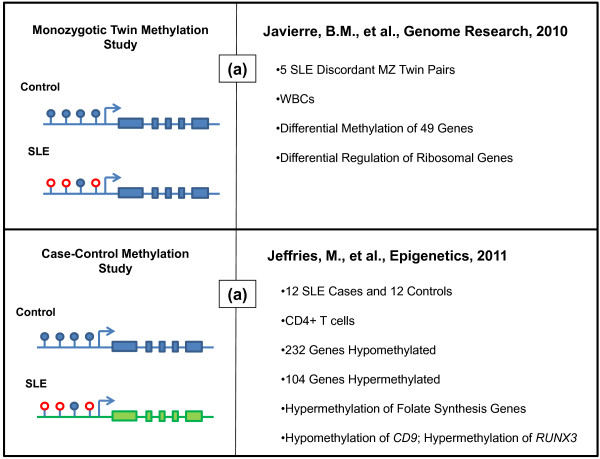
The focus of the present review is on the extent to which epigenetic alterations influence the development of systemic lupus erythematosus. Lupus is a systemic autoimmune disease characterized by the production of autoantibodies directed at nuclear self-antigens. A DNA methylation defect in CD4+ T cells has long been observed in idiopathic and drug-induced lupus. Recent studies utilizing high-throughput technologies have further characterized the nature of the DNA methylation defect in lupus CD4+ T cells. Emerging evidence in the literature is revealing an increasingly interconnected network of epigenetic dysregulation in lupus. Recent reports describe variable expression of a number of regulatory microRNAs in lupus CD4+ T cells, some of which govern the expression of DNA methyltransferase 1. While studies to date have revealed a significant role for epigenetic defects in the pathogenesis of lupus, the causal nature of epigenetic variation in lupus remains elusive. Future longitudinal epigenetic studies in lupus are therefore needed.
本综述的重点在于探讨表观遗传改变在系统性红斑狼疮(lupus)发展中的影响程度。狼疮是一种以自身抗体针对核自身抗原为特征的系统性自身免疫性疾病。在特发性和药物诱导性狼疮中,CD4+ T 细胞中的 DNA 甲基化缺陷早已被观察到。最近利用高通量技术的研究进一步描述了狼疮 CD4+ T 细胞中 DNA 甲基化缺陷的性质。文献中的新证据揭示了狼疮中表观遗传失调的日益相互关联的网络。最近的报告描述了狼疮 CD4+ T 细胞中许多调节 microRNA 的可变表达,其中一些 microRNA 控制 DNA 甲基转移酶 1 的表达。虽然迄今为止的研究表明表观遗传缺陷在狼疮发病机制中具有重要作用,但狼疮中表观遗传变异的因果关系仍然难以捉摸。因此,狼疮需要进行未来的纵向表观遗传学研究。