State Key Laboratory of Integrated Management of Pest Insects and Rodents, Institute of Zoology, Chinese Academy of Sciences, Beijing, China.
PLoS One. 2011;6(10):e26408. doi: 10.1371/journal.pone.0026408. Epub 2011 Oct 27.
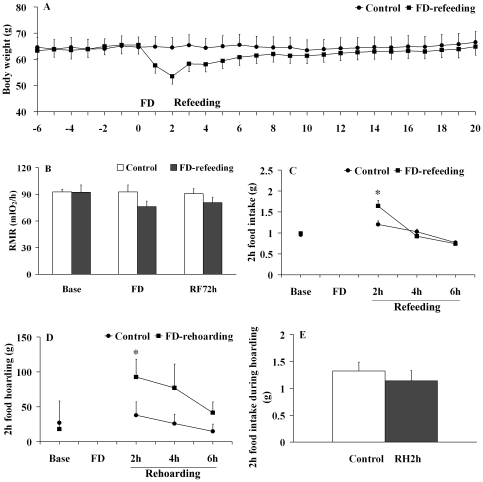
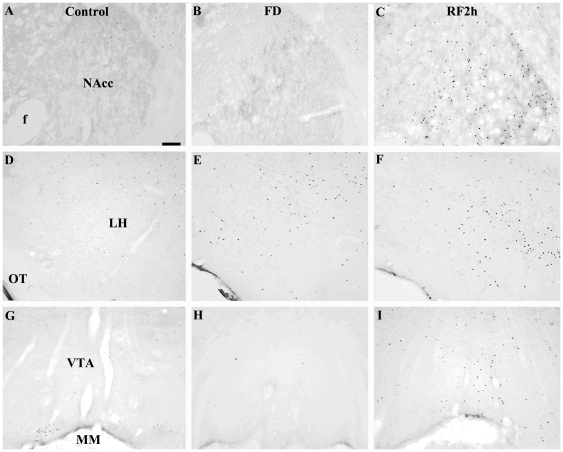
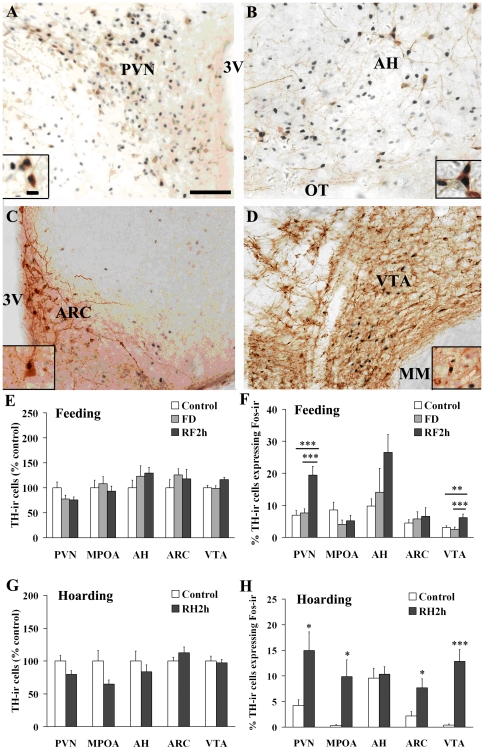
Small mammals usually face energetic challenges, such as food shortage, in the field. They have thus evolved species-specific adaptive strategies for survival and reproductive success. In the present study, we examined male Brandt's voles (Lasiopodomys brandtii) for their physiological, behavioral, and neuronal responses to food deprivation (FD) and subsequent re-feeding. Although 48 hr FD induced a decrease in body weight and the resting metabolic rate (RMR), such decreases did not reach statistical significance when compared to the control males that did not experience FD. During the first 2 hr of re-feeding following 48 hr FD, voles showed higher levels of feeding than controls. However, when permitted to hoard food, FD voles showed an increase in food hoarding, rather than feeding, compared to the controls. Further, both feeding and food hoarding induced an increase in neuronal activation, measured by Fos-ir, in a large number of brain areas examined. Interestingly, feeding and food hoarding also induced an increase in the percentage of tyrosine hydroxylase immunoreactive (TH-ir) cells that co-expressed Fos-ir in the ventral tegmental area (VTA), whereas both FD and feeding induced an increase in the percentage of orexin-ir cells that co-expressed Fos-ir in the lateral hypothalamus (LH). Food hoarding also increased orexin-ir/Fos-ir labeling in the LH. Together, our data indicate that food-deprived male Brandt's voles display enhanced feeding or food hoarding dependent upon an environmental setting. In addition, changes in central dopamine and orexin activities in selected brain areas are associated with feeding and hoarding behaviors following FD and subsequent re-feeding.
小型哺乳动物在野外通常面临能量方面的挑战,如食物短缺。因此,它们进化出了特定物种的适应性生存和繁殖成功策略。在本研究中,我们检查了雄性布氏田鼠(Lasiopodomys brandtii)在面对食物剥夺(FD)及其随后的再喂养时的生理、行为和神经元反应。尽管 48 小时 FD 导致体重和静息代谢率(RMR)下降,但与未经历 FD 的对照组雄性相比,这种下降并未达到统计学意义。在经历 48 小时 FD 后的头 2 小时再喂养期间,田鼠的进食水平高于对照组。然而,当允许它们囤积食物时,FD 田鼠的囤积行为增加,而不是进食,与对照组相比。此外,无论是进食还是囤积食物,都会导致大量检查的脑区中的神经元激活增加,这一现象通过 Fos-ir 进行测量。有趣的是,进食和囤积食物也会导致腹侧被盖区(VTA)中同时表达 Fos-ir 的酪氨酸羟化酶免疫反应性(TH-ir)细胞的百分比增加,而 FD 和进食都会导致外侧下丘脑(LH)中同时表达 Fos-ir 的食欲素-ir 细胞的百分比增加。囤积食物也会增加 LH 中的食欲素-ir/Fos-ir 标记。总之,我们的数据表明,处于饥饿状态的雄性布氏田鼠表现出增强的进食或囤积食物行为,这取决于环境设置。此外,在选定的脑区中,中枢多巴胺和食欲素活性的变化与 FD 及其随后的再喂养后的进食和囤积行为有关。