Sharabi Amir, Haran-Ghera Nechama
Department of Immunology, the Weizmann Institute of Science, Rehovot 76100, Israel.
Bone Marrow Res. 2011;2011:269519. doi: 10.1155/2011/269519. Epub 2011 Apr 6.
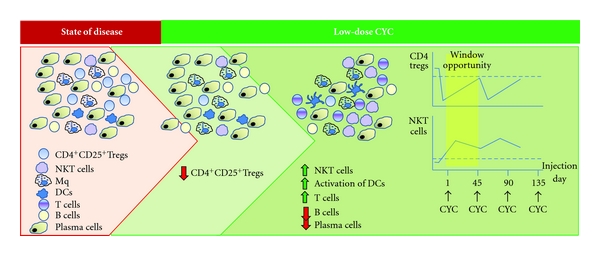
Multiple myeloma (MM) is a progressive B-lineage neoplasia characterized by clonal proliferation of malignant plasma cells. Increased numbers of regulatory T cells (Tregs) were determined in mouse models and in patients with MM, which correlated with disease burden. Thus, it became rational to target Tregs for treating MM. The effects of common chemotherapeutic drugs on Tregs are reviewed with a focus on cyclophosphamide (CYC). Studies indicated that selective depletion of Tregs may be accomplished following the administration of a low-dose CYC. We report that continuous nonfrequent administrations of CYC at low doses block the renewal of Tregs in MM-affected mice and enable the restoration of an efficient immune response against the tumor cells, thereby leading to prolonged survival and prevention of disease recurrence. Hence, distinctive time-schedule injections of low-dose CYC are beneficial for breaking immune tolerance against MM tumor cells.
多发性骨髓瘤(MM)是一种进行性B细胞系肿瘤,其特征为恶性浆细胞的克隆性增殖。在小鼠模型和MM患者中均检测到调节性T细胞(Tregs)数量增加,这与疾病负担相关。因此,将Tregs作为治疗MM的靶点变得合理。本文综述了常用化疗药物对Tregs的影响,重点关注环磷酰胺(CYC)。研究表明,给予低剂量CYC后可实现Tregs的选择性清除。我们报告,在受MM影响的小鼠中持续非频繁给予低剂量CYC可阻断Tregs的更新,并使针对肿瘤细胞的有效免疫反应得以恢复,从而延长生存期并预防疾病复发。因此,独特的低剂量CYC时间安排注射有利于打破对MM肿瘤细胞的免疫耐受。