Graduate School, Peking Union Medical College, Dongcheng District, Beijing, China.
BMC Microbiol. 2011 Nov 3;11:246. doi: 10.1186/1471-2180-11-246.
Enterovirus 71 (EV71) and Coxsackievirus A16 (CA16) are two major etiological agents of Hand, Foot and Mouth Disease (HFMD). EV71 is associated with severe cases but not CA16. The mechanisms contributed to the different pathogenesis of these two viruses are unknown. VP1 and VP4 are two major structural proteins of these viruses, and should be paid close attention to.
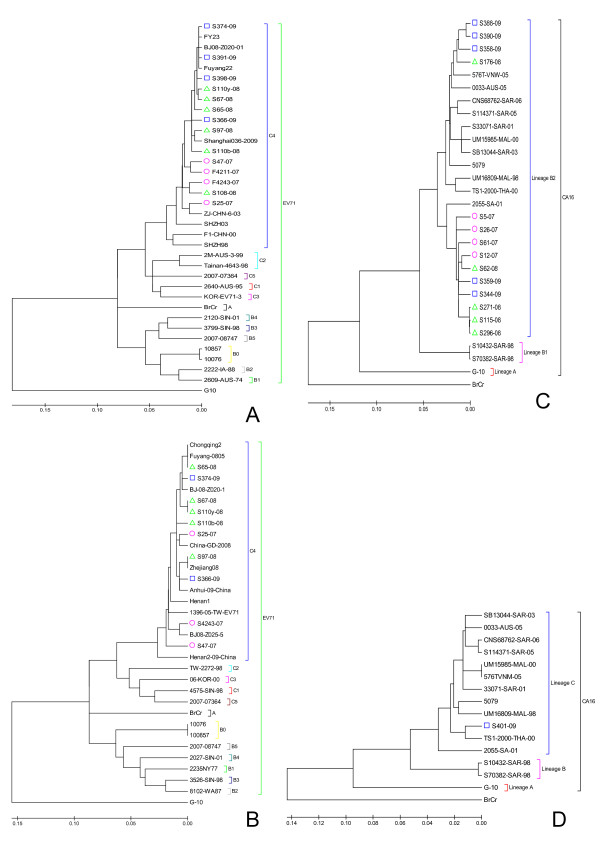
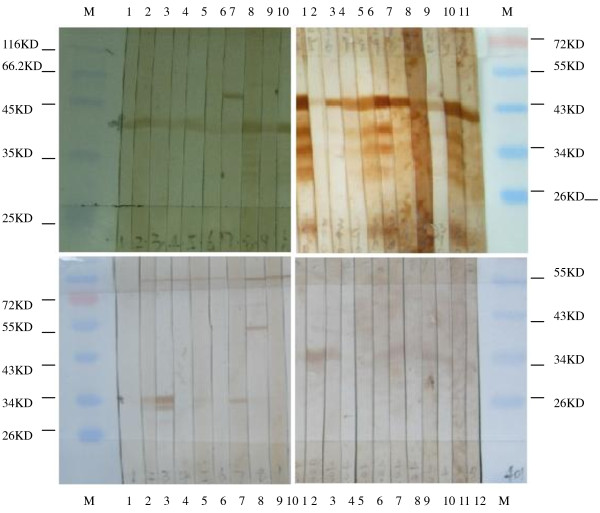
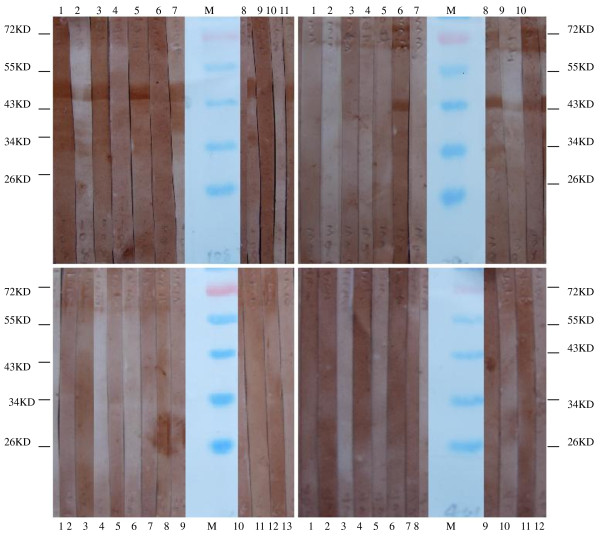
The sequences of vp1s from 14 EV71 and 14 CA16, and vp4s from 10 EV71 and 1 CA16 isolated in this study during 2007 to 2009 HFMD seasons were analyzed together with the corresponding sequences available in GenBank using DNAStar and MEGA 4.0. Phylogenetic analysis of complete vp1s or vp4s showed that EV71 isolated in Beijing belonged to C4 and CA16 belonged to lineage B2 (lineage C). VP1s and VP4s from 4 strains of viruses expressed in E. coli BL21 cells were used to detect IgM and IgG in human sera by Western Blot. The detection of IgM against VP1s of EV71 and CA16 showed consistent results with current infection, while none of the sera were positive against VP4s of EV71 and CA16. There was significant difference in the positive rates between EV71 VP1 and CA16 VP1 (χ(2) = 5.02, P < 0.05) as well as EV71 VP4 and CA16 VP4 (χ(2) = 15.30, P < 0.01) in the detection of IgG against recombinant proteins with same batch of serum samples. The sera-positive rate of IgG against VP1 was higher than that against VP4 for both EV71 (χ(2) = 26.47, P < 0.01) and CA16 (χ(2) = 16.78, P < 0.01), which might be because of different positions of VP1 and VP4 in the capsid of the viruses.
EV71 and CA16 were highly diverse in the nucleotide sequences of vp1s and vp4s. The sera positive rates of VP1 and VP4 of EV71 were lower than those of CA16 respectively, which suggested a less exposure rate to EV71 than CA16 in Beijing population. Human serum antibodies detected by Western blot using VP1s and VP4s as antigen indicated that the immunological reaction to VP1 and VP4 of both EV71 and CA16 was different.
肠道病毒 71 型(EV71)和柯萨奇病毒 A16 型(CA16)是手足口病(HFMD)的两个主要病原体。EV71 与严重病例有关,但 CA16 则不然。导致这两种病毒不同发病机制的机制尚不清楚。VP1 和 VP4 是这些病毒的两个主要结构蛋白,应密切关注。
对 2007 年至 2009 年 HFMD 季节从本研究中分离的 14 株 EV71 和 14 株 CA16 的 vp1s 序列以及来自 GenBank 的相应序列,以及来自 10 株 EV71 和 1 株 CA16 的 vp4s 序列,使用 DNAStar 和 MEGA 4.0 进行了分析。完整 vp1s 或 vp4s 的系统发育分析表明,北京分离的 EV71 属于 C4,CA16 属于谱系 B2(谱系 C)。在 E. coli BL21 细胞中表达的 4 株病毒的 VP1s 和 VP4s 被用于通过 Western Blot 检测人血清中的 IgM 和 IgG。针对 EV71 和 CA16 的 VP1s 的 IgM 检测结果与当前感染一致,而针对 EV71 和 CA16 的 VP4s 的血清均为阴性。在使用同批血清样本检测针对重组蛋白的 IgG 时,EV71 VP1 和 CA16 VP1(χ(2) = 5.02,P < 0.05)以及 EV71 VP4 和 CA16 VP4(χ(2) = 15.30,P < 0.01)之间的阳性率存在显著差异。针对 VP1 的 IgG 血清阳性率高于针对 VP4 的 IgG 血清阳性率,无论是针对 EV71(χ(2) = 26.47,P < 0.01)还是 CA16(χ(2) = 16.78,P < 0.01),这可能是因为 VP1 和 VP4 在病毒衣壳中的位置不同。
EV71 和 CA16 在 vp1s 和 vp4s 的核苷酸序列上高度多样化。针对 EV71 的 VP1 和 VP4 的血清阳性率均低于 CA16,这表明北京人群中 EV71 的暴露率低于 CA16。使用 VP1s 和 VP4s 作为抗原的 Western blot 检测人血清抗体表明,针对 EV71 和 CA16 的 VP1 和 VP4 的免疫反应不同。