Neuropsychiatry Section, Department of Psychiatry, University of Pennsylvania School of Medicine Philadelphia, PA, USA.
Front Hum Neurosci. 2011 Oct 3;5:96. doi: 10.3389/fnhum.2011.00096. eCollection 2011.
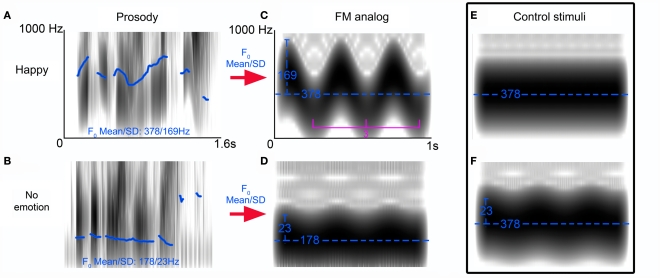
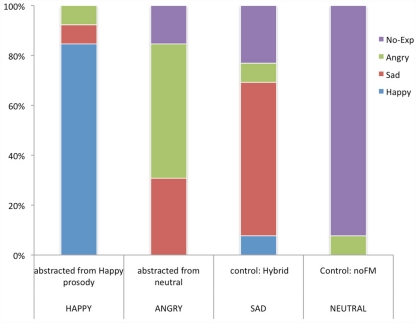
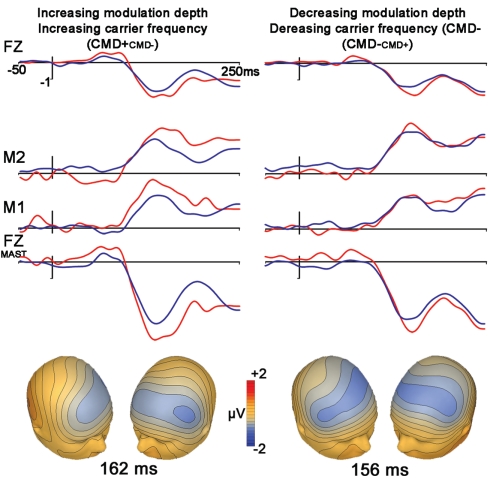
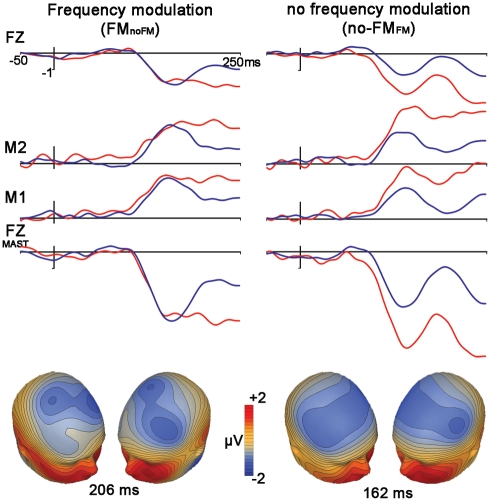
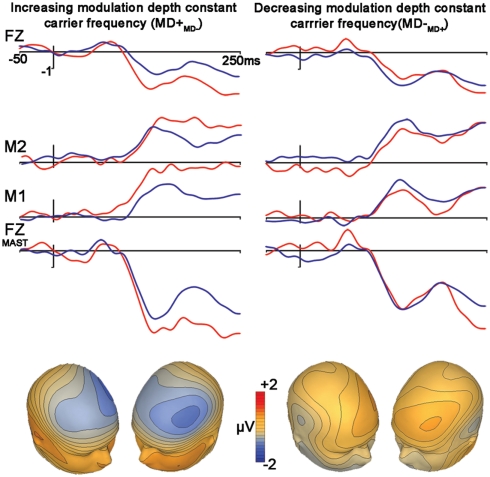
Recognizing emotion is an evolutionary imperative. An early stage of auditory scene analysis involves the perceptual grouping of acoustic features, which can be based on both temporal coincidence and spectral features such as perceived pitch. Perceived pitch, or fundamental frequency (F(0)), is an especially salient cue for differentiating affective intent through speech intonation (prosody). We hypothesized that: (1) simple frequency-modulated tone abstractions, based on the parameters of actual prosodic stimuli, would be reliably classified as representing differing emotional categories; and (2) that such differences would yield significant mismatch negativities (MMNs) - an index of pre-attentive deviance detection within the auditory environment. We constructed a set of FM tones that approximated the F(0) mean and variation of reliably recognized happy and neutral prosodic stimuli. These stimuli were presented to 13 subjects using a passive listening oddball paradigm. We additionally included stimuli with no frequency modulation (FM) and FM tones with identical carrier frequencies but differing modulation depths as control conditions. Following electrophysiological recording, subjects were asked to identify the sounds they heard as happy, sad, angry, or neutral. We observed that FM tones abstracted from happy and no-expression speech stimuli elicited MMNs. Post hoc behavioral testing revealed that subjects reliably identified the FM tones in a consistent manner. Finally, we also observed that FM tones and no-FM tones elicited equivalent MMNs. MMNs to FM tones that differentiate affect suggests that these abstractions may be sufficient to characterize prosodic distinctions, and that these distinctions can be represented in pre-attentive auditory sensory memory.
识别情感是一种进化的必要。听觉场景分析的早期阶段涉及到声学特征的感知分组,这些分组可以基于时间巧合和感知音高等频谱特征。感知音高或基频(F(0))是通过语音语调(韵律)区分情感意图的一个特别明显的线索。我们假设:(1) 基于实际韵律刺激参数的简单频率调制音调抽象,将可靠地分类为代表不同的情感类别;(2) 这种差异将产生显著的失配负波(MMN)- 一种在听觉环境中检测前注意偏差的指标。我们构建了一组 FM 音调,这些音调近似于可靠识别的快乐和中性韵律刺激的 F(0)均值和变化。这些刺激使用被动聆听的Oddball 范式呈现给 13 位受试者。我们还包括了没有频率调制(FM)的刺激以及具有相同载波频率但调制深度不同的 FM 音调作为对照条件。在进行电生理记录后,要求受试者识别他们听到的声音是快乐、悲伤、愤怒还是中性。我们观察到,从快乐和无表情的语音刺激中抽象出来的 FM 音调引起了 MMN。事后行为测试表明,受试者以一致的方式可靠地识别出 FM 音调。最后,我们还观察到 FM 音调和无 FM 音调引起了等效的 MMN。区分情感的 FM 音调引起的 MMN 表明,这些抽象可能足以描述韵律差异,并且这些差异可以在非注意听觉感觉记忆中表示。