Department of Psychology, San Diego State University, CA, USA.
Health Psychol. 2012 May;31(3):334-42. doi: 10.1037/a0025689. Epub 2011 Nov 7.
The current study examined the contributions of psychosocial factors to the association between socioeconomic status (SES) and metabolic syndrome (MetSyn) risk, in a randomly selected community cohort of 304 middle-aged (40-65 years old) Mexican-American women, a population at elevated cardiometabolic risk.
Participants underwent a clinical exam and measures of demographic factors and psychosocial resource (i.e., personal and social resources) and risk (i.e., negative emotions and cognitions) variables. Confirmatory factor analysis (CFA) and structural equation models (SEMs) were performed in the total sample and in more- and less-U.S.-acculturated women (defined by language preference) separately.
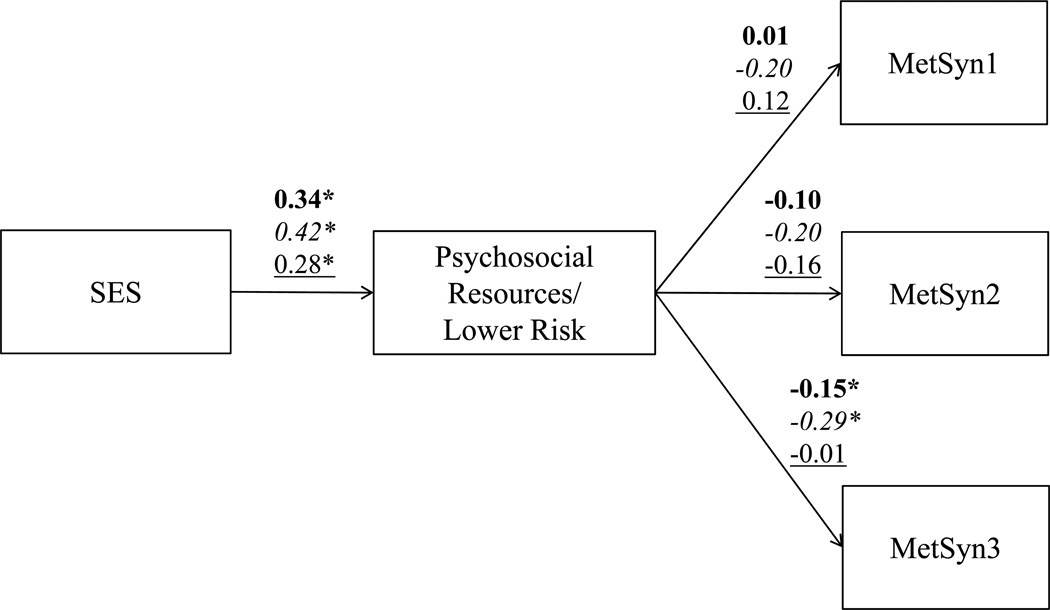
CFAs revealed single latent constructs for SES (i.e., income, education) and psychosocial resources/risk. Three-factor solution was identified, with blood pressure (systolic diastolic), lipids (high-density lipoprotein cholesterol triglycerides), and metabolic variables (glucose waist circumference) forming separate factors. SEMs showed that an indirect effects model with SES relating to MetSyn factors through psychosocial resources/risk provided a reasonable descriptive and statistical fit in the full and more-acculturated sample (root mean square error of approximation [RMSEA] and standardized root-mean-square residual < .08); fit in the less-acculturated sample was marginal according to RMSEA = .09. A significant mediated path from low SES to higher waist circumference/fasting glucose via lower psychosocial resources/higher psychosocial risk was identified in the overall and more-acculturated samples (p < .05).
In this cohort of healthy, middle-aged Mexican-American women, contributions of psychosocial factors to SES-MetSyn associations were limited to the core underlying metabolic mechanisms, and to more-U.S.-acculturated women.
本研究在一个随机选择的 304 名中年(40-65 岁)墨西哥裔美国女性社区队列中,检查了社会心理因素对社会经济地位(SES)与代谢综合征(MetSyn)风险之间关联的贡献,该队列人群存在升高的心血管代谢风险。
参与者接受了临床检查,并测量了人口统计学因素以及心理社会资源(即个人和社会资源)和风险(即负面情绪和认知)变量。在总样本中以及在更多和更少美国文化适应的女性(根据语言偏好定义)中分别进行验证性因子分析(CFA)和结构方程模型(SEM)。
CFA 显示 SES(即收入、教育)和心理社会资源/风险的单一潜在结构。确定了三因素解决方案,血压(收缩压舒张压)、血脂(高密度脂蛋白胆固醇甘油三酯)和代谢变量(血糖腰围)形成单独的因素。SEM 表明,SES 通过心理社会资源/风险与 MetSyn 因素相关的间接效应模型在全样本和更多文化适应的样本中提供了合理的描述性和统计拟合(近似均方根误差 [RMSEA]和标准化均方根残差<.08);根据 RMSEA =.09,较少文化适应的样本的拟合度为边缘。在总体和更多文化适应的样本中,低 SES 通过较低的心理社会资源/较高的心理社会风险与较高的腰围/空腹血糖之间存在显著的中介途径(p <.05)。
在这个健康的中年墨西哥裔美国女性队列中,心理社会因素对 SES-MetSyn 关联的贡献仅限于核心潜在的代谢机制,以及更美国文化适应的女性。