Biological and Experimental Psychology Group, School of Biological and Chemical Sciences, Queen Mary University of London, London, United Kingdom.
PLoS One. 2011;6(10):e27043. doi: 10.1371/journal.pone.0027043. Epub 2011 Oct 31.
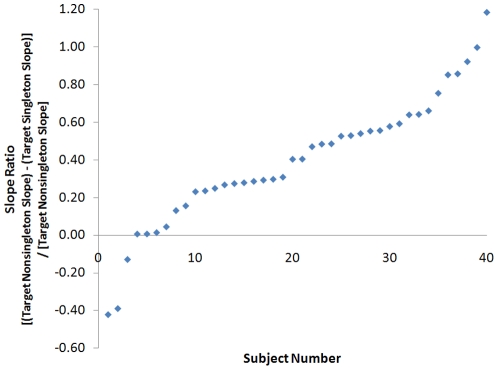
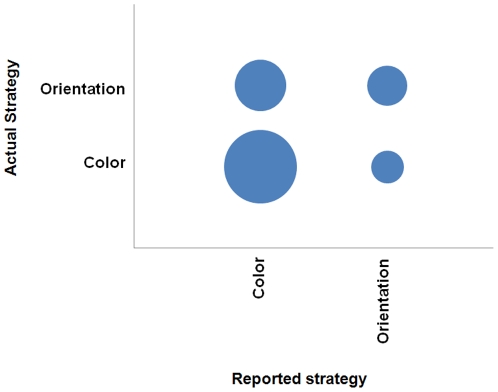
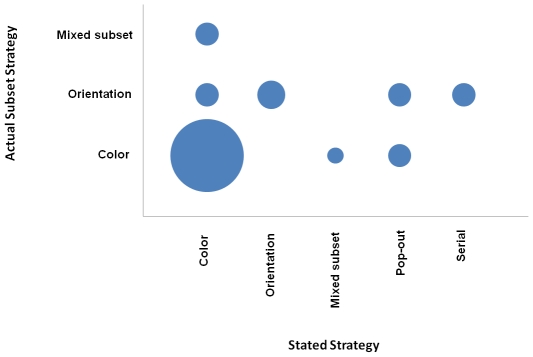
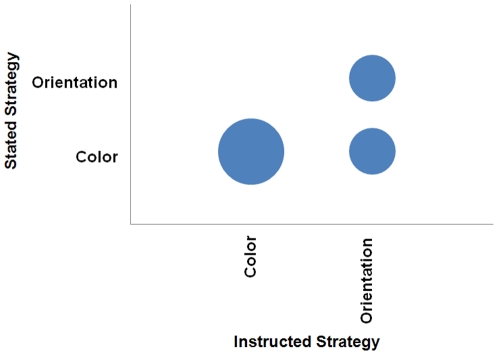
A crucial ability for an organism is to orient toward important objects and to ignore temporarily irrelevant objects. Attention provides the perceptual selectivity necessary to filter an overwhelming input of sensory information to allow for efficient object detection. Although much research has examined visual search and the 'template' of attentional set that allows for target detection, the behavior of individual subjects often reveals the limits of experimental control of attention. Few studies have examined important aspects such as individual differences and metacognitive strategies. The present study analyzes the data from two visual search experiments for a conjunctively defined target (Proulx, 2007). The data revealed attentional capture blindness, individual differences in search strategies, and a significant rate of metacognitive errors for the assessment of the strategies employed. These results highlight a challenge for visual attention studies to account for individual differences in search behavior and distractibility, and participants that do not (or are unable to) follow instructions.
生物体的一个关键能力是朝向重要的物体,并暂时忽略不相关的物体。注意力提供了感知选择性,以过滤压倒性的感官信息输入,从而实现有效的目标检测。尽管许多研究都考察了视觉搜索和注意力设置的“模板”,以便进行目标检测,但个体受试者的行为往往揭示了注意力实验控制的局限性。很少有研究考察个体差异和元认知策略等重要方面。本研究分析了两个用于联合定义目标的视觉搜索实验的数据(Proulx,2007)。数据显示出注意力捕获盲、搜索策略的个体差异,以及对所采用策略的评估中存在显著的元认知错误率。这些结果凸显了视觉注意力研究的一个挑战,即解释搜索行为和分心的个体差异,以及那些不(或无法)遵守指令的参与者。