Department of Medical Biosciences, Umeå University, S-901 85 Umea, Sweden.
Toxins (Basel). 2010 Oct;2(10):2467-77. doi: 10.3390/toxins2102467. Epub 2010 Oct 25.
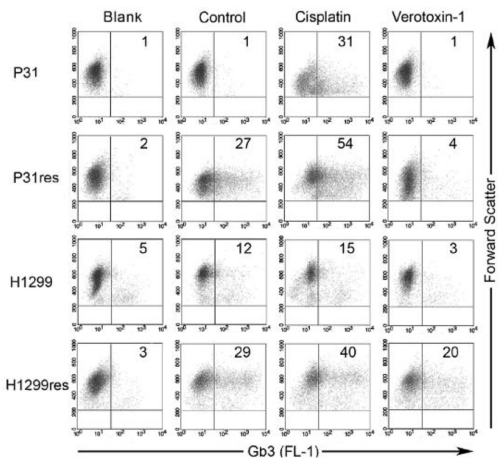
A major problem with anti-cancer drug treatment is the development of acquired multidrug resistance (MDR) of the tumor cells. Verotoxin-1 (VT-1) exerts its cytotoxicity by targeting the globotriaosylceramide membrane receptor (Gb3), a glycolipid associated with multidrug resistance. Gb3 is overexpressed in many human tumors and tumor cell lines with inherent or acquired MDR. Gb3 is co-expressed and interplays with the membrane efflux transporter P-gp encoded by the MDR1 gene. P-gp could act as a lipid flippase and stimulate Gb3 induction when tumor cells are exposed to cancer chemotherapy. Recent work has shown that apoptosis and inherent or acquired multidrug resistance in Gb3-expressing tumors could be affected by VT-1 holotoxin, a sub-toxic concentration of the holotoxin concomitant with chemotherapy or its Gb3-binding B-subunit coupled to cytotoxic or immunomodulatory drug, as well as chemical manipulation of Gb3 expression. The interplay between Gb3 and P-gp thus gives a possible physiological approach to augment the chemotherapeutic effect in multidrug resistant tumors.
抗癌药物治疗的一个主要问题是肿瘤细胞获得性多药耐药(MDR)的发展。霍乱毒素-1(VT-1)通过靶向与多药耐药相关的糖鞘脂膜受体(Gb3)发挥细胞毒性作用。Gb3 在许多具有固有或获得性 MDR 的人类肿瘤和肿瘤细胞系中过度表达。Gb3 与 MDR1 基因编码的膜外排转运蛋白 P-gp 共同表达并相互作用。当肿瘤细胞暴露于癌症化疗药物时,P-gp 可以作为脂质翻转酶并刺激 Gb3 的诱导。最近的研究表明,Gb3 表达肿瘤中的细胞凋亡和固有或获得性多药耐药性可受 VT-1 全毒素、全毒素的亚毒性浓度以及与其结合的细胞毒性或免疫调节药物的 B 亚单位、以及 Gb3 表达的化学调控的影响。因此,Gb3 和 P-gp 之间的相互作用为增强多药耐药肿瘤的化疗效果提供了一种可能的生理方法。