Laboratory of Cell Biology, Division of Monoclonal Antibodies, Office of Biotechnology Products, Office of Pharmaceutical Science, Center for Drug Evaluation and Research, U.S. Food and Drug Administration, Bethesda, MD 20892, USA.
Toxins (Basel). 2011 Jun;3(6):591-607. doi: 10.3390/toxins3060591. Epub 2011 Jun 14.
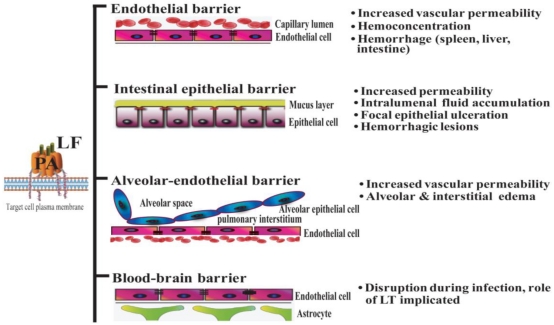
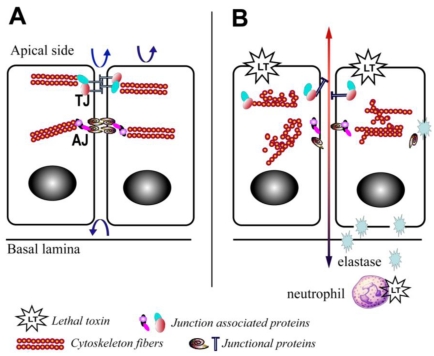
The pathological actions of anthrax toxin require the activities of its edema factor (EF) and lethal factor (LF) enzyme components, which gain intracellular access via its receptor-binding component, protective antigen (PA). LF is a metalloproteinase with specificity for selected mitogen-activated protein kinase kinases (MKKs), but its activity is not directly lethal to many types of primary and transformed cells in vitro. Nevertheless, in vivo treatment of several animal species with the combination of LF and PA (termed lethal toxin or LT) leads to morbidity and mortality, suggesting that LT-dependent toxicity is mediated by cellular interactions between host cells. Decades of research have revealed that a central hallmark of this toxicity is the disruption of key cellular barriers required to maintain homeostasis. This review will focus on the current understanding of the effects of LT on barrier function, highlighting recent progress in establishing the molecular mechanisms underlying these effects.
炭疽毒素的病理作用需要其水肿因子 (EF) 和致死因子 (LF) 酶成分的活性,这些成分通过其受体结合成分保护性抗原 (PA) 获得细胞内进入。LF 是一种对选定的丝裂原激活的蛋白激酶激酶 (MKKs) 具有特异性的金属蛋白酶,但它的活性对体外许多类型的原代和转化细胞并不直接致命。然而,用 LF 和 PA(称为致死毒素或 LT)组合对几种动物物种进行体内治疗会导致发病率和死亡率,这表明 LT 依赖性毒性是由宿主细胞之间的细胞相互作用介导的。几十年来的研究表明,这种毒性的一个中心标志是破坏维持体内平衡所需的关键细胞屏障。这篇综述将重点介绍 LT 对屏障功能的影响的最新认识,强调了在确定这些影响的分子机制方面的最新进展。