Department of Molecular Biology and Genetics, Cornell University, Ithaca, New York, USA.
PLoS Genet. 2011 Nov;7(11):e1002340. doi: 10.1371/journal.pgen.1002340. Epub 2011 Nov 3.
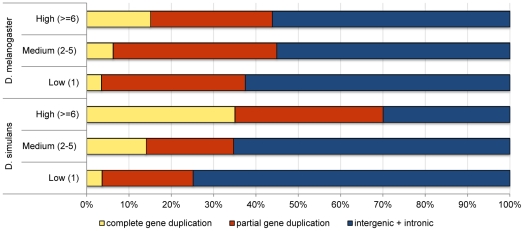
Duplications play a significant role in both extremes of the phenotypic spectrum of newly arising mutations: they can have severe deleterious effects (e.g. duplications underlie a variety of diseases) but can also be highly advantageous. The phenotypic potential of newly arisen duplications has stimulated wide interest in both the mutational and selective processes shaping these variants in the genome. Here we take advantage of the Drosophila simulans-Drosophila melanogaster genetic system to further our understanding of both processes. Regarding mutational processes, the study of two closely related species allows investigation of the potential existence of shared duplication hotspots, and the similarities and differences between the two genomes can be used to dissect its underlying causes. Regarding selection, the difference in the effective population size between the two species can be leveraged to ask questions about the strength of selection acting on different classes of duplications. In this study, we conducted a survey of duplication polymorphisms in 14 different lines of D. simulans using tiling microarrays and combined it with an analogous survey for the D. melanogaster genome. By integrating the two datasets, we identified duplication hotspots conserved between the two species. However, unlike the duplication hotspots identified in mammalian genomes, Drosophila duplication hotspots are not associated with sequences of high sequence identity capable of mediating non-allelic homologous recombination. Instead, Drosophila duplication hotspots are associated with late-replicating regions of the genome, suggesting a link between DNA replication and duplication rates. We also found evidence supporting a higher effectiveness of selection on duplications in D. simulans than in D. melanogaster. This is also true for duplications segregating at high frequency, where we find evidence in D. simulans that a sizeable fraction of these mutations is being driven to fixation by positive selection.
它们可能产生严重的有害影响(例如,重复是多种疾病的基础),但也可能具有高度优势。新出现的重复的表型潜力激发了人们对塑造基因组中这些变体的突变和选择过程的广泛兴趣。在这里,我们利用黑腹果蝇模拟果蝇-黑腹果蝇遗传系统来进一步了解这两个过程。关于突变过程,对两个密切相关的物种的研究可以调查共享重复热点的潜在存在,并且可以利用两个基因组之间的相似性和差异性来剖析其潜在原因。关于选择,两个物种之间有效种群大小的差异可以用来询问不同类别的重复受到选择的强度的问题。在这项研究中,我们使用平铺微阵列对 14 条不同的黑腹果蝇模拟线进行了重复多态性调查,并将其与黑腹果蝇基因组的类似调查相结合。通过整合这两个数据集,我们确定了两个物种之间保守的重复热点。然而,与哺乳动物基因组中鉴定的重复热点不同,黑腹果蝇重复热点与能够介导非等位基因同源重组的高序列同一性序列无关。相反,黑腹果蝇重复热点与基因组中复制较晚的区域相关,表明 DNA 复制与重复率之间存在联系。我们还发现了支持在黑腹果蝇模拟中选择重复的有效性高于在黑腹果蝇中的证据。在高频率分离的重复中也是如此,我们在黑腹果蝇模拟中发现了证据,表明这些突变中的相当一部分正在受到正选择的驱动而固定。