Stöver Timo, Lenarz Thomas
Department of Otolaryngology, Goethe University Frankfurt, Frankfurt a.M., Germany.
GMS Curr Top Otorhinolaryngol Head Neck Surg. 2009;8:Doc10. doi: 10.3205/cto000062. Epub 2011 Mar 10.
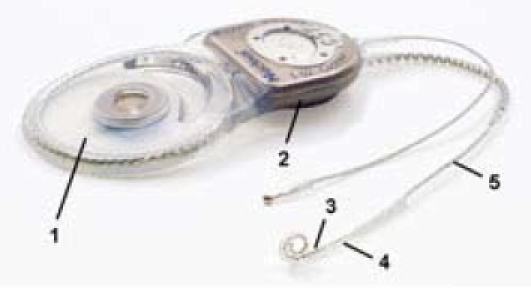
The cochlear implant (CI) represents, for almost 25 years now, the gold standard in the treatment of children born deaf and for postlingually deafened adults. These devices thus constitute the greatest success story in the field of 'neurobionic' prostheses. Their (now routine) fitting in adults, and especially in young children and even babies, places exacting demands on these implants, particularly with regard to the biocompatibility of a CI's surface components. Furthermore, certain parts of the implant face considerable mechanical challenges, such as the need for the electrode array to be flexible and resistant to breakage, and for the implant casing to be able to withstand external forces.As these implants are in the immediate vicinity of the middle-ear mucosa and of the junction to the perilymph of the cochlea, the risk exists - at least in principle - that bacteria may spread along the electrode array into the cochlea. The wide-ranging requirements made of the CI in terms of biocompatibility and the electrode mechanism mean that there is still further scope - despite the fact that CIs are already technically highly sophisticated - for ongoing improvements to the properties of these implants and their constituent materials, thus enhancing the effectiveness of these devices.This paper will therefore discuss fundamental material aspects of CIs as well as the potential for their future development.
近25年来,人工耳蜗一直是治疗先天性耳聋儿童和语后聋成年人的金标准。因此,这些装置堪称“神经仿生”假体领域最成功的典范。它们(如今已很常见)应用于成年人,尤其是幼儿甚至婴儿,这对这些植入物提出了严格要求,特别是在人工耳蜗表面部件的生物相容性方面。此外,植入物的某些部分面临着相当大的机械挑战,例如电极阵列需要灵活且抗断裂,植入物外壳要能够承受外力。由于这些植入物紧邻中耳黏膜以及与耳蜗外淋巴的连接处,至少在理论上存在细菌可能沿电极阵列扩散至耳蜗的风险。人工耳蜗在生物相容性和电极机制方面的广泛要求意味着,尽管人工耳蜗在技术上已经高度复杂,但这些植入物及其组成材料的性能仍有进一步改进的空间,从而提高这些装置的有效性。因此,本文将讨论人工耳蜗的基本材料方面以及它们未来的发展潜力。