Cao Huiliang, Qiao Shichong, Qin Hui, Jandt Klaus D
Interfacial Electrochemistry and Biomaterials, School of Materials Science and Engineering, East China University of Science and Technology, Shanghai 200237, China.
Lab of Low-Dimensional Materials Chemistry, Key Laboratory for Ultrafine Materials of Ministry of Education, East China University of Science & Technology, Shanghai 200237, China.
J Funct Biomater. 2022 Jun 21;13(3):86. doi: 10.3390/jfb13030086.
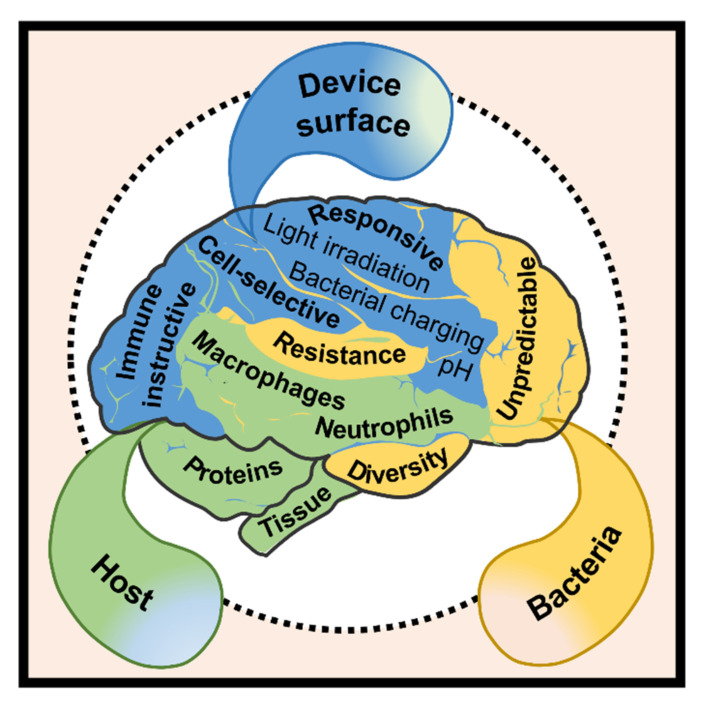
The uses of implantable medical devices are safer and more common since sterilization methods and techniques were established a century ago; however, device-associated infections (DAIs) are still frequent and becoming a leading complication as the number of medical device implantations keeps increasing. This urges the world to develop instructive prevention and treatment strategies for DAIs, boosting the studies on the design of antibacterial surfaces. Every year, studies associated with DAIs yield thousands of publications, which here are categorized into four groups, i.e., antibacterial surfaces with long-term efficacy, cell-selective capability, tailored responsiveness, and immune-instructive actions. These innovations are promising in advancing the solution to DAIs; whereas most of these are normally quite preliminary "" studies lacking exact clinical scopes. To help identify the flaws of our current antibacterial designs, clinical features of DAIs are highlighted. These include unpredictable onset, site-specific incidence, and possibly involving multiple and resistant pathogenic strains. The key point we delivered is antibacterial designs should meet the specific requirements of the primary functions defined by the "" of an implantable medical device. This review intends to help comprehend the complex relationship between the device, pathogens, and the host, and figure out future directions for improving the quality of antibacterial designs and promoting clinical translations.
自从一个世纪前建立了灭菌方法和技术以来,可植入医疗设备的使用更加安全且更为普遍;然而,随着医疗设备植入数量的不断增加,与设备相关的感染(DAIs)仍然频发,并成为主要并发症。这促使全球为DAIs制定指导性的预防和治疗策略,推动对抗菌表面设计的研究。每年,与DAIs相关的研究都会产生数千篇出版物,在此将其分为四类,即具有长期疗效、细胞选择性、定制响应性和免疫指导作用的抗菌表面。这些创新在推进DAIs解决方案方面很有前景;然而,其中大多数通常只是相当初步的研究,缺乏确切的临床范围。为了帮助识别我们当前抗菌设计的缺陷,突出了DAIs的临床特征。这些特征包括发病不可预测、部位特异性发病率,并且可能涉及多种耐药病原菌。我们强调的关键点是抗菌设计应满足可植入医疗设备基本功能所定义的特定要求。这篇综述旨在帮助理解设备、病原体和宿主之间的复杂关系,并找出提高抗菌设计质量和促进临床转化的未来方向。