Department of Anthropology, University of Oregon, Eugene, Oregon, United States of America.
PLoS One. 2011;6(11):e26720. doi: 10.1371/journal.pone.0026720. Epub 2011 Nov 4.
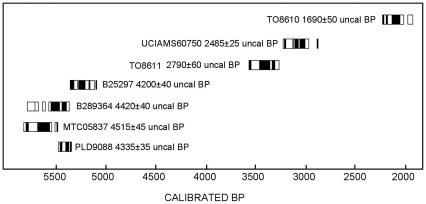
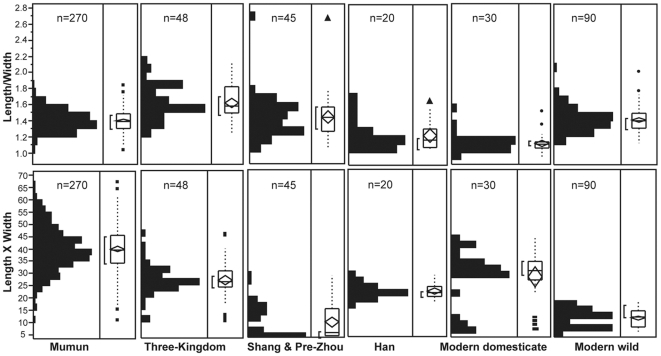
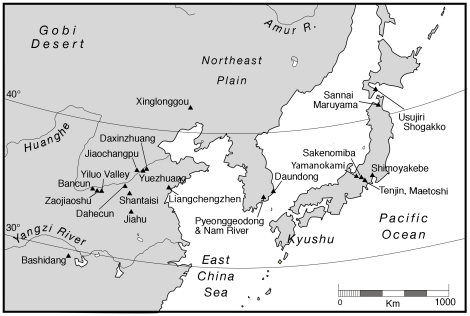
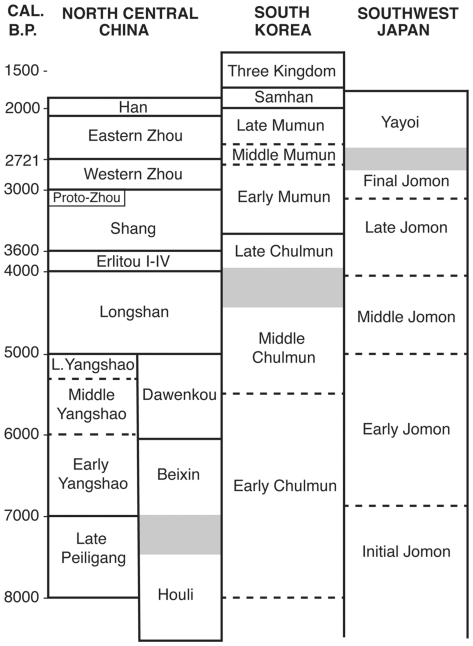
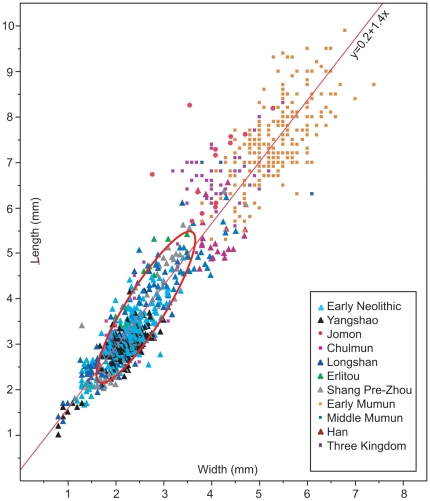
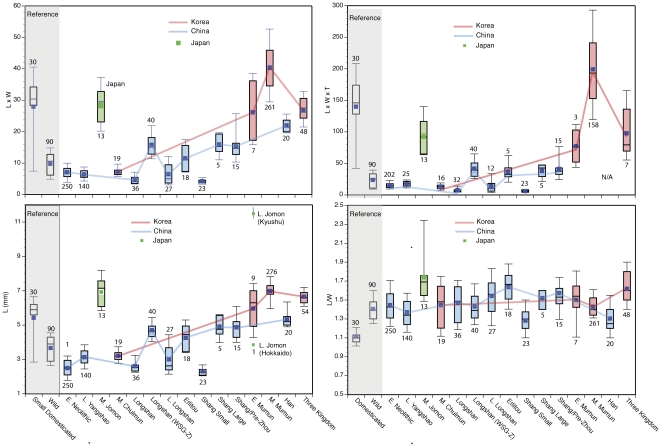
The recently acquired archaeological record for soybean from Japan, China and Korea is shedding light on the context in which this important economic plant became associated with people and was domesticated. This paper examines archaeological (charred) soybean seed size variation to determine what insight can be gained from a comprehensive comparison of 949 specimens from 22 sites. Seed length alone appears to represent seed size change through time, although the length × width × thickness product has the potential to provide better size change resolution. A widespread early association of small seeded soybean is as old as 9000-8600 cal BP in northern China and 7000 cal BP in Japan. Direct AMS radiocarbon dates on charred soybean seeds indicate selection resulted in large seed sizes in Japan by 5000 cal BP (Middle Jomon) and in Korea by 3000 cal BP (Early Mumun). Soybean seeds recovered in China from the Shang through Han periods are similar in length to the large Korean and Japanese specimens, but the overall size of the large Middle and Late Jomon, Early Mumun through Three Kingdom seeds is significantly larger than any of the Chinese specimens. The archaeological record appears to disconfirm the hypothesis of a single domestication of soybean and supports the view informed by recent phyologenetic research that soybean was domesticated in several locations in East Asia.
近期在日本、中国和韩国考古发掘的大豆遗存,为深入了解这种重要的经济作物与人类的关系以及其驯化过程提供了新的线索。本研究通过对 22 个遗址的 949 个样本的考古(炭化)大豆种子大小变化进行分析,旨在全面比较的基础上,探究其中蕴含的信息。种子长度似乎单独代表了随时间推移的种子大小变化,尽管种子的长×宽×厚乘积可能提供更好的大小变化分辨率。在中国北方,小粒大豆的早期广泛分布可追溯到 9000-8600 cal BP,在日本则可追溯到 7000 cal BP。直接对炭化大豆种子进行的 AMS 放射性碳测年表明,日本的大豆选择在 5000 cal BP(中绳文时代),韩国在 3000 cal BP(早马牧文化)时,种子的大小发生了显著变化。中国从商代到汉代的考古遗址中出土的大豆种子长度与韩国和日本的大型样本相似,但中绳文时代、早马牧文化到三国时期的大型晚期和晚期样本的整体大小明显大于中国的任何样本。考古记录似乎否定了大豆单一驯化的假说,支持了近年来基于系统发育研究的观点,即大豆在东亚的几个地区被驯化。