Darlington L Gail, Forrest Caroline M, Mackay Gillian M, Smith Robert A, Smith Andrew J, Stoy Nicholas, Stone Trevor W
Epsom General Hospital, Dorking Road, Epsom, Surrey KT18 7EG, UK.
Int J Tryptophan Res. 2010;3:51-9. doi: 10.4137/ijtr.s4282. Epub 2010 Jun 10.
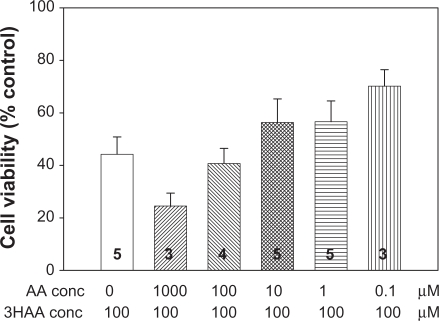
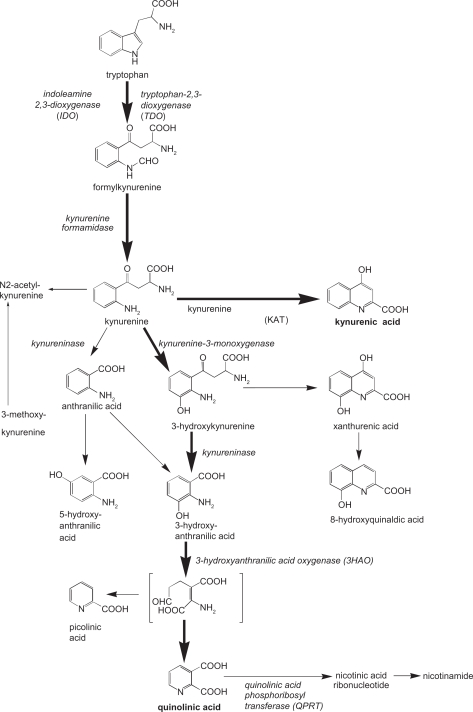
Of the major components of the kynurenine pathway for the oxidative metabolism of tryptophan, most attention has focussed on the N-methyl-D-aspartate (NMDA) receptor agonist quinolinic acid, and the glutamate receptor blocker kynurenic acid. However, there is increasing evidence that the redox-active compound 3-hydroxyanthranilic acid may also have potent actions on cell function in the nervous and immune systems, and recent clinical data show marked changes in the levels of this compound, associated with changes in anthranilic acid levels, in patients with a range of neurological and other disorders including osteoporosis, chronic brain injury, Huntington's disease, coronary heart disease, thoracic disease, stroke and depression. In most cases, there is a decrease in 3-hydroxyanthranilic acid levels and an increase in anthranilic acid levels. In this paper, we summarise the range of data obtained to date, and hypothesise that the levels of 3-hydroxyanthranilic acid or the ratio of 3-hydroxyanthranilic acid to anthranilic acid levels, may contribute to disorders with an inflammatory component, and may represent a novel marker for the assessment of inflammation and its progression. Data are presented which suggest that the ratio between these two compounds is not a simple determinant of neuronal viability. Finally, a hypothesis is presented to account for the development of the observed changes in 3-hydroxyanthranilic acid and anthranilate levels in inflammation and it is suggested that the change of the 3HAA:AA ratio, particularly in the brain, could possibly be a protective response to limit primary and secondary damage.
在色氨酸氧化代谢的犬尿氨酸途径的主要成分中,大部分注意力都集中在N-甲基-D-天冬氨酸(NMDA)受体激动剂喹啉酸和谷氨酸受体阻滞剂犬尿喹啉酸上。然而,越来越多的证据表明,具有氧化还原活性的化合物3-羟基邻氨基苯甲酸可能也对神经和免疫系统的细胞功能有强大作用,并且最近的临床数据显示,在一系列神经疾病和其他疾病(包括骨质疏松症、慢性脑损伤、亨廷顿舞蹈病、冠心病、胸科疾病、中风和抑郁症)患者中,该化合物的水平有显著变化,且与邻氨基苯甲酸水平的变化相关。在大多数情况下,3-羟基邻氨基苯甲酸水平下降,邻氨基苯甲酸水平上升。在本文中,我们总结了迄今为止获得的一系列数据,并推测3-羟基邻氨基苯甲酸的水平或3-羟基邻氨基苯甲酸与邻氨基苯甲酸水平的比值,可能与具有炎症成分的疾病有关,并且可能代表一种评估炎症及其进展的新标志物。所呈现的数据表明,这两种化合物之间的比值并非神经元活力的简单决定因素。最后,我们提出了一个假设来解释在炎症中观察到的3-羟基邻氨基苯甲酸和邻氨基苯甲酸水平变化的发生机制,并表明3HAA:AA比值的变化,尤其是在大脑中的变化,可能是一种限制原发性和继发性损伤的保护性反应。