Baran Halina, Staniek Katrin, Bertignol-Spörr Melanie, Attam Martin, Kronsteiner Carina, Kepplinger Berthold
Neurophysiology, Institute of Physiology, Department of Biomedical Sciences, University of Veterinary Medicine, Vienna.; Karl Landsteiner Research Institute for Neurochemistry, Neuropharmacology, Neurorehabilitation and Pain Treatment, Mauer-Amstetten, Austria.
Institute of Pharmacology and Toxicology, Department of Biomedical Sciences, University of Veterinary Medicine, Vienna.
Int J Tryptophan Res. 2016 May 17;9:17-29. doi: 10.4137/IJTR.S37973. eCollection 2016.
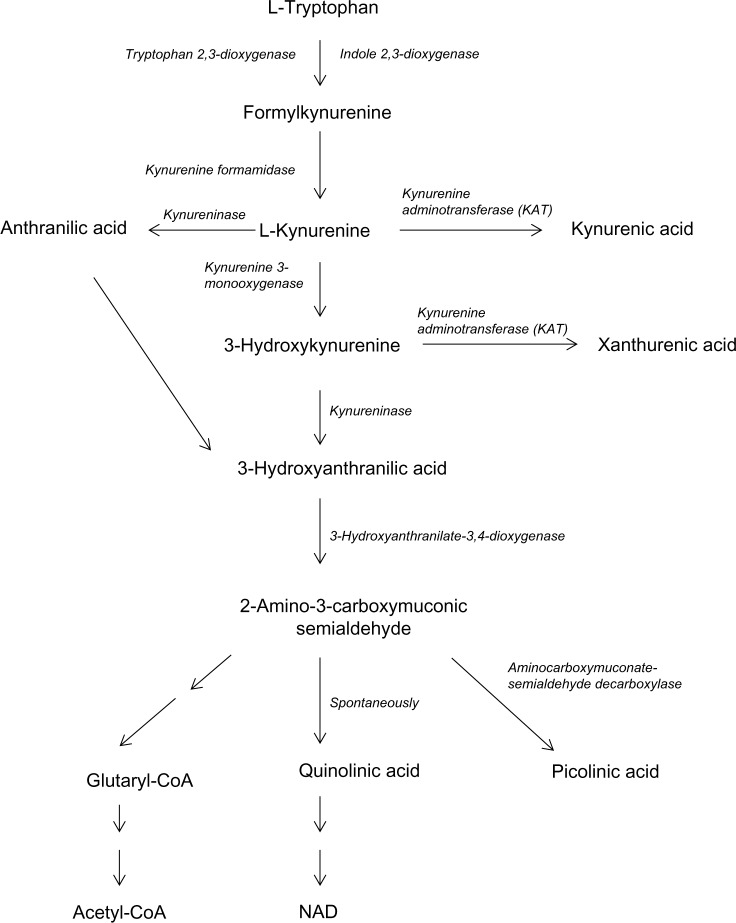
Previously, we demonstrated that the endogenous glutamate receptor antagonist kynurenic acid dose-dependently and significantly affected rat heart mitochondria. Now we have investigated the effects of L-tryptophan, L-kynurenine, 3-hydroxykynurenine and kynurenic, anthranilic, 3-hydroxyanthranilic, xanthurenic and quinolinic acids on respiratory parameters (ie, state 2, state 3), respiratory control index (RC) and ADP/oxygen ratio in brain, liver and heart mitochondria of adult rats. Mitochondria were incubated with glutamate/malate (5 mM) or succinate (10 mM) and in the presence of L-tryptophan metabolites (1 mM) or in the absence, as control. Kynurenic and anthranilic acids significantly reduced RC values of heart mitochondria in the presence of glutamate/malate. Xanthurenic acid significantly reduced RC values of brain mitochondria in the presence of glutamate/malate. Furthermore, 3-hydroxykynurenine and 3-hydroxyanthranilic acid decreased RC values of brain, liver and heart mitochondria using glutamate/malate. In the presence of succinate, 3-hydroxykynurenine and 3-hydroxyanthranilic acid affected RC values of brain mitochondria, whereas in liver and heart mitochondria only 3-hydroxykynurenine lowered RC values significantly. Furthermore, lowered ADP/oxygen ratios were observed in brain mitochondria in the presence of succinate with 3-hydroxykynurenine and 3-hydroxyanthranilic acid, and to a lesser extent with glutamate/malate. In addition, 3-hydroxyanthranilic acid significantly lowered the ADP/oxygen ratio in heart mitochondria exposed to glutamate/malate, while in the liver mitochondria only a mild reduction was found. Tests of the influence of L-tryptophan and its metabolites on complex I in liver mitochondria showed that only 3-hydroxykynurenine, 3-hydroxyanthranilic acid and L-kynurenine led to a significant acceleration of NADH-driven complex I activities. The data indicate that L-tryptophan metabolites had different effects on brain, liver and heart mitochondria. Alterations of L-tryptophan metabolism might have an impact on the bioenergetic activities of brain, liver and/or heart mitochondria and might be involved in the development of clinical symptoms such as cardiomyopathy, hepatopathy and dementia.
此前,我们证明内源性谷氨酸受体拮抗剂犬尿喹啉酸对大鼠心脏线粒体有剂量依赖性的显著影响。现在我们研究了L-色氨酸、L-犬尿氨酸、3-羟基犬尿氨酸以及犬尿喹啉酸、邻氨基苯甲酸、3-羟基邻氨基苯甲酸、黄尿酸和喹啉酸对成年大鼠脑、肝和心脏线粒体呼吸参数(即状态2、状态3)、呼吸控制指数(RC)和ADP/氧比值的影响。线粒体与谷氨酸/苹果酸(5 mM)或琥珀酸(10 mM)一起孵育,同时存在L-色氨酸代谢物(1 mM)或不存在代谢物作为对照。在存在谷氨酸/苹果酸的情况下,犬尿喹啉酸和邻氨基苯甲酸显著降低了心脏线粒体的RC值。在存在谷氨酸/苹果酸的情况下,黄尿酸显著降低了脑线粒体的RC值。此外,使用谷氨酸/苹果酸时,3-羟基犬尿氨酸和3-羟基邻氨基苯甲酸降低了脑、肝和心脏线粒体的RC值。在存在琥珀酸的情况下,3-羟基犬尿氨酸和3-羟基邻氨基苯甲酸影响了脑线粒体的RC值,而在肝和心脏线粒体中,只有3-羟基犬尿氨酸显著降低了RC值。此外,在存在琥珀酸以及3-羟基犬尿氨酸和3-羟基邻氨基苯甲酸的情况下,观察到脑线粒体中ADP/氧比值降低,在存在谷氨酸/苹果酸时降低程度较小。此外,3-羟基邻氨基苯甲酸显著降低了暴露于谷氨酸/苹果酸的心脏线粒体中的ADP/氧比值,而在肝线粒体中仅发现轻微降低。对L-色氨酸及其代谢物对肝线粒体中复合体I影响的测试表明,只有3-羟基犬尿氨酸、3-羟基邻氨基苯甲酸和L-犬尿氨酸导致NADH驱动的复合体I活性显著加速。数据表明,L-色氨酸代谢物对脑、肝和心脏线粒体有不同影响。L-色氨酸代谢的改变可能会影响脑、肝和/或心脏线粒体的生物能量活动,并可能参与心肌病、肝病和痴呆等临床症状的发展。