Mood Disorders Centre, University of Exeter, UK.
Psychol Med. 2012 Jul;42(7):1359-71. doi: 10.1017/S0033291711002480. Epub 2011 Nov 16.
The development of widely accessible, effective psychological interventions for depression is a priority. This randomized trial provides the first controlled data on an innovative cognitive bias modification (CBM) training guided self-help intervention for depression.
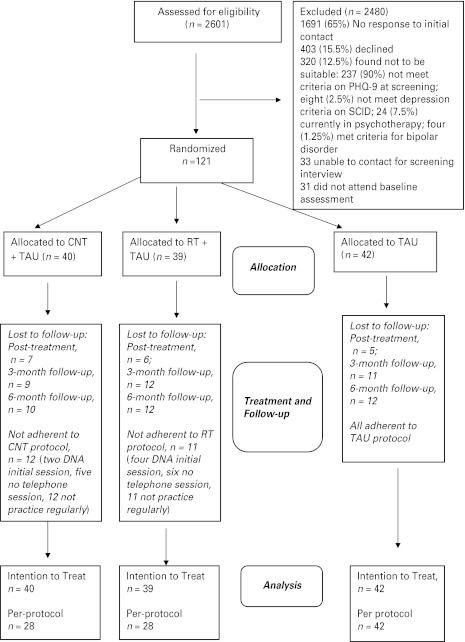
One hundred and twenty-one consecutively recruited participants meeting criteria for current major depression were randomly allocated to treatment as usual (TAU) or to TAU plus concreteness training (CNT) guided self-help or to TAU plus relaxation training (RT) guided self-help. CNT involved repeated practice at mental exercises designed to switch patients from an unhelpful abstract thinking habit to a helpful concrete thinking habit, thereby targeting depressogenic cognitive processes (rumination, overgeneralization).
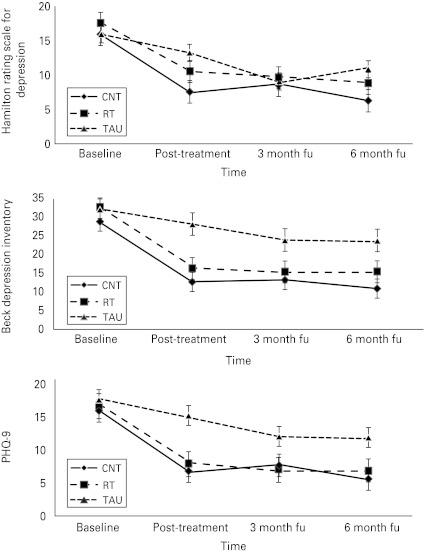
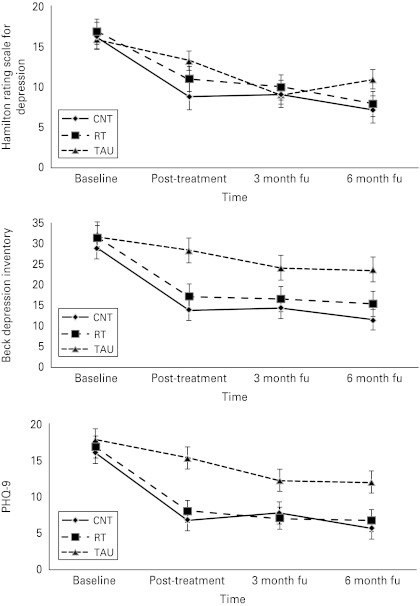
The addition of CNT to TAU significantly improved depressive symptoms at post-treatment [mean difference on the Hamilton Rating Scale for Depression (HAMD) 4.28, 95% confidence interval (CI) 1.29-7.26], 3- and 6-month follow-ups, and for rumination and overgeneralization post-treatment. There was no difference in the reduction of symptoms between CNT and RT (mean difference on the HAMD 1.98, 95% CI -1.14 to 5.11), although CNT significantly reduced rumination and overgeneralization relative to RT post-treatment, suggesting a specific benefit on these cognitive processes.
This study provides preliminary evidence that CNT guided self-help may be a useful addition to TAU in treating major depression in primary care, although the effect was not significantly different from an existing active treatment (RT) matched for structural and common factors. Because of its relative brevity and distinct format, it may have value as an additional innovative approach to increase the accessibility of treatment choices for depression.
开发广泛可及且有效的抑郁心理干预措施是当务之急。本随机试验提供了首个关于创新认知偏差矫正(CBM)训练引导自助式干预抑郁的对照数据。
连续招募了 121 名符合当前重度抑郁症标准的参与者,将他们随机分配到常规治疗(TAU)、TAU 加具体性训练(CNT)引导自助式或 TAU 加放松训练(RT)引导自助式。CNT 涉及反复练习旨在使患者从无益的抽象思维习惯转变为有益的具体思维习惯的心理练习,从而针对抑郁认知过程(反刍、过度泛化)。
与 TAU 相比,CNT 的加入显著改善了治疗后的抑郁症状[汉密尔顿抑郁量表(HAMD)的平均差异 4.28,95%置信区间(CI)1.29-7.26],在治疗后 3 个月和 6 个月的随访中,以及在治疗后的反刍和过度泛化中。CNT 和 RT 组的症状减轻程度没有差异(HAMD 平均差异 1.98,95%CI -1.14 至 5.11),尽管 CNT 相对于 RT 显著减少了治疗后的反刍和过度泛化,这表明对这些认知过程有特定的益处。
本研究初步表明,CNT 引导自助式治疗可能是对初级保健中重度抑郁症常规治疗的有用补充,尽管其效果与现有针对结构和常见因素的活性治疗(RT)没有显著差异。由于其相对简短和独特的形式,它可能具有作为增加抑郁症治疗选择可及性的额外创新方法的价值。