Bang Sunhee, Yu Jeong Jin, Han Myung-Ki, Ko Hong Ki, Chun Sail, Choi Hyung Soon, Kim Young-Hwue, Ko Jae-Kon, Park In-Sook
Division of Pediatric Cardiology, Department of Pediatrics, University of Ulsan College of Medicine, Seoul, Korea.
Korean J Pediatr. 2011 Aug;54(8):340-4. doi: 10.3345/kjp.2011.54.8.340. Epub 2011 Aug 31.
Brain natriuretic peptide (BNP) has been considered a biochemical marker for myocarditis in Kawasaki disease. We performed this study to determine its quantitative significance.
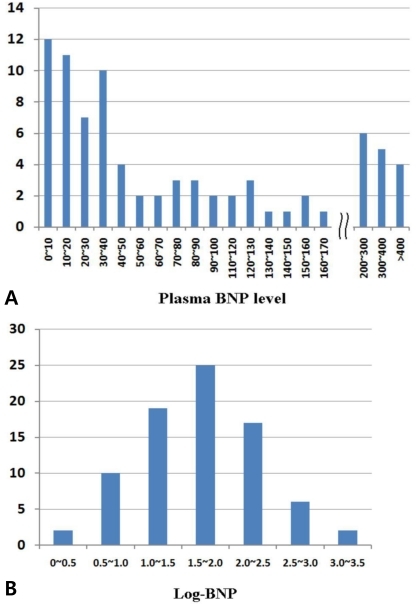
We attempted to correlate log-transformed BNP concentrations (log-BNP) and clinical, laboratory, and echocardiographic variables in 81 children with Kawasaki disease. Stepwise multiple linear regression analysis was used to determine the variables independently associated with log-BNP concentration.
Serum C-reactive protein level (P<0.0001), serum alanine aminotransferase concentration (P=0.0032), white blood cell count (P=0.0030), and left ventricular mass index (P=0.0024) were positively related with log-BNP, and hemoglobin level (P<0.0001), serum albumin level (P<0.0001), Na(+) concentrations (P<0.0001), left ventricular fractional shortening (P=0.0080), and peak early diastolic tissue velocity of the left ventricular basal lateral segment (P=0.0045) were negatively related to the log-BNP concentration. Multiple regression analysis showed that serum albumin concentration (R(2)=0.31, P=0.0098) and left ventricular mass index (R(2)=0.09, P=0.0004) were significantly associated with the log-BNP concentration.
Elevated BNP levels during the acute phase of Kawasaki disease may be attributable to cardiac dysfunction associated with the increase in left ventricular mass, and log-BNP concentration may be a quantitative biochemical marker of myocarditis in Kawasaki disease.
脑钠肽(BNP)一直被视为川崎病心肌炎的生化标志物。我们开展本研究以确定其定量意义。
我们试图将81例川崎病患儿经对数转换的BNP浓度(log-BNP)与临床、实验室及超声心动图变量进行关联分析。采用逐步多元线性回归分析来确定与log-BNP浓度独立相关的变量。
血清C反应蛋白水平(P<0.0001)、血清丙氨酸转氨酶浓度(P=0.0032)、白细胞计数(P=0.0030)及左心室质量指数(P=0.0024)与log-BNP呈正相关,而血红蛋白水平(P<0.0001)、血清白蛋白水平(P<0.0001)、Na(+)浓度(P<0.0001)、左心室短轴缩短率(P=0.0080)及左心室基底外侧段舒张早期组织速度峰值(P=0.0045)与log-BNP浓度呈负相关。多元回归分析显示血清白蛋白浓度(R(2)=0.31,P=0.0098)及左心室质量指数(R(2)=0.09,P=0.0004)与log-BNP浓度显著相关。
川崎病急性期BNP水平升高可能归因于与左心室质量增加相关的心脏功能障碍,且log-BNP浓度可能是川崎病心肌炎的定量生化标志物。