Department of Pediatrics, University of Naples Federico II, Naples, Italy.
PLoS One. 2011;6(11):e26920. doi: 10.1371/journal.pone.0026920. Epub 2011 Nov 7.
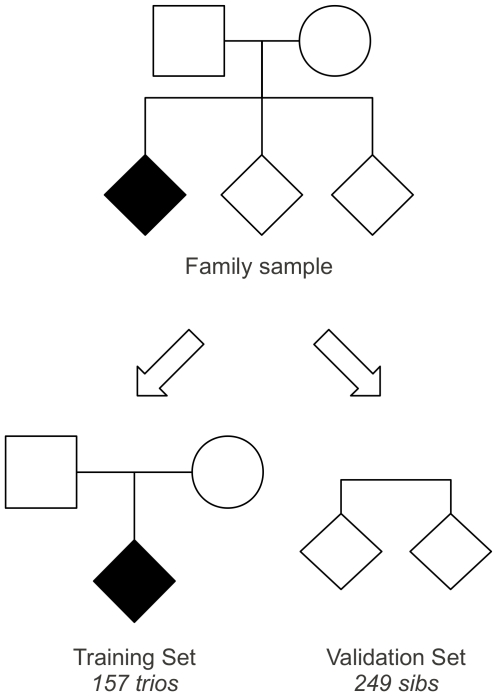
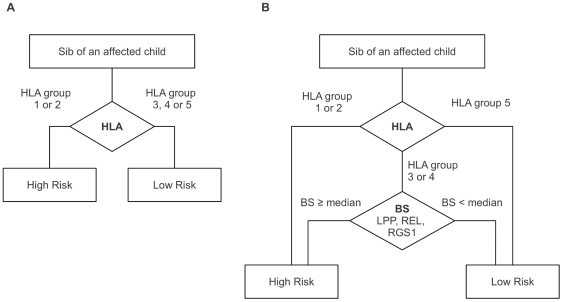
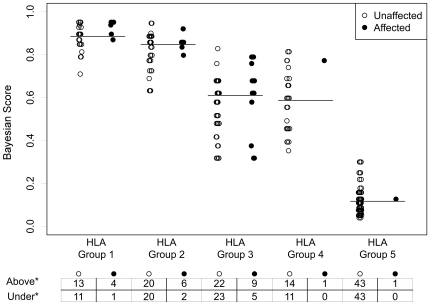
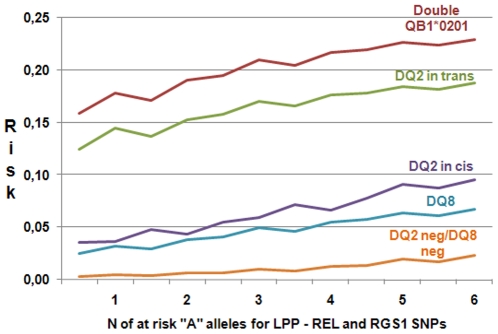
Celiac Disease (CD) is a polygenic trait, and HLA genes explain less than half of the genetic variation. Through large GWAs more than 40 associated non-HLA genes were identified, but they give a small contribution to the heritability of the disease. The aim of this study is to improve the estimate of the CD risk in siblings, by adding to HLA a small set of non-HLA genes. One-hundred fifty-seven Italian families with a confirmed CD case and at least one other sib and both parents were recruited. Among 249 sibs, 29 developed CD in a 6 year follow-up period. All individuals were typed for HLA and 10 SNPs in non-HLA genes: CCR1/CCR3 (rs6441961), IL12A/SCHIP1 and IL12A (rs17810546 and rs9811792), TAGAP (rs1738074), RGS1 (rs2816316), LPP (rs1464510), OLIG3 (rs2327832), REL (rs842647), IL2/IL21 (rs6822844), SH2B3 (rs3184504). Three associated SNPs (in LPP, REL, and RGS1 genes) were identified through the Transmission Disequilibrium Test and a Bayesian approach was used to assign a score (BS) to each detected HLA+SNPs genotype combination. We then classified CD sibs as at low or at high risk if their BS was respectively < or ≥ median BS value within each HLA risk group. A larger number (72%) of CD sibs showed a BS ≥ the median value and had a more than two fold higher OR than CD sibs with a BS value < the median (O.R = 2.53, p = 0.047). Our HLA+SNPs genotype classification, showed both a higher predictive negative value (95% vs 91%) and diagnostic sensitivity (79% vs 45%) than the HLA only. In conclusion, the estimate of the CD risk by HLA+SNPs approach, even if not applicable to prevention, could be a precious tool to improve the prediction of the disease in a cohort of first degree relatives, particularly in the low HLA risk groups.
乳糜泻(CD)是一种多基因特征,HLA 基因仅能解释其一半的遗传变异。通过大型全基因组关联研究(GWAS),已经确定了 40 多个与非 HLA 相关的基因,但它们对疾病的遗传度贡献很小。本研究的目的是通过在 HLA 中添加一小部分非 HLA 基因,来提高对 CD 同胞患病风险的估计。招募了 157 个意大利家庭,这些家庭有一个确诊的 CD 病例,至少还有一个其他兄弟姐妹和父母双方。在 249 个兄弟姐妹中,有 29 人在 6 年的随访期间患上了 CD。所有个体均进行 HLA 分型和 10 个非 HLA 基因 SNP 分型:CCR1/CCR3(rs6441961)、IL12A/SCHIP1 和 IL12A(rs17810546 和 rs9811792)、TAGAP(rs1738074)、RGS1(rs2816316)、LPP(rs1464510)、OLIG3(rs2327832)、REL(rs842647)、IL2/IL21(rs6822844)、SH2B3(rs3184504)。通过传递不平衡检验(TDT)和贝叶斯方法,发现了三个相关的 SNP(位于 LPP、REL 和 RGS1 基因中),并为每个检测到的 HLA+SNP 基因型组合分配了一个分数(BS)。然后,我们根据每个 HLA 风险组内的 BS 值中位数将 CD 同胞分为低风险或高风险。与 BS 值低于中位数的 CD 同胞相比,更多(72%)的 CD 同胞的 BS 值≥中位数,OR 值高出两倍以上(OR=2.53,p=0.047)。我们的 HLA+SNP 基因型分类法,与仅基于 HLA 相比,不仅具有更高的阴性预测值(95%对 91%)和诊断敏感性(79%对 45%)。总之,即使 HLA+SNP 方法不能用于预防,其对 CD 风险的估计也可以成为提高一级亲属队列中疾病预测的宝贵工具,特别是在 HLA 低风险组中。