Instituto de Investigación en Recursos Cinegéticos (CSIC-UCLM-JCCM), Ronda de Toledo s/n, E-13005 Ciudad Real, Spain.
BMC Evol Biol. 2011 Nov 17;11:333. doi: 10.1186/1471-2148-11-333.
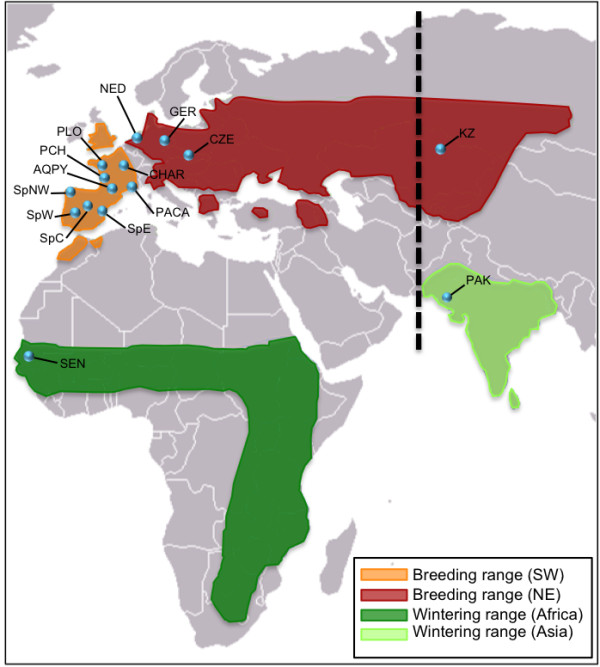
Environmental preferences and past climatic changes may determine the length of time during which a species range has contracted or expanded from refugia, thereby influencing levels of genetic diversification. Connectivity among populations of steppe-associated taxa might have been maximal during the long glacial periods, and interrupted only during the shorter interglacial phases, potentially resulting in low levels of genetic differentiation among populations. We investigated this hypothesis by exploring patterns of genetic diversity, past demography and gene flow in a raptor species characteristic of steppes, the Montagu's harrier (Circus pygargus), using mitochondrial DNA data from 13 breeding populations and two wintering populations.
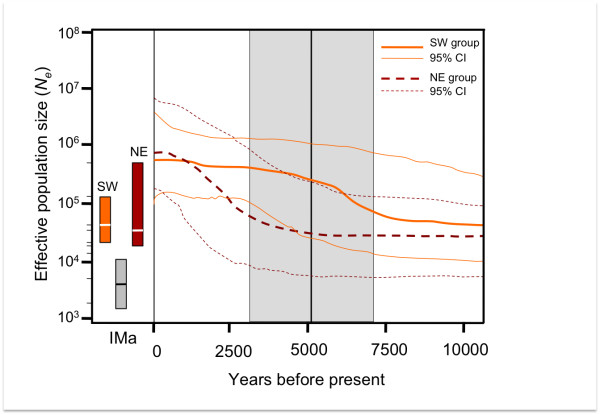
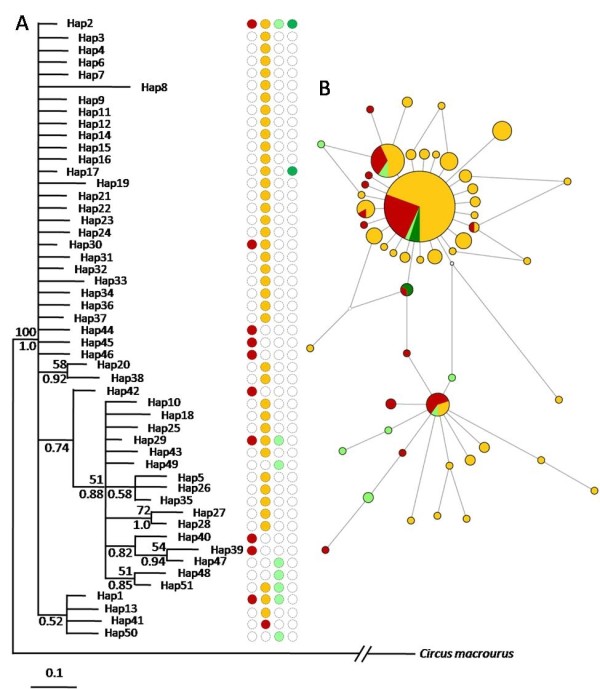
Consistent with our hypothesis, Montagu's harrier has relatively low genetic variation at the mitochondrial DNA. The highest levels of genetic diversity were found in coastal Spain, France and central Asia. These areas, which were open landscapes during the Holocene, may have acted as refugia when most of the European continent was covered by forests. We found significant genetic differentiation between two population groups, at the SW and NE parts of the species' range. Two events of past population growth were detected, and occurred ca. 7500-5500 and ca. 3500-1000 years BP in the SW and NE part of the range respectively. These events were likely associated with vegetation shifts caused by climate and human-induced changes during the Holocene.
The relative genetic homogeneity observed across populations of this steppe raptor may be explained by a short isolation time, relatively recent population expansions and a relaxed philopatry. We highlight the importance of considering the consequence of isolation and colonization processes in order to better understand the evolutionary history of steppe species.
环境偏好和过去的气候变化可能决定一个物种从避难所收缩或扩张的时间长度,从而影响遗传多样性水平。与草原相关的分类单元的种群之间的连通性在漫长的冰河时期可能达到最大值,而仅在较短的间冰期中断,这可能导致种群之间的遗传分化水平较低。我们通过探索草原特有猛禽-麻鹰(Circus pygargus)的遗传多样性、过去的种群动态和基因流模式来检验这一假说,该研究使用了来自 13 个繁殖种群和 2 个越冬种群的线粒体 DNA 数据。
与我们的假说一致,麻鹰的线粒体 DNA 遗传变异相对较低。遗传多样性水平最高的地区是西班牙沿海地区、法国和中亚。这些地区在全新世是开阔的景观,当欧洲大陆大部分地区被森林覆盖时,它们可能充当了避难所。我们发现,在物种分布范围的西南和东北部分,存在着显著的遗传分化。在物种分布范围的西南和东北部分,我们检测到过去两次种群增长事件,分别发生在大约 7500-5500 年前和大约 3500-1000 年前。这些事件可能与全新世气候和人类引起的变化导致的植被变化有关。
这种草原猛禽的种群间相对遗传同质性可能是由于隔离时间短、种群扩张相对较近和较宽松的亲缘选择所致。我们强调了考虑隔离和殖民化过程的后果对于更好地理解草原物种的进化历史的重要性。