State Key Laboratory of Oral Diseases, Sichuan University, Chengdu, Sichuan, China.
PLoS One. 2011;6(11):e27529. doi: 10.1371/journal.pone.0027529. Epub 2011 Nov 9.
Yes-associated protein (YAP) is considered an oncogene found amplified in multiple tumors, including head and neck squamous cell carcinoma (HNSCC). However, the role for YAP expression in HNSCC is not understood. Based on the central role of YAP in the hippo pathway, we tested if YAP was associated with the stage of HNSCC progression and metastatic potential.
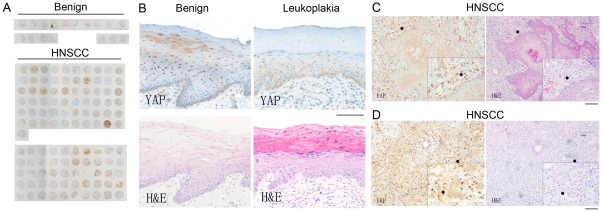
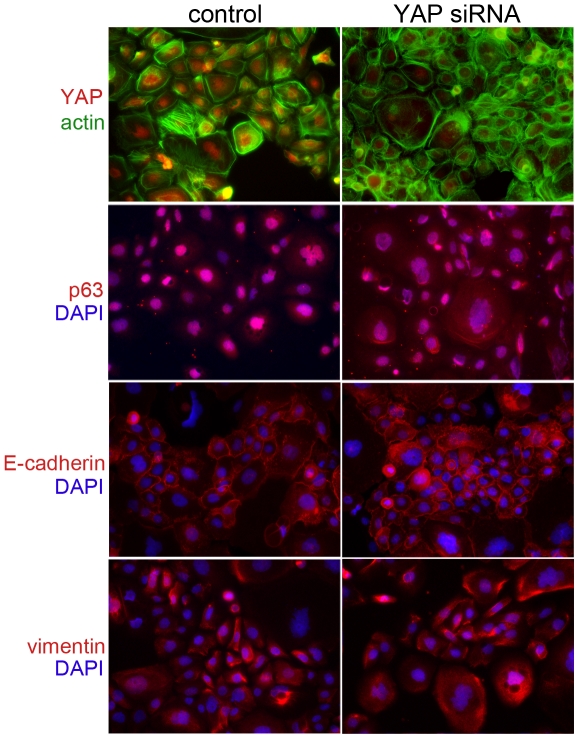
To determine the expression of YAP in human benign and HNSCC tissue specimens, immunohistochemical analyses were performed in whole tissue samples and tissue microarrays. The expression of YAP in tissues of microarray was first associated with clinic-pathologic factors and results verified in samples from whole tissue sections. To investigate the role of YAP and p63 in regulating HNSCC epithelial to mesenchymal transition, epithelial and mesenchymal markers were assayed in Fadu and SCC-25 cells, HNSCC cells with endogenously elevated YAP expression and siRNA-mediated expression knockdown.
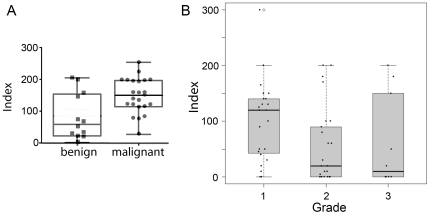
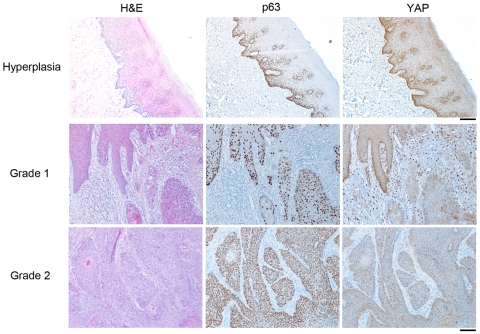
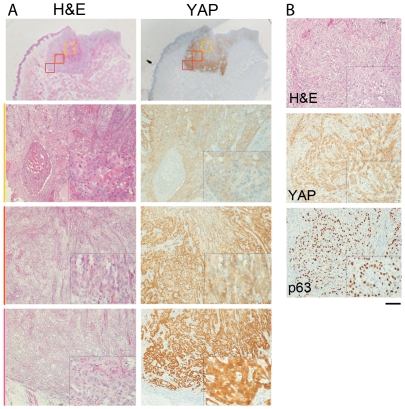
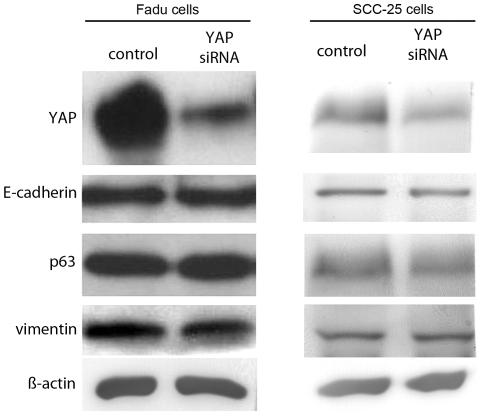
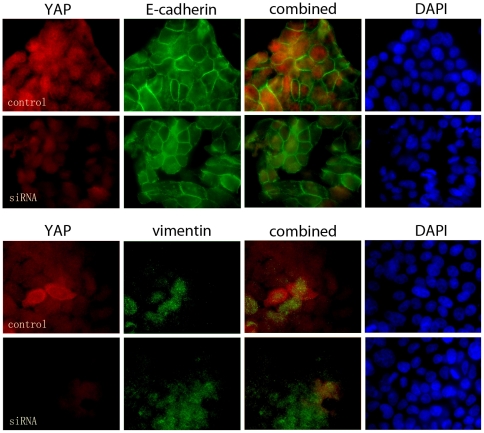
Analysis of human HNSCC tissues suggested YAP expression was elevated in tumors compared to benign tissues and specifically localized at the tumor invasive front (p value < 0.05). But, indexed YAP expression was lower with greater tumor grade (p value = 0.02). In contrast, p63 expression was primarily elevated in high-grade tumors. Interestingly, both YAP and p63 was strongly expressed at the tumor invasive front and in metastatic HNSCC. Strikingly, we demonstrated YAP expression in the primary HNSCC tumor was associated with nodal metastasis in univariate analysis (p value = 0.02). However, the knockdown of YAP in Fadu and SCC-25 cell lines was not associated with changes in epithelial to mesenchymal transdifferentiation or p63 expression.
Together, YAP expression, in combination with p63 can facilitate identification of HNSCC tumors from hyperplastic and benign tissues and the metastatic function of YAP in HNSCC may not be a result of epithelia to mesenchymal transdifferentiation.
Yes 相关蛋白(YAP)被认为是一种癌基因,在多种肿瘤中发现有扩增,包括头颈部鳞状细胞癌(HNSCC)。然而,YAP 在 HNSCC 中的表达作用尚不清楚。基于 YAP 在 hippo 通路中的核心作用,我们检测了 YAP 是否与 HNSCC 进展和转移潜能的阶段相关。
为了确定 YAP 在人良性和 HNSCC 组织标本中的表达,对全组织标本和组织微阵列进行了免疫组织化学分析。首先将组织微阵列中 YAP 的表达与临床病理因素相关联,并在全组织切片样本中验证结果。为了研究 YAP 和 p63 在调节 HNSCC 上皮间质转化中的作用,在 HNSCC 细胞系 Fadu 和 SCC-25 中检测了上皮和间充质标志物,这些细胞系的 YAP 表达水平升高,或通过 siRNA 介导的表达下调。
对人 HNSCC 组织的分析表明,与良性组织相比,YAP 在肿瘤中的表达升高,并且特别定位于肿瘤浸润前沿(p 值<0.05)。但是,随着肿瘤分级的增加,YAP 的表达指数降低(p 值=0.02)。相反,p63 的表达主要在高级别肿瘤中升高。有趣的是,YAP 和 p63 在肿瘤浸润前沿和转移性 HNSCC 中均强烈表达。引人注目的是,我们发现原发性 HNSCC 肿瘤中的 YAP 表达与单因素分析中的淋巴结转移相关(p 值=0.02)。然而,在 Fadu 和 SCC-25 细胞系中敲低 YAP 与上皮间质转化或 p63 表达的变化无关。
综上所述,YAP 表达与 p63 相结合,可有助于将 HNSCC 肿瘤与增生性和良性组织区分开,并且 YAP 在 HNSCC 中的转移功能可能不是上皮间质转化的结果。