Department of Epidemiology, Erasmus MC, Rotterdam, the Netherlands.
Diabetes Care. 2012 Jan;35(1):119-24. doi: 10.2337/dc11-0857. Epub 2011 Nov 18.
Numerous studies have suggested a decreased risk of cancer in patients with diabetes on metformin. Because different comparison groups were used, the effect magnitude is difficult to estimate. Therefore, the objective of this study was to further analyze whether, and to what extent, use of metformin is associated with a decreased risk of cancer in a cohort of incident users of metformin compared with users of sulfonylurea derivatives.
Data for this study were obtained from dispensing records from community pharmacies individually linked to hospital discharge records from 2.5 million individuals in the Netherlands. The association between the risk of cancer in those using metformin compared with those using sulfonylurea derivatives was analyzed using Cox proportional hazard models with cumulative duration of drug use as a time-varying determinant.
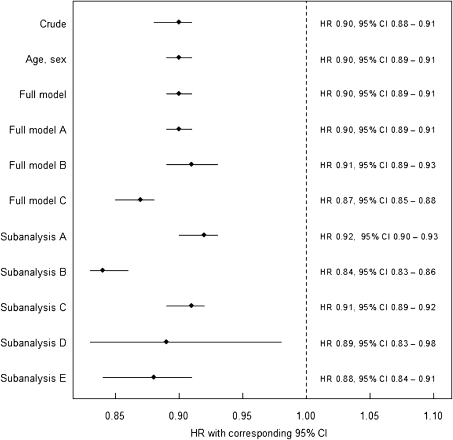
Use of metformin was associated with a lower risk of cancer in general (hazard ratio 0.90 [95% CI 0.88-0.91]) compared with use of sulfonylurea derivatives. When specific cancers were used as end points, similar estimates were found. Dosage-response relations were identified for users of metformin but not for users of sulfonylurea derivatives.
In our study, cumulative exposure to metformin was associated with a lower risk of specific cancers and cancer in general, compared with cumulative exposure to sulfonylurea derivatives. However, whether this should indeed be seen as a decreased risk of cancer for the use of metformin or as an increased risk of cancer for the use sulfonylurea derivatives remains to be elucidated.
许多研究表明,使用二甲双胍的糖尿病患者患癌症的风险降低。由于使用了不同的对照组,因此难以估计影响的幅度。因此,本研究的目的是进一步分析与使用磺酰脲类药物相比,二甲双胍的新使用者发生癌症的风险是否降低,以及降低的程度如何。
本研究的数据来自荷兰 250 万人的配药记录,这些记录与医院出院记录单独相关联。使用 Cox 比例风险模型,以药物使用的累积时间作为时变决定因素,分析使用二甲双胍与使用磺酰脲类药物的患者发生癌症的风险之间的关系。
与使用磺酰脲类药物相比,使用二甲双胍总体上癌症风险较低(风险比 0.90 [95% CI 0.88-0.91])。当将特定癌症作为终点时,也发现了类似的估计值。在使用二甲双胍的患者中确定了剂量反应关系,但在使用磺酰脲类药物的患者中没有确定。
在我们的研究中,与使用磺酰脲类药物相比,累积暴露于二甲双胍与特定癌症和总体癌症的风险降低相关。但是,这是否确实应被视为使用二甲双胍降低癌症风险,或者使用磺酰脲类药物增加癌症风险,仍有待阐明。