Department of Surgery, Maastricht University Medical Centre, P. Debyelaan 25, 6229 HX, Maastricht, The Netherlands.
Surg Endosc. 2012 May;26(5):1231-7. doi: 10.1007/s00464-011-2041-2. Epub 2011 Nov 20.
Single-incision laparoscopy is a step forward toward nearly scarless surgery. Concern has been raised that single-incision laparoscopy is technically more challenging than conventional laparoscopy. This study researched the performance curves of novice trainees for single-incision laparoscopy (SILS) versus conventional laparoscopy for performing two basic tasks on a box trainer.
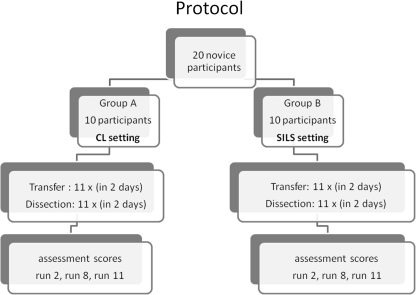
In this study, 20 novice participants performed two tasks (peg transfer and a dissection task) on a standard box trainer. All the participants practiced each task 11 times and were randomized in two groups. The first group performed the tasks on a box trainer through three incisions. The second group used a single-incision access with the same box trainer. The assessment scores for errors and time were recorded. The 2nd, 8th, and 11th runs of both tasks in both settings were assessed to objectify the gain in basic laparoscopic skills.
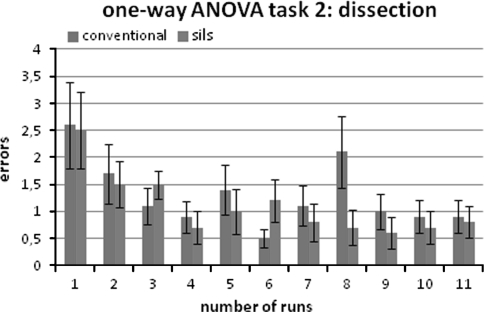
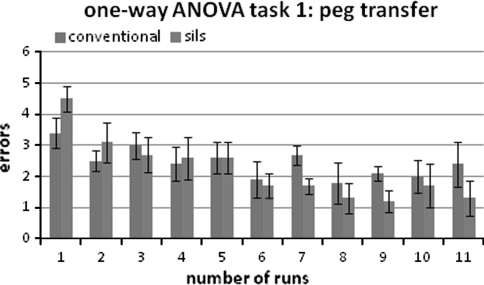
The performance curves for both groups improved significantly in terms of both time and errors in performing the two tasks [P < 0.01, analysis of variance (ANOVA)]. For the first task, no significant difference in time between the two groups was observed at the top of the performance curve (mean, 212 ± 64 vs. 182 ± 48 s), but the SILS group performed with fewer errors (1.3 ± 1.5 vs. 2.7 ± 2.11). However, the difference was not significant (P = 0.10). The dissection task was performed faster in the SILS group (mean, 205 ± 78 vs. 243 ± 40 s; P = 0, 18) with fewer errors (0.7 ± 1.05 vs. 1.9 ± 2.1; P = 0. 12), but the difference was not significant.
This study showed a significant improvement in basic skills for both the SILS and conventional laparoscopy settings after 11 repetitions. These data suggest that box training shows no significant difference between conventional laparoscopic and single-incision laparoscopic settings in terms of error or time in performing basic tasks at a low complexity level for the novice. These data also show significant improvement in basic skills over a relatively short period.
单切口腹腔镜技术是朝着近乎无痕手术迈出的一步。人们担心单切口腹腔镜技术比传统腹腔镜技术更具挑战性。本研究旨在研究新手学员在使用标准箱式训练器进行两项基本任务时,单切口腹腔镜(SILS)与传统腹腔镜的操作性能曲线。
在这项研究中,20 名新手学员在标准箱式训练器上完成两项任务(针转移和解剖任务)。所有学员都练习了每个任务 11 次,并随机分为两组。第一组通过三个切口完成任务。第二组使用相同的箱式训练器进行单切口入路。记录错误和时间的评估得分。评估了两组在两种设置下第 2、8 和 11 次运行的任务,以客观评估基本腹腔镜技能的提高。
两组在执行两项任务时,无论是在时间还是在错误方面,操作性能曲线都显著改善[P < 0.01,方差分析(ANOVA)]。对于第一项任务,在操作性能曲线的顶部,两组之间的时间差异没有统计学意义(平均,212 ± 64 与 182 ± 48 s),但 SILS 组的错误较少(1.3 ± 1.5 与 2.7 ± 2.11)。然而,差异无统计学意义(P = 0.10)。SILS 组在执行解剖任务时速度更快(平均,205 ± 78 与 243 ± 40 s;P = 0.18),错误更少(0.7 ± 1.05 与 1.9 ± 2.1;P = 0.12),但差异无统计学意义。
本研究表明,在进行 11 次重复后,SILS 和传统腹腔镜设置的基本技能均有显著提高。这些数据表明,在低复杂度水平下,对于新手学员,箱式训练在执行基本任务时,在错误或时间方面,传统腹腔镜和单切口腹腔镜设置之间没有显著差异。这些数据还表明,在相对较短的时间内,基本技能有了显著提高。