Program in Cellular and Molecular Biology, University of Wisconsin-Madison, Madison, Wisconsin 53706, USA.
Nature. 2011 Nov 20;480(7375):109-12. doi: 10.1038/nature10632.
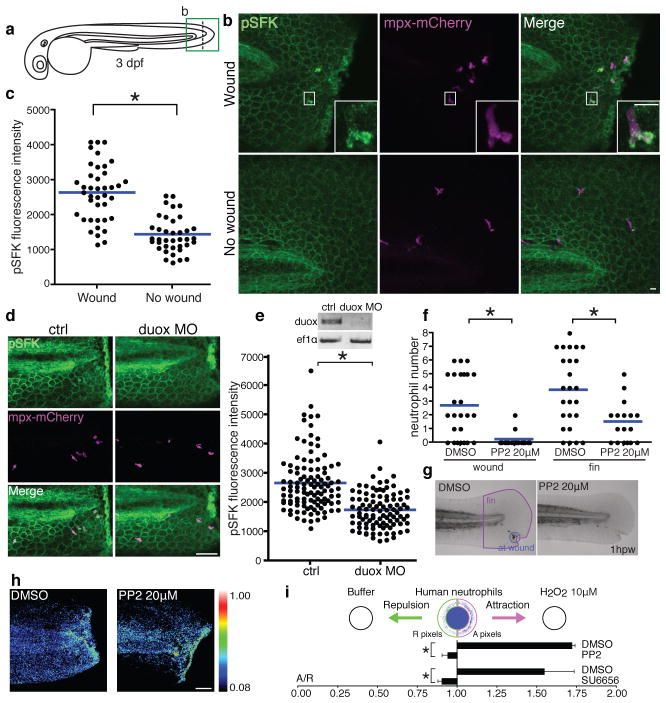
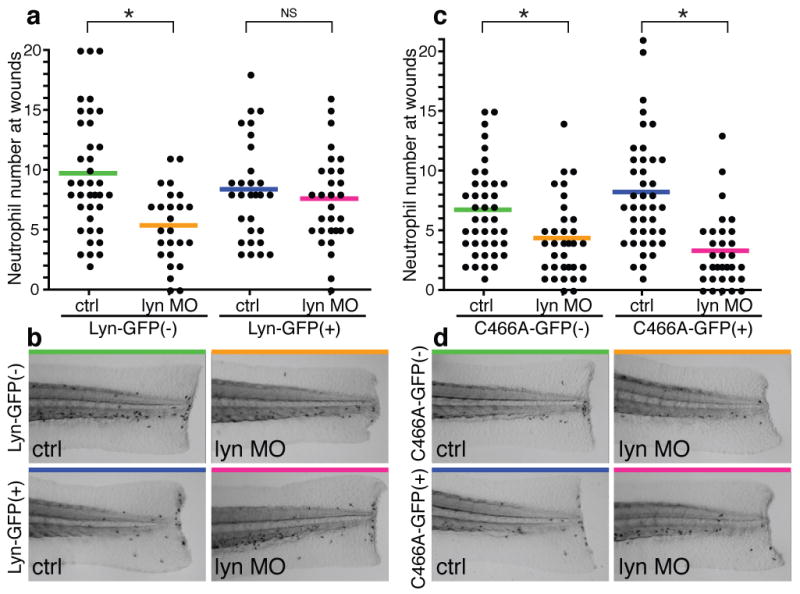
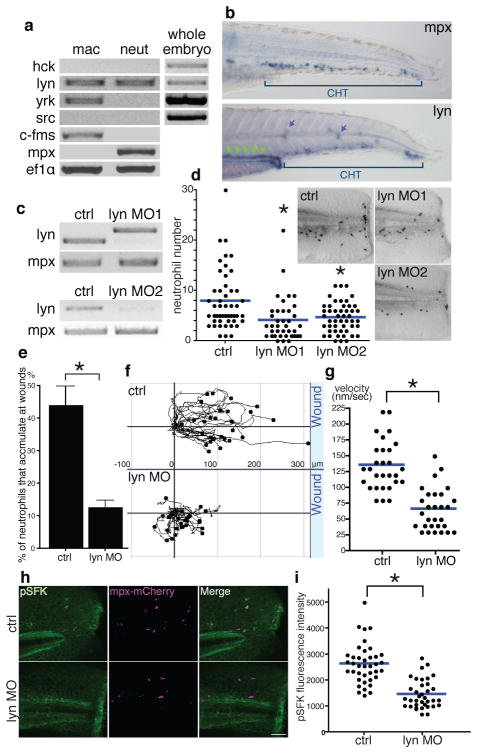
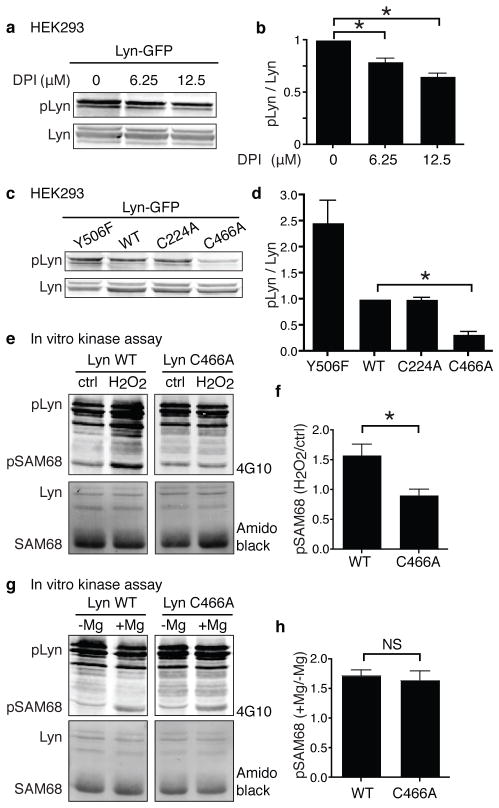
Tissue wounding induces the rapid recruitment of leukocytes. Wounds and tumours--a type of 'unhealed wound'--generate hydrogen peroxide (H(2)O(2)) through an NADPH oxidase (NOX). This extracellular H(2)O(2) mediates recruitment of leukocytes, particularly the first responders of innate immunity, neutrophils, to injured tissue. However, the sensor that neutrophils use to detect the redox state at wounds is unknown. Here we identify the Src family kinase (SFK) Lyn as a redox sensor that mediates initial neutrophil recruitment to wounds in zebrafish larvae. Lyn activation in neutrophils is dependent on wound-derived H(2)O(2) after tissue injury, and inhibition of Lyn attenuates neutrophil wound recruitment. Inhibition of SFKs also disrupted H(2)O(2)-mediated chemotaxis of primary human neutrophils. In vitro analysis identified a single cysteine residue, C466, as being responsible for direct oxidation-mediated activation of Lyn. Furthermore, transgenic-tissue-specific reconstitution with wild-type Lyn and a cysteine mutant revealed that Lyn C466 is important for the neutrophil wound response and downstream signalling in vivo. This is the first identification, to our knowledge, of a physiological redox sensor that mediates leukocyte wound attraction in multicellular organisms.
组织损伤会迅速募集白细胞。伤口和肿瘤——一种“未愈合的伤口”——通过 NADPH 氧化酶 (NOX) 产生过氧化氢 (H(2)O(2))。这种细胞外的 H(2)O(2)介导白细胞的募集,特别是先天免疫的最初反应者中性粒细胞,到受损组织。然而,中性粒细胞用来检测伤口氧化还原状态的传感器尚不清楚。在这里,我们确定 Src 家族激酶 (SFK) Lyn 作为一种氧化还原传感器,介导斑马鱼幼虫伤口中中性粒细胞的初始募集。组织损伤后,中性粒细胞中 Lyn 的激活依赖于伤口衍生的 H(2)O(2),而 Lyn 的抑制会减弱中性粒细胞对伤口的募集。SFK 的抑制也破坏了原代人中性粒细胞的 H(2)O(2)介导的趋化作用。体外分析确定了一个单一的半胱氨酸残基 C466,作为直接氧化介导的 Lyn 激活的原因。此外,用野生型 Lyn 和半胱氨酸突变体进行的转基因组织特异性重建表明,Lyn C466 对于中性粒细胞的伤口反应和体内下游信号转导很重要。据我们所知,这是首次鉴定出一种生理氧化还原传感器,它介导多细胞生物中白细胞对伤口的吸引。