Department of Psychiatry, Warneford Hospital, University of Oxford, Oxford OX3 7JX, UK.
J Behav Ther Exp Psychiatry. 2012 Jun;43(2):758-64. doi: 10.1016/j.jbtep.2011.10.008. Epub 2011 Nov 2.
Involuntary autobiographical memories that spring unbidden into conscious awareness form part of everyday experience. In psychopathology, involuntary memories can be associated with significant distress. However, the cognitive mechanisms associated with the development of involuntary memories require further investigation and understanding. Since involuntary autobiographical memories are image-based, we tested predictions that visuospatial (but not other) established cognitive tasks could disrupt their consolidation when completed post-encoding.
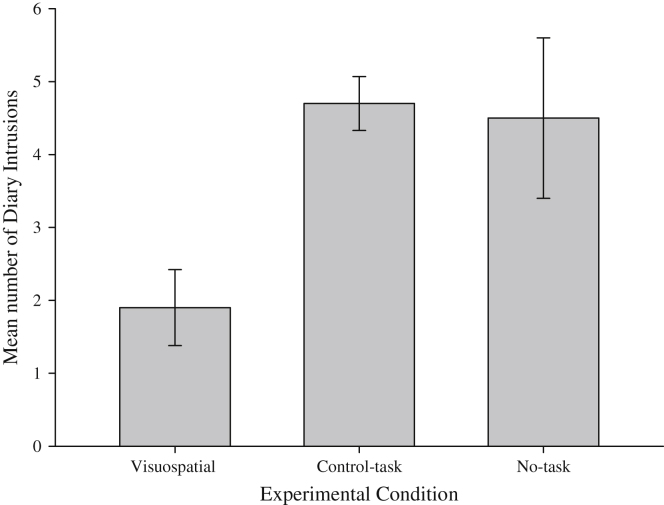
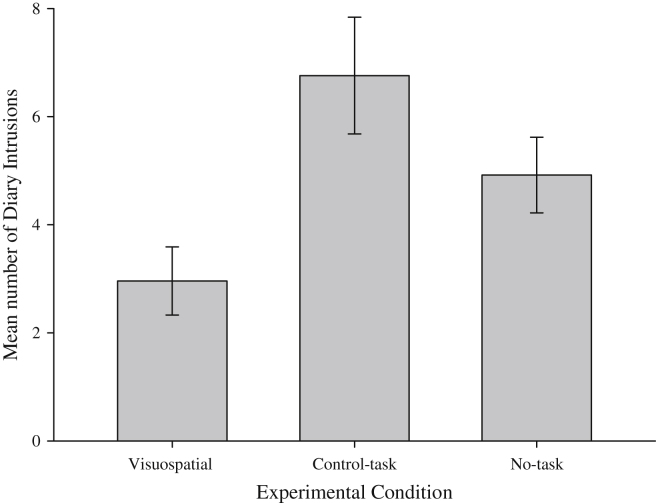
In Experiment 1, participants watched a stressful film then immediately completed a visuospatial task (complex pattern tapping), a control-task (verbal task) or no-task. Involuntary memories of the film were recorded for 1-week. In Experiment 2, the cognitive tasks were administered 30-min post-film.
Compared to both control and no-task conditions, completing a visuospatial task post-film reduced the frequency of later involuntary memories (Expts 1 and 2) but did not affect voluntary memory performance on a recognition task (Expt 2).
Voluntary memory was assessed using a verbal recognition task and a broader range of memory tasks could be used. The relative difficulty of the cognitive tasks used was not directly established.
An established visuospatial task after encoding of a stressful experience selectively interferes with sensory-perceptual information processing and may therefore prevent the development of involuntary autobiographical memories.
不由自主地出现在意识中的自传体记忆是日常生活经验的一部分。在精神病理学中,不由自主的记忆可能与明显的痛苦有关。然而,与不由自主的记忆发展相关的认知机制需要进一步的研究和理解。由于不由自主的自传体记忆是基于图像的,我们测试了这样的预测,即在完成后编码时,视觉空间(而不是其他)已建立的认知任务可以破坏它们的巩固。
在实验 1 中,参与者观看了一部有压力的电影,然后立即完成了一项视觉空间任务(复杂模式敲击)、一项控制任务(言语任务)或没有任务。记录了对电影的不由自主的记忆 1 周。在实验 2 中,认知任务在电影后 30 分钟进行。
与控制和无任务条件相比,完成后编码的视觉空间任务减少了随后不由自主记忆的频率(实验 1 和 2),但对识别任务(实验 2)中的自愿记忆表现没有影响。
自愿记忆是使用言语识别任务评估的,可以使用更广泛的记忆任务。使用的认知任务的相对难度没有直接确定。
在经历压力后进行已建立的视觉空间任务会选择性地干扰感觉知觉信息处理,因此可能会阻止不由自主的自传体记忆的发展。