Neuropsychiatry Unit, National Institute of Neurology and Neurosurgery, Mexico City, Mexico.
University of British Columbia, Vancouver, BC, Canada.
Brain Behav. 2021 Feb;11(2):e01984. doi: 10.1002/brb3.1984. Epub 2020 Dec 13.
Traumatic memories of events such as a life-threatening incident, serious injury, or sexual violence are a core symptom of stress-related disorders; they might be susceptible to positive modification with interference tasks (reconsolidation-based interventions). Our objective was to test the effect of performing a motor interference task (finger tapping in response to audio cues) on patients who suffer from traumatic memories.
We designed an uncontrolled pilot prospective clinical trial. Ten participants listened to an audio track that instructed them to tap their fingers in response to specific audio cues while trying to recall the traumatic event. Each patient underwent an assessment including the Spanish version of the PTSD Symptom Severity Scale-Revised (EGS-R), the visual analogue scale (EQ-VAS) from EuroQol 5D (EQ-5D), and a simple visual analogue scale (VAS) before the intervention, immediately after, and a week after the treatment.
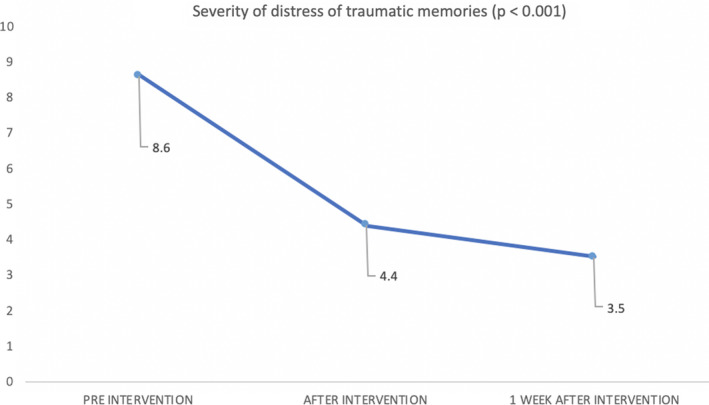
All measures exhibited a statistically significant improvement 1 week after the study. On the PTSD scale, 1 week later, 30% of the patients did not score high enough for such diagnosis. The VAS measured immediately following the intervention (4.4, SD = 2.22) also improved (p < .001), and 30% of the patients scored zero. One week after the intervention, the VAS improved more than 50% CONCLUSION: The rapid 1-week improvement on the PSTD scale and the VAS after a 30 min intervention support the idea of further research using a double-blind, controlled design powered to demonstrate the efficacy of motor interference, an easy-to-apply therapeutic tool, in the treatment of traumatic memories.
危及生命的事件、严重伤害或性暴力等事件的创伤性记忆是应激相关障碍的核心症状;它们可能容易受到干扰任务(基于再巩固的干预)的积极改变。我们的目的是测试对患有创伤性记忆的患者进行运动干扰任务(响应音频提示的手指敲击)的效果。
我们设计了一项无对照的前瞻性临床试验。十名参与者听一段音频,该音频指示他们在试图回忆创伤性事件的同时,响应特定音频提示敲击手指。每位患者在干预前、干预后立即和治疗后一周进行评估,评估包括西班牙语版 PTSD 症状严重程度量表修订版(EGS-R)、EuroQol 5D 视觉模拟量表(EQ-VAS)和简单视觉模拟量表(VAS)。
所有措施在研究结束后 1 周均显示出统计学上的显著改善。在 PTSD 量表上,1 周后,30%的患者没有达到足够高的诊断标准。干预后立即测量的 VAS(4.4,SD=2.22)也有所改善(p<.001),30%的患者得分为零。干预后 1 周,VAS 改善超过 50%。
PTSD 量表在 1 周内迅速改善,VAS 在 30 分钟干预后改善,支持使用双盲、对照设计进行进一步研究的想法,以证明运动干扰的有效性,运动干扰是一种易于应用的治疗工具,可用于治疗创伤性记忆。