Lau-Zhu Alex, Henson Richard N, Holmes Emily A
Medical Research Council Cognition and Brain Sciences Unit, Department of Psychiatry, University of Cambridge.
Oxford Institute of Clinical Psychology Training and Research, Division of Medical Sciences, University of Oxford.
Clin Psychol Sci. 2021 Nov;9(6):1128-1143. doi: 10.1177/2167702621998315. Epub 2021 May 6.
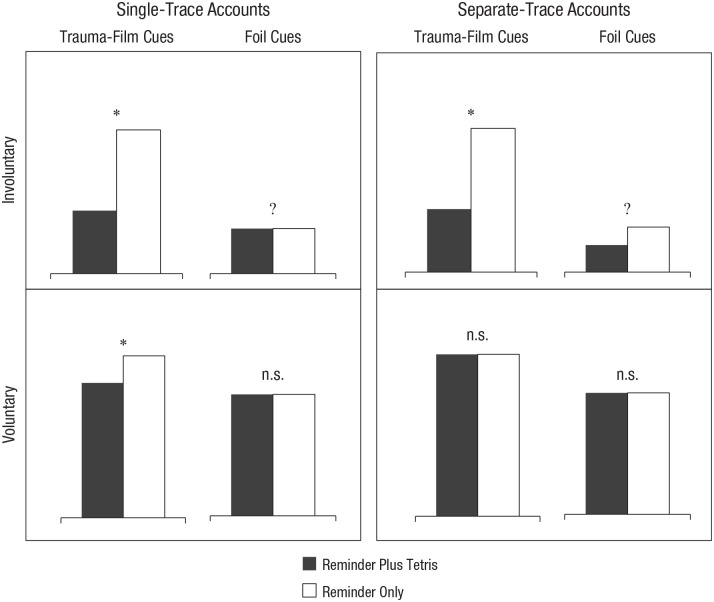
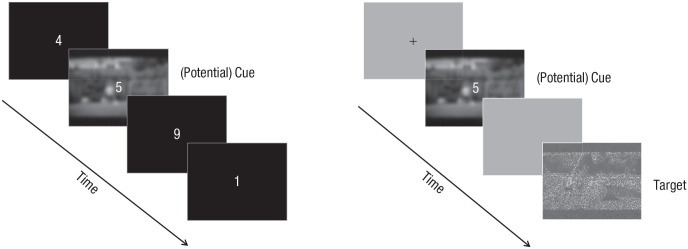
Intrusive memories of a traumatic event can be reduced by a subsequent interference procedure, seemingly sparing voluntary memory for that event. This has potential therapeutic benefits (e.g., for emotional disorders) and legal importance (e.g., for witness testimony). However, the measurements of intrusive memory and voluntary memory typically differ in the role of associations between a cue and the emotional memory "hotspots." To test this, we asked participants to watch a traumatic film followed by either an interference procedure (reminder plus Tetris) or control procedure (reminder only). Measurement of intrusions (using a laboratory task) and voluntary memory (recognition for film stills) were crossed with the presence or absence of associative cues. The reminder-plus-Tetris group exhibited fewer intrusions despite comparable recognition memory, replicating the results of prior studies. Note that this selective interference did not appear to depend on associative cues. This involuntary versus voluntary memory dissociation for emotional material further supports separate-trace memory theories and has applied advantages.
创伤性事件的侵入性记忆可以通过后续的干扰程序来减少,这似乎不会损害对该事件的自主记忆。这具有潜在的治疗益处(例如,对情绪障碍)和法律重要性(例如,对证人证词)。然而,侵入性记忆和自主记忆的测量通常在线索与情绪记忆“热点”之间关联的作用上有所不同。为了对此进行测试,我们让参与者观看一部创伤性影片,随后进行干扰程序(提示加俄罗斯方块)或对照程序(仅提示)。侵入性记忆的测量(使用实验室任务)和自主记忆(对电影剧照的识别)与联想线索的有无交叉进行。尽管识别记忆相当,但提示加俄罗斯方块组的侵入性记忆较少,重复了先前研究的结果。请注意,这种选择性干扰似乎并不依赖于联想线索。这种情绪材料的非自主记忆与自主记忆的分离进一步支持了独立痕迹记忆理论,并具有应用优势。