• 文献检索
  • 文档翻译
  • 深度研究
  • 学术资讯
  • Suppr Zotero 插件Zotero 插件
  • 邀请有礼
  • 套餐&价格
  • 历史记录
应用&插件
Suppr Zotero 插件Zotero 插件浏览器插件Mac 客户端Windows 客户端微信小程序
定价
高级版会员购买积分包购买API积分包
服务
文献检索文档翻译深度研究API 文档MCP 服务
关于我们
关于 Suppr公司介绍联系我们用户协议隐私条款
关注我们

Suppr 超能文献

核心技术专利:CN118964589B侵权必究
粤ICP备2023148730 号-1Suppr @ 2026

文献检索

告别复杂PubMed语法,用中文像聊天一样搜索,搜遍4000万医学文献。AI智能推荐,让科研检索更轻松。

立即免费搜索

文件翻译

保留排版,准确专业,支持PDF/Word/PPT等文件格式,支持 12+语言互译。

免费翻译文档

深度研究

AI帮你快速写综述,25分钟生成高质量综述,智能提取关键信息,辅助科研写作。

立即免费体验

快速物体识别的视觉特征是什么?

What are the Visual Features Underlying Rapid Object Recognition?

机构信息

Cognitive, Linguistic, and Psychological Sciences Department, Institute for Brain Sciences, Brown University Providence, RI, USA.

出版信息

Front Psychol. 2011 Nov 15;2:326. doi: 10.3389/fpsyg.2011.00326. eCollection 2011.

DOI:10.3389/fpsyg.2011.00326
PMID:22110461
原文链接:https://pmc.ncbi.nlm.nih.gov/articles/PMC3216029/
Abstract

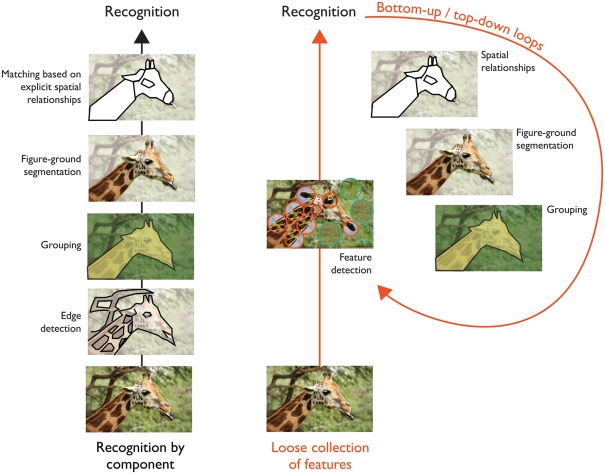
Research progress in machine vision has been very significant in recent years. Robust face detection and identification algorithms are already readily available to consumers, and modern computer vision algorithms for generic object recognition are now coping with the richness and complexity of natural visual scenes. Unlike early vision models of object recognition that emphasized the role of figure-ground segmentation and spatial information between parts, recent successful approaches are based on the computation of loose collections of image features without prior segmentation or any explicit encoding of spatial relations. While these models remain simplistic models of visual processing, they suggest that, in principle, bottom-up activation of a loose collection of image features could support the rapid recognition of natural object categories and provide an initial coarse visual representation before more complex visual routines and attentional mechanisms take place. Focusing on biologically plausible computational models of (bottom-up) pre-attentive visual recognition, we review some of the key visual features that have been described in the literature. We discuss the consistency of these feature-based representations with classical theories from visual psychology and test their ability to account for human performance on a rapid object categorization task.

摘要

近年来,机器视觉领域的研究取得了重大进展。稳健的人脸检测和识别算法已经面向消费者推出,而用于通用目标识别的现代计算机视觉算法也正在应对自然视觉场景的丰富性和复杂性。与早期强调图形-背景分割和部分之间空间信息的目标识别视觉模型不同,最近成功的方法基于松散的图像特征集合的计算,而无需预先分割或任何显式的空间关系编码。虽然这些模型仍然是视觉处理的简化模型,但它们表明,原则上,松散的图像特征集合的自底向上激活可以支持自然目标类别的快速识别,并在更复杂的视觉例程和注意机制发生之前提供初始粗略的视觉表示。我们专注于(自底向上)非注意视觉识别的生物上合理的计算模型,回顾了文献中描述的一些关键视觉特征。我们讨论了这些基于特征的表示与视觉心理学经典理论的一致性,并测试了它们在快速目标分类任务中解释人类表现的能力。
https://cdn.ncbi.nlm.nih.gov/pmc/blobs/f083/3216029/d815d6ef0f42/fpsyg-02-00326-g007.jpg
https://cdn.ncbi.nlm.nih.gov/pmc/blobs/f083/3216029/f123c71d5a0b/fpsyg-02-00326-g001.jpg
https://cdn.ncbi.nlm.nih.gov/pmc/blobs/f083/3216029/3c76618eb290/fpsyg-02-00326-g002.jpg
https://cdn.ncbi.nlm.nih.gov/pmc/blobs/f083/3216029/131b7a06b2cc/fpsyg-02-00326-g003.jpg
https://cdn.ncbi.nlm.nih.gov/pmc/blobs/f083/3216029/0efaa3ab92f8/fpsyg-02-00326-g004.jpg
https://cdn.ncbi.nlm.nih.gov/pmc/blobs/f083/3216029/949f09925954/fpsyg-02-00326-g005.jpg
https://cdn.ncbi.nlm.nih.gov/pmc/blobs/f083/3216029/e7fdd837380d/fpsyg-02-00326-g006.jpg
https://cdn.ncbi.nlm.nih.gov/pmc/blobs/f083/3216029/d815d6ef0f42/fpsyg-02-00326-g007.jpg
https://cdn.ncbi.nlm.nih.gov/pmc/blobs/f083/3216029/f123c71d5a0b/fpsyg-02-00326-g001.jpg
https://cdn.ncbi.nlm.nih.gov/pmc/blobs/f083/3216029/3c76618eb290/fpsyg-02-00326-g002.jpg
https://cdn.ncbi.nlm.nih.gov/pmc/blobs/f083/3216029/131b7a06b2cc/fpsyg-02-00326-g003.jpg
https://cdn.ncbi.nlm.nih.gov/pmc/blobs/f083/3216029/0efaa3ab92f8/fpsyg-02-00326-g004.jpg
https://cdn.ncbi.nlm.nih.gov/pmc/blobs/f083/3216029/949f09925954/fpsyg-02-00326-g005.jpg
https://cdn.ncbi.nlm.nih.gov/pmc/blobs/f083/3216029/e7fdd837380d/fpsyg-02-00326-g006.jpg
https://cdn.ncbi.nlm.nih.gov/pmc/blobs/f083/3216029/d815d6ef0f42/fpsyg-02-00326-g007.jpg

相似文献

1
What are the Visual Features Underlying Rapid Object Recognition?快速物体识别的视觉特征是什么?
Front Psychol. 2011 Nov 15;2:326. doi: 10.3389/fpsyg.2011.00326. eCollection 2011.
2
Performance of a Computational Model of the Mammalian Olfactory System哺乳动物嗅觉系统计算模型的性能
3
3-D vision and figure-ground separation by visual cortex.视觉皮层的三维视觉与图形-背景分离
Percept Psychophys. 1994 Jan;55(1):48-121. doi: 10.3758/bf03206880.
4
How can selection of biologically inspired features improve the performance of a robust object recognition model?生物启发特征的选择如何提高鲁棒目标识别模型的性能?
PLoS One. 2012;7(2):e32357. doi: 10.1371/journal.pone.0032357. Epub 2012 Feb 27.
5
Depth in convolutional neural networks solves scene segmentation.卷积神经网络的深度解决了场景分割问题。
PLoS Comput Biol. 2020 Jul 24;16(7):e1008022. doi: 10.1371/journal.pcbi.1008022. eCollection 2020 Jul.
6
Feedforward object-vision models only tolerate small image variations compared to human.与人类相比,前馈目标视觉模型只能容忍很小的图像变化。
Front Comput Neurosci. 2014 Jul 18;8:74. doi: 10.3389/fncom.2014.00074. eCollection 2014.
7
On the Necessity of Recurrent Processing during Object Recognition: It Depends on the Need for Scene Segmentation.论物体识别过程中循环处理的必要性:这取决于场景分割的需求。
J Neurosci. 2021 Jul 21;41(29):6281-6289. doi: 10.1523/JNEUROSCI.2851-20.2021.
8
Visual Object Recognition: Do We (Finally) Know More Now Than We Did?视觉物体识别:我们(终于)比以前知道得更多了吗?
Annu Rev Vis Sci. 2016 Oct 14;2:377-396. doi: 10.1146/annurev-vision-111815-114621. Epub 2016 Aug 3.
9
A hierarchical probabilistic model for rapid object categorization in natural scenes.一种用于自然场景中快速目标分类的分层概率模型。
PLoS One. 2011;6(5):e20002. doi: 10.1371/journal.pone.0020002. Epub 2011 May 25.
10
Object recognition and segmentation by a fragment-based hierarchy.基于片段层次结构的目标识别与分割
Trends Cogn Sci. 2007 Feb;11(2):58-64. doi: 10.1016/j.tics.2006.11.009. Epub 2006 Dec 22.

引用本文的文献

1
Effects of object-scene congruency with and without awareness.有无意识情况下物体-场景一致性的影响。
J Vis. 2025 Jun 2;25(7):3. doi: 10.1167/jov.25.7.3.
2
RTify: Aligning Deep Neural Networks with Human Behavioral Decisions.RTify:使深度神经网络与人类行为决策保持一致
ArXiv. 2024 Dec 26:arXiv:2411.03630v2.
3
Identification of movie encoding neurons enables movie recognition AI.电影编码神经元的识别使电影识别人工智能成为可能。

本文引用的文献

1
Low-level cues and ultra-fast face detection.低级别线索与超快速面部检测。
Front Psychol. 2011 Nov 21;2:342. doi: 10.3389/fpsyg.2011.00342. eCollection 2011.
2
Metamers of the ventral stream.腹侧流的同型物。
Nat Neurosci. 2011 Aug 14;14(9):1195-201. doi: 10.1038/nn.2889.
3
Encoding of complexity, shape, and curvature by macaque infero-temporal neurons.猕猴下颞叶神经元对复杂性、形状和曲率的编码。
Proc Natl Acad Sci U S A. 2024 Nov 26;121(48):e2412260121. doi: 10.1073/pnas.2412260121. Epub 2024 Nov 19.
4
Ultrafast Image Categorization in Biology and Neural Models.生物学和神经模型中的超快图像分类
Vision (Basel). 2023 Mar 24;7(2):29. doi: 10.3390/vision7020029.
5
Paradoxical relationship between speed and accuracy in olfactory figure-background segregation.嗅觉图形-背景分离中的速度与准确性之间的矛盾关系。
PLoS Comput Biol. 2021 Dec 6;17(12):e1009674. doi: 10.1371/journal.pcbi.1009674. eCollection 2021 Dec.
6
Leveraging Prior Concept Learning Improves Generalization From Few Examples in Computational Models of Human Object Recognition.利用先前的概念学习可提高人类物体识别计算模型中少量示例的泛化能力。
Front Comput Neurosci. 2021 Jan 12;14:586671. doi: 10.3389/fncom.2020.586671. eCollection 2020.
7
Depth in convolutional neural networks solves scene segmentation.卷积神经网络的深度解决了场景分割问题。
PLoS Comput Biol. 2020 Jul 24;16(7):e1008022. doi: 10.1371/journal.pcbi.1008022. eCollection 2020 Jul.
8
Low-level image statistics in natural scenes influence perceptual decision-making.自然场景中的低级图像统计信息会影响感知决策。
Sci Rep. 2020 Jun 29;10(1):10573. doi: 10.1038/s41598-020-67661-8.
9
The role of low-level image features in the affective categorization of rapidly presented scenes.在快速呈现场景的情感分类中,低水平图像特征的作用。
PLoS One. 2019 May 1;14(5):e0215975. doi: 10.1371/journal.pone.0215975. eCollection 2019.
10
Ultra-rapid object categorization in real-world scenes with top-down manipulations.利用自上而下的操作在真实场景中进行超快速目标分类。
PLoS One. 2019 Apr 10;14(4):e0214444. doi: 10.1371/journal.pone.0214444. eCollection 2019.
Front Syst Neurosci. 2011 Jul 4;5:51. doi: 10.3389/fnsys.2011.00051. eCollection 2011.
4
On the road to invariant recognition: explaining tradeoff and morph properties of cells in inferotemporal cortex using multiple-scale task-sensitive attentive learning.在不变识别的道路上:使用多尺度任务敏感注意学习解释下颞叶皮质中细胞的权衡和形态特性。
Neural Netw. 2011 Dec;24(10):1036-49. doi: 10.1016/j.neunet.2011.04.001. Epub 2011 Apr 22.
5
A hierarchical probabilistic model for rapid object categorization in natural scenes.一种用于自然场景中快速目标分类的分层概率模型。
PLoS One. 2011;6(5):e20002. doi: 10.1371/journal.pone.0020002. Epub 2011 May 25.
6
How does the brain rapidly learn and reorganize view-invariant and position-invariant object representations in the inferotemporal cortex?大脑如何在后颞叶皮层中快速学习和重新组织不变视图和不变位置的物体表示?
Neural Netw. 2011 Dec;24(10):1050-61. doi: 10.1016/j.neunet.2011.04.004. Epub 2011 Apr 22.
7
Canonical visual size for real-world objects.真实世界物体的规范视觉尺寸。
J Exp Psychol Hum Percept Perform. 2011 Feb;37(1):23-37. doi: 10.1037/a0020413.
8
The power of the feed-forward sweep.前馈扫描的力量。
Adv Cogn Psychol. 2008 Jul 15;3(1-2):167-76. doi: 10.2478/v10053-008-0022-3.
9
What and where: a Bayesian inference theory of attention.是什么与在哪里:注意力的贝叶斯推理理论
Vision Res. 2010 Oct 28;50(22):2233-47. doi: 10.1016/j.visres.2010.05.013. Epub 2010 May 20.
10
Fast saccades toward faces: face detection in just 100 ms.快速朝向面部的扫视:仅需100毫秒即可检测到面部。
J Vis. 2010 Apr 28;10(4):16.1-17. doi: 10.1167/10.4.16.