Department of Surveillance and Epidemiology, Public Health Ontario, Toronto, Ontario, Canada.
PLoS One. 2011;6(11):e26427. doi: 10.1371/journal.pone.0026427. Epub 2011 Nov 14.
We designed a seroprevalence study using multiple testing assays and population sources to estimate the community seroprevalence of pH1N1/09 and risk factors for infection before the outbreak was recognized and throughout the pandemic to the end of 2009/10 influenza season.
Residual serum specimens from five time points (between 01/2009 and 05/2010) and samples from two time points from a prospectively recruited cohort were included. The distribution of risk factors was explored in multivariate adjusted analyses using logistic regression among the cohort. Antibody levels were measured by hemagglutination inhibition (HAI) and microneutralization (MN) assays.
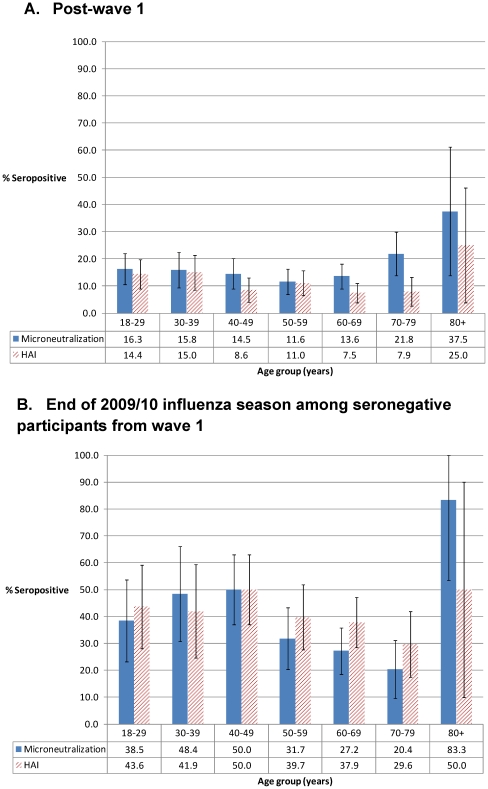
Residual sera from 3375 patients and 1024 prospectively recruited cohort participants were analyzed. Pre-pandemic seroprevalence ranged from 2%-12% across age groups. Overall seropositivity ranged from 10%-19% post-first wave and 32%-41% by the end of the 2009/10 influenza season. Seroprevalence and risk factors differed between MN and HAI assays, particularly in older age groups and between waves. Following the H1N1 vaccination program, higher GMT were noted among vaccinated individuals. Overall, 20-30% of the population was estimated to be infected.
Combining population sources of sera across five time points with prospectively collected epidemiological information yielded a complete description of the evolution of pH1N1 infection.
我们设计了一项血清流行率研究,使用多种检测方法和人群来源,以在疫情被发现之前以及整个大流行期间至 2009/10 流感季结束时,估计 pH1N1/09 的社区血清流行率和感染的危险因素。
纳入了五个时间点(2009 年 1 月至 5 月)的剩余血清标本和前瞻性招募队列的两个时间点的样本。使用逻辑回归对队列中的多变量调整分析探索危险因素的分布。采用血凝抑制(HAI)和微量中和(MN)检测法测定抗体水平。
对 3375 例患者和 1024 例前瞻性招募队列参与者的剩余血清进行了分析。大流行前的血清流行率在各年龄组之间为 2%-12%。首次流行后,总血清阳性率为 10%-19%,2009/10 流感季末为 32%-41%。MN 和 HAI 检测之间的血清阳性率和危险因素存在差异,尤其是在年龄较大的人群和各波次之间。在 H1N1 疫苗接种计划实施后,接种者的 GMT 更高。总体而言,估计有 20%-30%的人口被感染。
将五个时间点的人群血清来源与前瞻性收集的流行病学信息相结合,全面描述了 pH1N1 感染的演变。