Department of Molecular Biology and Functional Genomics, Stockholm University, Stockholm, Sweden.
PLoS One. 2011;6(11):e27434. doi: 10.1371/journal.pone.0027434. Epub 2011 Nov 14.
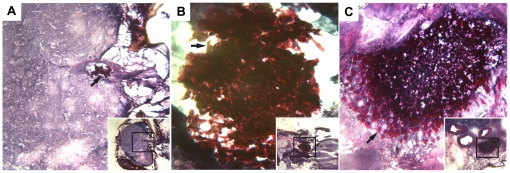
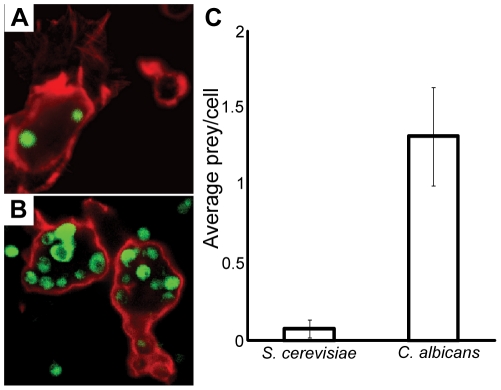
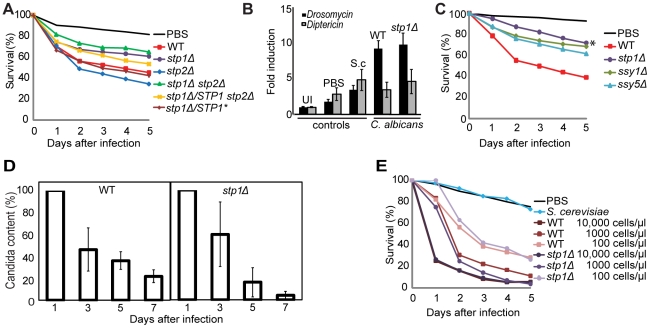
The fungal pathogen Candida albicans is a common cause of opportunistic infections in humans. We report that wild-type Drosophila melanogaster (OrR) flies are susceptible to virulent C. albicans infections and have established experimental conditions that enable OrR flies to serve as model hosts for studying C. albicans virulence. After injection into the thorax, wild-type C. albicans cells disseminate and invade tissues throughout the fly, leading to lethality. Similar to results obtained monitoring systemic infections in mice, well-characterized cph1Δ efg1Δ and csh3Δ fungal mutants exhibit attenuated virulence in flies. Using the OrR fly host model, we assessed the virulence of C. albicans strains individually lacking functional components of the SPS sensing pathway. In response to extracellular amino acids, the plasma membrane localized SPS-sensor (Ssy1, Ptr3, and Ssy5) activates two transcription factors (Stp1 and Stp2) to differentially control two distinct modes of nitrogen acquisition (host protein catabolism and amino acid uptake, respectively). Our results indicate that a functional SPS-sensor and Stp1 controlled genes required for host protein catabolism and utilization, including the major secreted aspartyl protease SAP2, are required to establish virulent infections. By contrast, Stp2, which activates genes required for amino acid uptake, is dispensable for virulence. These results indicate that nutrient availability within infected hosts directly influences C. albicans virulence.
真菌病原体白色念珠菌是人类机会性感染的常见原因。我们报告说,野生型黑腹果蝇(OrR)对强毒白色念珠菌感染敏感,并且已经建立了实验条件,使 OrR 果蝇能够作为研究白色念珠菌毒力的模型宿主。在胸部注射后,野生型白色念珠菌细胞扩散并侵入果蝇的组织,导致死亡。类似于在监测系统性感染的小鼠中获得的结果,经过充分表征的 cph1Δ efg1Δ 和 csh3Δ 真菌突变体在果蝇中表现出减弱的毒力。使用 OrR 果蝇宿主模型,我们评估了单独缺失 SPS 感应途径功能组件的白色念珠菌菌株的毒力。响应细胞外氨基酸,质膜定位的 SPS-传感器(Ssy1、Ptr3 和 Ssy5)激活两个转录因子(Stp1 和 Stp2),以分别控制两种不同的氮获取模式(分别是宿主蛋白分解代谢和氨基酸摄取)。我们的结果表明,功能性 SPS-传感器和 Stp1 控制宿主蛋白分解代谢和利用所需的基因,包括主要分泌的天冬氨酸蛋白酶 SAP2,是建立强毒感染所必需的。相比之下,激活氨基酸摄取所需基因的 Stp2 对于毒力是可有可无的。这些结果表明,感染宿主内的营养物质可用性直接影响白色念珠菌的毒力。