Biology Department, University of Massachusetts, Boston, Massachusetts, United States of America.
PLoS One. 2011;6(11):e27585. doi: 10.1371/journal.pone.0027585. Epub 2011 Nov 15.
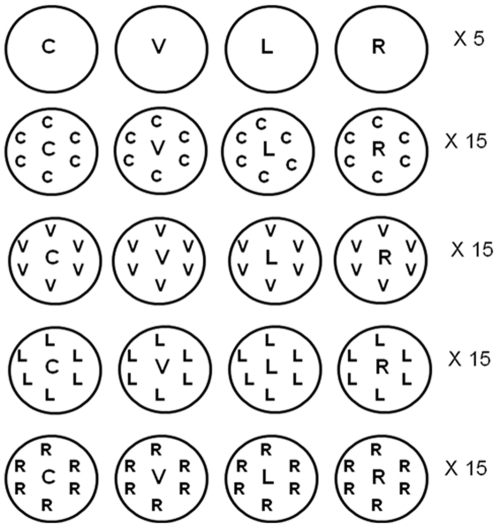
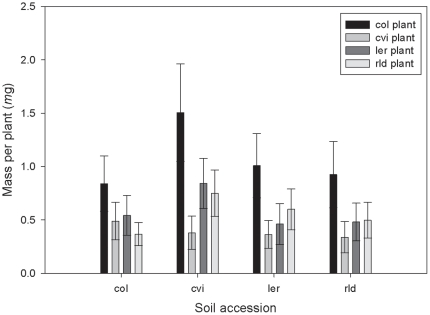
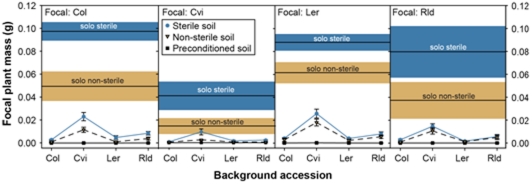
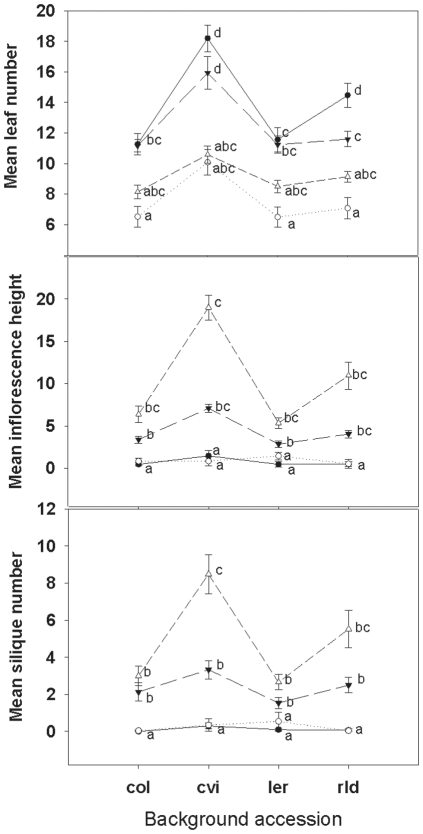
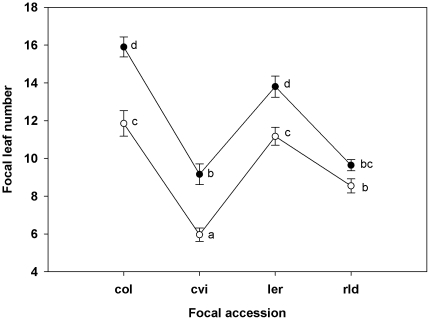
Soil communities associated with specific plant species affect individual plants' growth and competitive ability. Limited evidence suggests that unique soil communities can also differentially influence growth and competition at the ecotype level. Previous work with Arabidopsis thaliana has shown that accessions produce distinct and reproducible rhizosphere bacterial communities, with significant differences in both species composition and relative abundance. We tested the hypothesis that soil communities uniquely affect the growth and reproduction of the plant accessions with which they are associated. Specifically, we examined the growth of four accessions when exposed to their own soil communities and the communities generated by each of the other three accessions. To do this we planted focal accessions inside a ring of six plants that created a "background" soil community. We grew focal plants in this design in three separate soil treatments: non-sterile soil, sterilized soil, and "preconditioned" soil. We preconditioned soil by growing accessions in non-sterile soil for six weeks before the start of the experiment. The main experiment was harvested after seven weeks of growth and we recorded height, silique number, and dry weight of each focal plant. Plants grown in the preconditioned soil treatment showed less growth relative to the non-sterile and sterile soil treatments. In addition, plants in the sterile soil grew larger than those in non-sterile soil. However, we saw no interaction between soil treatment and background accession. We conclude that the soil communities have a negative net impact on Arabidopsis thaliana growth, and that the unique soil communities associated with each accession do not differentially affect growth and competition of study species.
与特定植物物种相关的土壤群落影响个体植物的生长和竞争能力。有限的证据表明,独特的土壤群落也可以在生态型水平上对生长和竞争产生不同的影响。先前对拟南芥的研究表明,不同的品系产生独特且可重复的根际细菌群落,在物种组成和相对丰度上都有显著差异。我们检验了这样一个假设,即土壤群落独特地影响与其相关的植物品系的生长和繁殖。具体来说,我们研究了四个品系在暴露于自身土壤群落和其他三个品系产生的群落时的生长情况。为此,我们将焦点品系种植在一个由六株植物组成的环内,形成了一个“背景”土壤群落。我们在三种不同的土壤处理中种植焦点植物:非无菌土壤、无菌土壤和“预处理”土壤。我们通过在非无菌土壤中种植品系六周来预处理土壤,然后才开始实验。主实验在七周的生长后收获,我们记录了每个焦点植物的高度、角果数量和干重。在预处理土壤处理中生长的植物与非无菌和无菌土壤处理相比,生长情况较差。此外,无菌土壤中生长的植物比非无菌土壤中生长的植物更大。然而,我们没有看到土壤处理和背景品系之间的相互作用。我们的结论是,土壤群落对拟南芥的生长有负面影响,而且与每个品系相关的独特土壤群落不会对研究物种的生长和竞争产生不同的影响。