Institute of Cell Biology and Immunology, University Stuttgart, Stuttgart, Germany.
PLoS One. 2011;6(11):e27621. doi: 10.1371/journal.pone.0027621. Epub 2011 Nov 14.
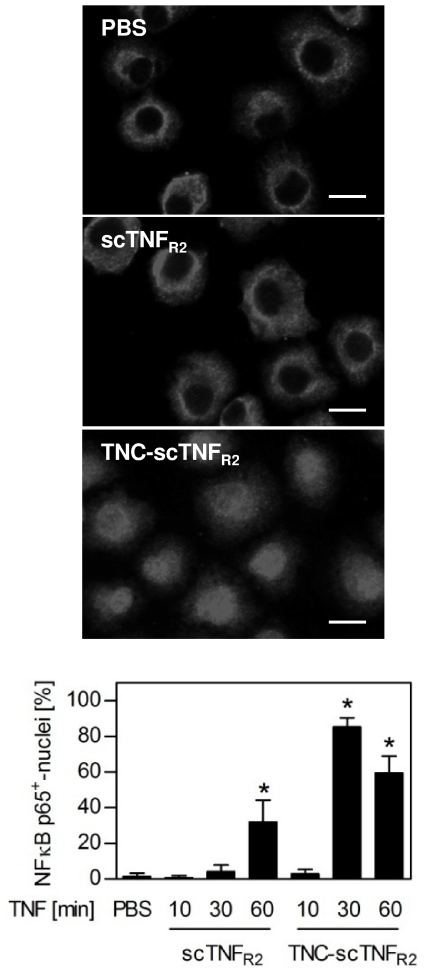
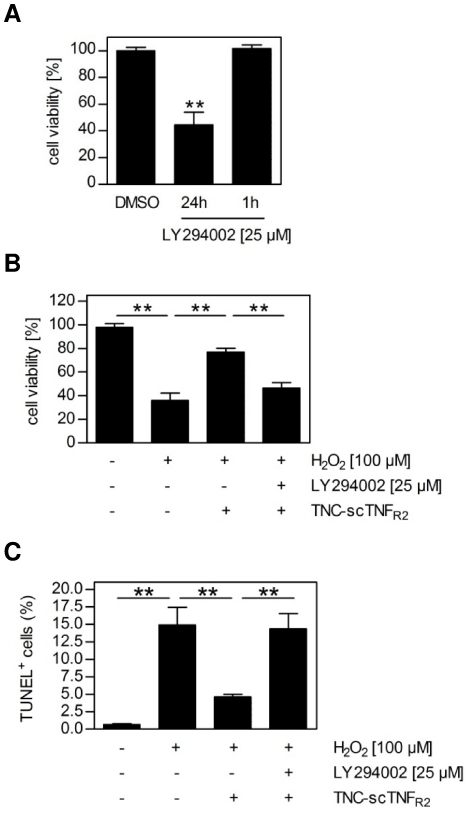
Tumor necrosis factor (TNF) plays a dual role in neurodegenerative diseases. Whereas TNF receptor (TNFR) 1 is predominantly associated with neurodegeneration, TNFR2 is involved in tissue regeneration and neuroprotection. Accordingly, the availability of TNFR2-selective agonists could allow the development of new therapeutic treatments of neurodegenerative diseases. We constructed a soluble, human TNFR2 agonist (TNC-scTNF(R2)) by genetic fusion of the trimerization domain of tenascin C to a TNFR2-selective single-chain TNF molecule, which is comprised of three TNF domains connected by short peptide linkers. TNC-scTNF(R2) specifically activated TNFR2 and possessed membrane-TNF mimetic activity, resulting in TNFR2 signaling complex formation and activation of downstream signaling pathways. Protection from neurodegeneration was assessed using the human dopaminergic neuronal cell line LUHMES. First we show that TNC-scTNF(R2) interfered with cell death pathways subsequent to H(2)O(2) exposure. Protection from cell death was dependent on TNFR2 activation of the PI3K-PKB/Akt pathway, evident from restoration of H(2)O(2) sensitivity in the presence of PI3K inhibitor LY294002. Second, in an in vitro model of Parkinson disease, TNC-scTNF(R2) rescues neurons after induction of cell death by 6-OHDA. Since TNFR2 is not only promoting anti-apoptotic responses but also plays an important role in tissue regeneration, activation of TNFR2 signaling by TNC-scTNF(R2) appears a promising strategy to ameliorate neurodegenerative processes.
肿瘤坏死因子 (TNF) 在神经退行性疾病中发挥双重作用。TNF 受体 (TNFR)1 主要与神经退行性变有关,而 TNFR2 则参与组织再生和神经保护。因此,开发 TNFR2 选择性激动剂可能为神经退行性疾病的治疗提供新的策略。我们通过将 tenascin C 的三聚体结构域与 TNFR2 选择性单链 TNF 分子融合,构建了一种可溶性的人 TNFR2 激动剂 (TNC-scTNF(R2))。该单链 TNF 分子由三个 TNF 结构域通过短肽接头连接而成。TNC-scTNF(R2) 特异性激活 TNFR2,并具有膜 TNF 模拟活性,导致 TNFR2 信号复合物的形成和下游信号通路的激活。我们使用人多巴胺能神经元细胞系 LUHMES 评估了神经退行性变的保护作用。首先,我们发现 TNC-scTNF(R2) 可干扰 H2O2 暴露后细胞死亡途径。TNFR2 通过激活 PI3K-PKB/Akt 通路对细胞死亡的保护作用,可通过在存在 PI3K 抑制剂 LY294002 的情况下恢复 H2O2 敏感性得到证明。其次,在 6-OHDA 诱导细胞死亡的体外帕金森病模型中,TNC-scTNF(R2) 可挽救神经元。由于 TNFR2 不仅促进抗凋亡反应,而且在组织再生中也发挥重要作用,因此 TNC-scTNF(R2) 激活 TNFR2 信号似乎是改善神经退行性过程的一种有前途的策略。