McCoy Melissa K, Tansey Malú G
Department of Physiology, The University of Texas Southwestern Medical Center at Dallas, Dallas, TX 75390-9040, USA.
J Neuroinflammation. 2008 Oct 17;5:45. doi: 10.1186/1742-2094-5-45.
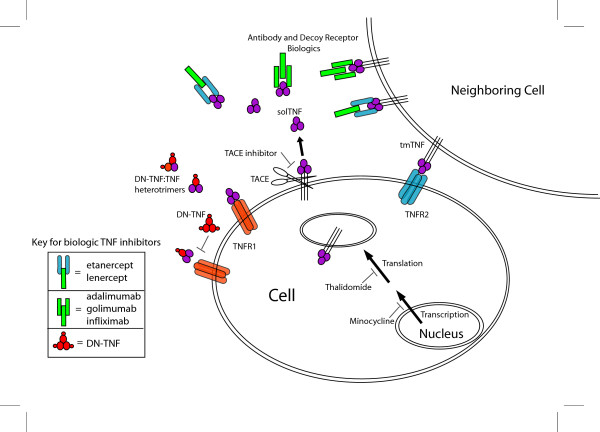
The role of tumor necrosis factor (TNF) as an immune mediator has long been appreciated but its function in the brain is still unclear. TNF receptor 1 (TNFR1) is expressed in most cell types, and can be activated by binding of either soluble TNF (solTNF) or transmembrane TNF (tmTNF), with a preference for solTNF; whereas TNFR2 is expressed primarily by microglia and endothelial cells and is preferentially activated by tmTNF. Elevation of solTNF is a hallmark of acute and chronic neuroinflammation as well as a number of neurodegenerative conditions including ischemic stroke, Alzheimer's (AD), Parkinson's (PD), amyotrophic lateral sclerosis (ALS), and multiple sclerosis (MS). The presence of this potent inflammatory factor at sites of injury implicates it as a mediator of neuronal damage and disease pathogenesis, making TNF an attractive target for therapeutic development to treat acute and chronic neurodegenerative conditions. However, new and old observations from animal models and clinical trials reviewed here suggest solTNF and tmTNF exert different functions under normal and pathological conditions in the CNS. A potential role for TNF in synaptic scaling and hippocampal neurogenesis demonstrated by recent studies suggest additional in-depth mechanistic studies are warranted to delineate the distinct functions of the two TNF ligands in different parts of the brain prior to large-scale development of anti-TNF therapies in the CNS. If inactivation of TNF-dependent inflammation in the brain is warranted by additional pre-clinical studies, selective targeting of TNFR1-mediated signaling while sparing TNFR2 activation may lessen adverse effects of anti-TNF therapies in the CNS.
肿瘤坏死因子(TNF)作为一种免疫介质的作用早已为人所知,但其在大脑中的功能仍不清楚。TNF受体1(TNFR1)在大多数细胞类型中表达,可通过可溶性TNF(solTNF)或跨膜TNF(tmTNF)的结合而激活,其中更倾向于solTNF;而TNFR2主要由小胶质细胞和内皮细胞表达,并且优先被tmTNF激活。solTNF升高是急性和慢性神经炎症以及包括缺血性中风、阿尔茨海默病(AD)、帕金森病(PD)、肌萎缩侧索硬化症(ALS)和多发性硬化症(MS)在内的多种神经退行性疾病的一个标志。这种强效炎症因子在损伤部位的存在表明它是神经元损伤和疾病发病机制的介质,这使得TNF成为治疗急性和慢性神经退行性疾病的有吸引力的治疗开发靶点。然而,本文综述的来自动物模型和临床试验的新老观察结果表明,solTNF和tmTNF在中枢神经系统的正常和病理条件下发挥不同的功能。最近的研究表明TNF在突触缩放和海马神经发生中具有潜在作用,这表明在中枢神经系统抗TNF疗法大规模开发之前,有必要进行更多深入的机制研究来阐明这两种TNF配体在大脑不同部位的不同功能。如果更多的临床前研究证明有必要使大脑中依赖TNF的炎症失活,那么在保留TNFR2激活的同时选择性靶向TNFR1介导的信号传导可能会减轻抗TNF疗法在中枢神经系统中的不良反应。