Graduate School of Materials Science, Nara Institute of Science and Technology, Ikoma, Nara, Japan.
PLoS One. 2011;6(11):e27677. doi: 10.1371/journal.pone.0027677. Epub 2011 Nov 16.
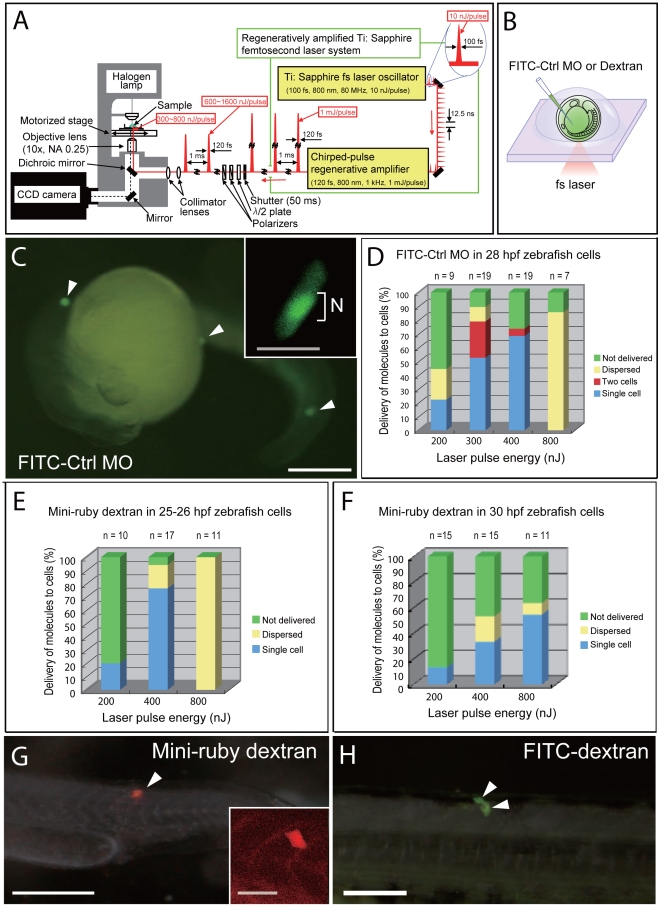
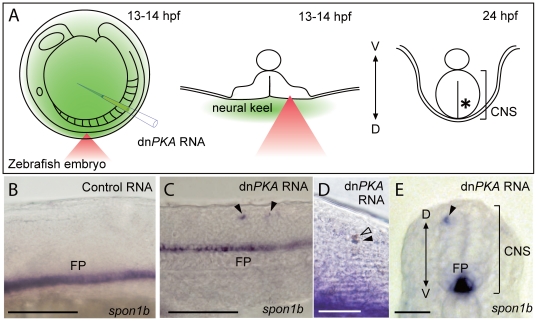
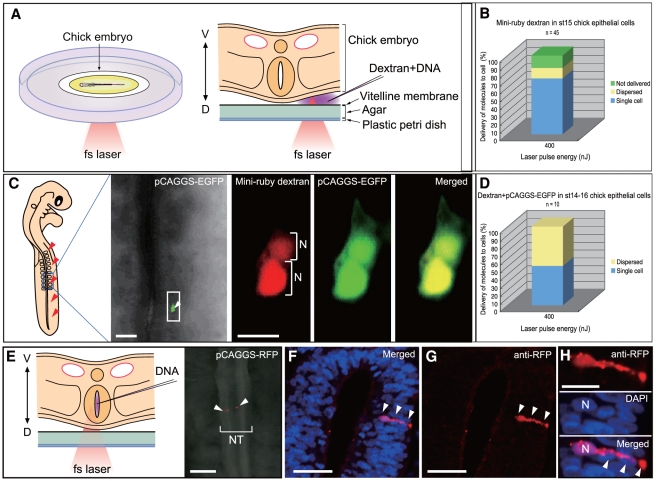
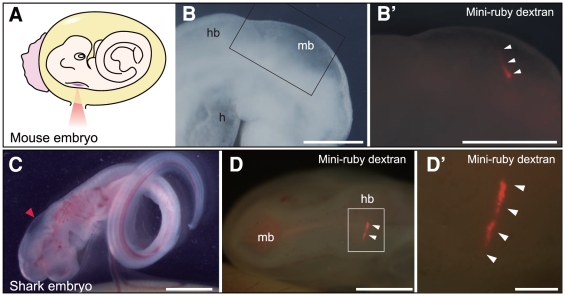
Introduction of biomolecules into cells in living animals is one of the most important techniques in molecular and developmental biology research, and has potentially broad biomedical implications. Here we report that biomolecules can be introduced into single cells in living vertebrate embryos by photoporation using a femtosecond laser amplifier with a high pulse energy and a low repetition rate. First, we confirmed the efficiency of this photoporation technique by introducing dextran, morpholino oligonucleotides, or DNA plasmids into targeted single cells of zebrafish, chick, shark, and mouse embryos. Second, we demonstrated that femtosecond laser irradiation efficiently delivered DNA plasmids into single neurons of chick embryos. Finally, we successfully manipulated the fate of single neurons in zebrafish embryos by delivering mRNA. Our observations suggest that photoporation using a femtosecond laser with a high pulse energy and low repetition rate offers a novel way to manipulate the function(s) of individual cells in a wide range of vertebrate embryos by introduction of selected biomolecules.
将生物分子导入活体动物细胞是分子和发育生物学研究中最重要的技术之一,具有广泛的潜在生物医学意义。在这里,我们报告说,通过使用具有高脉冲能量和低重复率的飞秒激光放大器对活体脊椎动物胚胎中的单个细胞进行光穿孔,可以将生物分子导入单个细胞。首先,我们通过将葡聚糖、吗啉代寡核苷酸或 DNA 质粒导入斑马鱼、鸡、鲨鱼和小鼠胚胎的目标单个细胞,证实了这种光穿孔技术的效率。其次,我们证明飞秒激光照射可有效地将 DNA 质粒导入鸡胚的单个神经元。最后,我们通过递送 mRNA 成功地操纵了斑马鱼胚胎中单神经元的命运。我们的观察结果表明,使用具有高脉冲能量和低重复率的飞秒激光进行光穿孔,为通过导入选定的生物分子来操纵广泛的脊椎动物胚胎中单个细胞的功能提供了一种新方法。