Centro de Investigación en Enfermedades Infecciosas, Instituto Nacional de Enfermedades Respiratorias, Mexico City, Mexico.
PLoS One. 2011;6(11):e27812. doi: 10.1371/journal.pone.0027812. Epub 2011 Nov 15.
Transmitted drug resistance (TDR) remains an important concern for the management of HIV infection, especially in countries that have recently scaled-up antiretroviral treatment (ART) access.
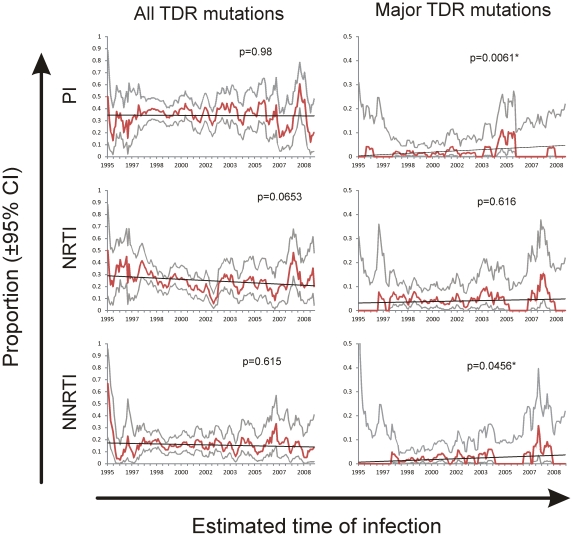
METHODOLOGY/PRINCIPAL FINDINGS: We designed a study to assess HIV diversity and transmitted drug resistance (TDR) prevalence and trends in Mexico. 1655 ART-naïve patients from 12 Mexican states were enrolled from 2005 to 2010. TDR was assessed from plasma HIV pol sequences using Stanford scores and the WHO TDR surveillance mutation list. TDR prevalence fluctuations over back-projected dates of infection were tested. HIV subtype B was highly prevalent in Mexico (99.9%). TDR prevalence (Stanford score>15) in the country for the study period was 7.4% (95% CI, 6.2∶8.8) and 6.8% (95% CI, 5.7∶8.2) based on the WHO TDR surveillance mutation list. NRTI TDR was the highest (4.2%), followed by NNRTI (2.5%) and PI (1.7%) TDR. Increasing trends for NNRTI (p = 0.0456) and PI (p = 0.0061) major TDR mutations were observed at the national level. Clustering of viruses containing minor TDR mutations was observed with some apparent transmission pairs and geographical effects.
TDR prevalence in Mexico remains at the intermediate level and is slightly lower than that observed in industrialized countries. Whether regional variations in TDR trends are associated with differences in antiretroviral drug usage/ART efficacy or with local features of viral evolution remains to be further addressed.
传播性耐药(TDR)仍然是 HIV 感染管理的一个重要关注点,特别是在最近扩大抗逆转录病毒治疗(ART)可及性的国家。
方法/主要发现:我们设计了一项研究,以评估墨西哥的 HIV 多样性和传播性耐药(TDR)的流行率和趋势。1655 名来自墨西哥 12 个州的 ART 初治患者于 2005 年至 2010 年期间入组。使用斯坦福评分和世卫组织 TDR 监测突变列表,从血浆 HIV pol 序列评估 TDR。测试了 TDR 流行率在感染回溯日期的波动情况。HIV 亚型 B 在墨西哥高度流行(99.9%)。在研究期间,该国的 TDR 流行率(斯坦福评分>15)根据世卫组织 TDR 监测突变列表,分别为 7.4%(95%CI,6.2∶8.8)和 6.8%(95%CI,5.7∶8.2)。NRTI TDR 最高(4.2%),其次是 NNRTI(2.5%)和 PI(1.7%)TDR。在全国范围内,NNRTI(p=0.0456)和 PI(p=0.0061)主要 TDR 突变的上升趋势观察到。含有次要 TDR 突变的病毒聚类与一些明显的传播对和地理效应有关。
墨西哥的 TDR 流行率仍处于中等水平,略低于工业化国家。TDR 趋势的区域差异是否与抗逆转录病毒药物使用/ART 疗效的差异有关,或者与病毒进化的当地特征有关,仍有待进一步解决。