Department of Anesthesiology and Pain Medicine, School of Medicine, Chosun University, Gwangju, Korea.
Korean J Anesthesiol. 2011 Oct;61(4):302-7. doi: 10.4097/kjae.2011.61.4.302. Epub 2011 Oct 22.
During general anesthesia, core temperature decreases, largely due to heat loss caused by peripheral vasodilation, resulting in heat redistribution to peripheral tissues. Multiple factors contribute to body temperature regulation during general anesthesia. It was reported that baroreceptor unloading by positive end-expiratory pressure (PEEP) attenuates anesthetically-induced hypothermia. So, we evaluated the effects of PEEP on thermoregulatory responses during total intravenous anesthesia (TIVA).
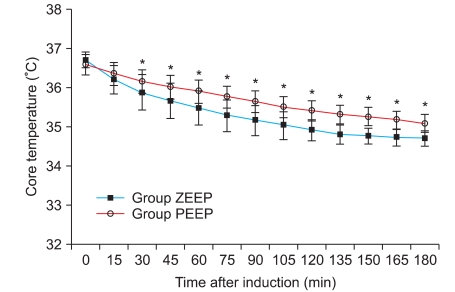
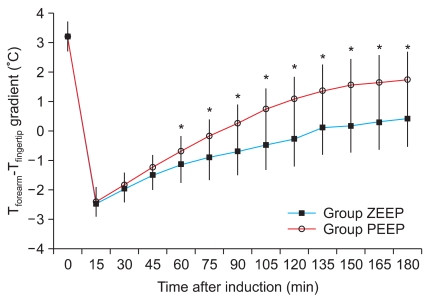
Forty healthy patients scheduled for tympanoplasty were allocated two groups, Group ZEEP (zero end-expiratory pressure, n = 20) and Group PEEP (PEEP application of 5 cmH(2)O, n = 20). Ambient temperature was maintained at 22-24℃, and anesthesia was induced and maintained with propofol-remifentanil. The core temperature and the temperature difference between forearm and fingertip skin were monitored before and after the induction of general anesthesia having a duration of 180 minutes.
The core temperature gradient (Ti-Tf) was higher in patients with ZEEP than with PEEP. The core temperature was maintained at a higher level in patients with PEEP. Additionally, the vasoconstriction threshold was higher in patients with PEEP.
It seems that PEEP attenuates anesthetically-induced hypothermia during TIVA.
在全身麻醉期间,核心体温会下降,主要是由于外周血管扩张导致的热量损失,从而导致热量重新分布到外周组织。在全身麻醉期间,有多种因素会影响体温调节。有报道称,正呼气末压(PEEP)通过对压力感受器的卸载作用减轻麻醉引起的体温过低。因此,我们评估了 PEEP 对全静脉麻醉(TIVA)期间体温调节反应的影响。
40 名拟行鼓室成形术的健康患者被分为两组,ZEEP 组(零呼气末压,n = 20)和 PEEP 组(PEEP 应用 5 cmH₂O,n = 20)。环境温度保持在 22-24℃,用丙泊酚-瑞芬太尼诱导和维持麻醉。在全身麻醉诱导后 180 分钟内监测核心温度和前臂与指尖皮肤之间的温度差。
ZEEP 组患者的核心温度梯度(Ti-Tf)高于 PEEP 组。PEEP 组患者的核心温度维持在较高水平。此外,PEEP 组患者的血管收缩阈值较高。
PEEP 似乎可以减轻 TIVA 期间麻醉引起的体温过低。