Department of Anaesthesiology and Pain Medicine, Konyang University Hospital, Konyang University Myunggok Medical Research Institute, Konyang University College of Medicine, Daejeon, Republic of Korea.
Department of Anaesthesiology and Pain Medicine, Konyang University Hospital, Konyang University College of Medicine, Daejeon, Republic of Korea.
Int J Med Sci. 2024 Sep 30;21(13):2510-2517. doi: 10.7150/ijms.100262. eCollection 2024.
Remimazolam is an ultrashort-acting benzodiazepine that is increasingly used for its efficacy in anesthesia induction and maintenance. However, limited research has explored its impact on intraoperative hypothermia compared to that of traditional inhalation anesthetics. This study aimed to compare the incidence of hypothermia during endoscopic nasal surgery when using remimazolam for maintenance anesthesia versus using inhalation anesthetics.
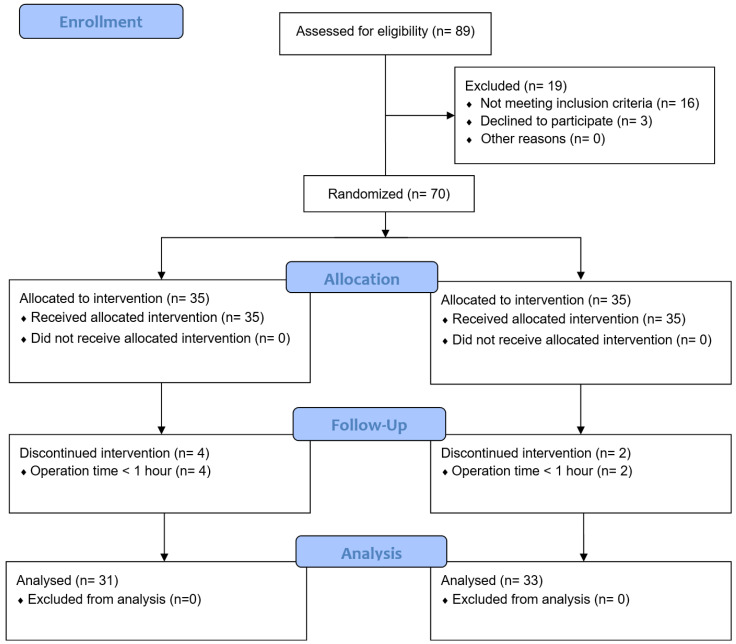
This prospective study included 70 patients who underwent endoscopic nasal surgery under general anesthesia. The patients were randomly assigned to one of two groups: the inhalation anesthetic (IA) group (n=35), in which desflurane and nitrous oxide were administered, and the remimazolam (R) group (n=35), in which remimazolam and remifentanil were administered for anesthesia maintenance. The primary outcome was the incidence of intraoperative hypothermia, defined as an esophageal temperature below 36 °C during anesthesia.
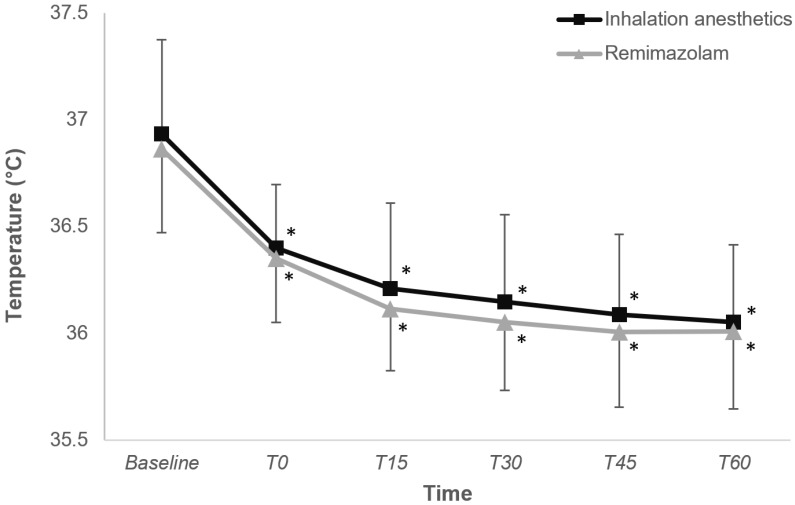
The incidence of intraoperative hypothermia was significantly higher in the R group than in the IA group (P = 0.014). Furthermore, the temperature at the end of the surgery was significantly lower in the R group than in the IA group (P = 0.006). Additionally, the use of warming devices after surgery was more frequent in the R group than in the IA group (P = 0.047).
These findings suggest that the use of remimazolam for maintenance anesthesia during endoscopic nasal surgery increases the risk of intraoperative hypothermia compared to the use of inhalation anesthetics. This highlights the importance of temperature monitoring in patients receiving remimazolam to minimize the adverse outcomes associated with hypothermia during surgery.
雷米唑仑是一种超短效苯二氮䓬类药物,因其在麻醉诱导和维持中的功效而被越来越多地应用。然而,与传统吸入麻醉剂相比,其对术中低体温影响的研究有限。本研究旨在比较雷米唑仑维持麻醉与吸入麻醉用于内镜鼻窦手术时术中低体温的发生率。
这是一项前瞻性研究,纳入了 70 例行全身麻醉下内镜鼻窦手术的患者。患者被随机分配至两组:吸入麻醉剂(IA)组(n=35),给予地氟烷和氧化亚氮;雷米唑仑(R)组(n=35),给予雷米唑仑和瑞芬太尼维持麻醉。主要结局是术中低体温的发生率,定义为麻醉期间食管温度低于 36°C。
R 组术中低体温的发生率明显高于 IA 组(P=0.014)。此外,R 组手术结束时的体温明显低于 IA 组(P=0.006)。此外,R 组术后使用升温设备的频率明显高于 IA 组(P=0.047)。
这些发现表明,与吸入麻醉剂相比,雷米唑仑用于内镜鼻窦手术的维持麻醉会增加术中低体温的风险。这强调了在接受雷米唑仑治疗的患者中进行体温监测的重要性,以尽量减少手术期间低体温相关的不良结局。