Royal Veterinary College, North Mymms, Hatfield, UK.
BMC Vet Res. 2011 Nov 23;7:74. doi: 10.1186/1746-6148-7-74.
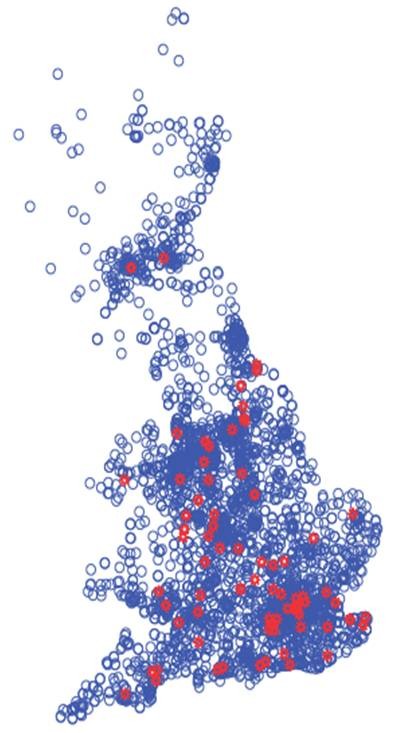
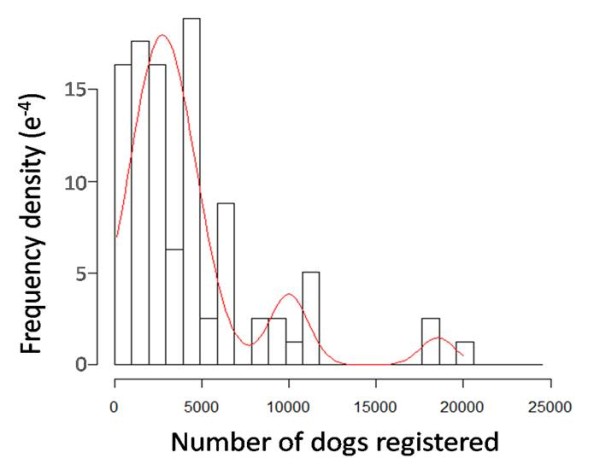
Current estimates of the UK dog population vary, contain potential sources of bias and are based on expensive, large scale, public surveys. Here, we evaluate the potential of a variety of sources for estimation and monitoring of the companion dog population in the UK and associated demographic information. The sources considered were: a public survey; veterinary practices; pet insurance companies; micro-chip records; Kennel Club registrations; and the Pet Travel Scheme. The public survey and subpopulation estimates from veterinary practices, pet insurance companies and Kennel Club registrations, were combined to generate distinct estimates of the UK owned dog population using a Bayesian approach.
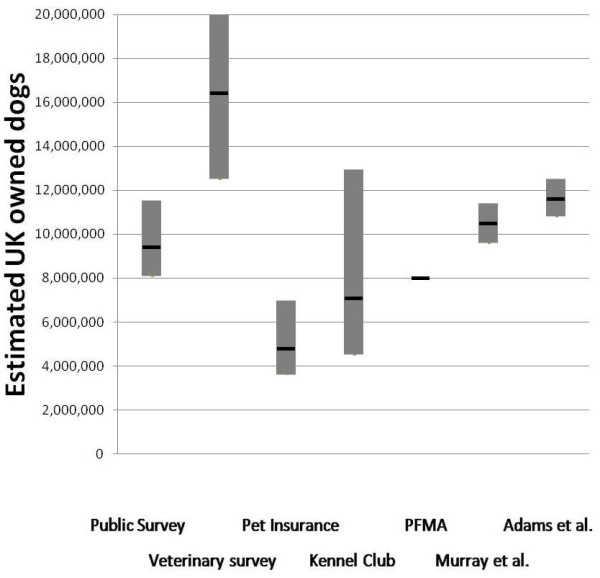
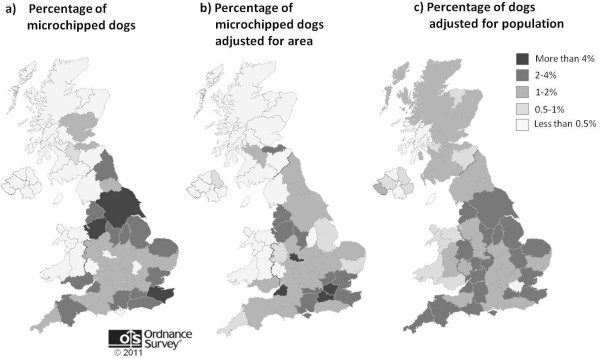
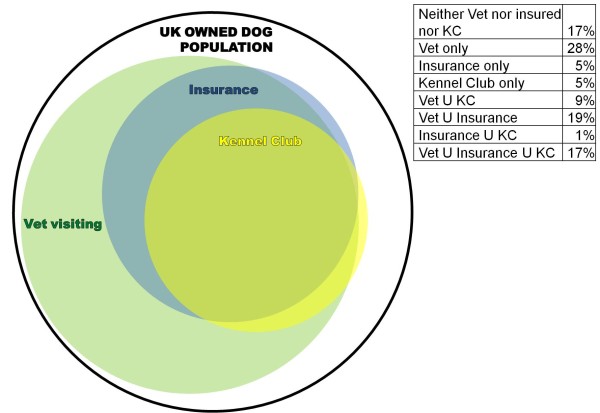
We estimated there are 9.4 (95% CI: 8.1-11.5) million companion dogs in the UK according to the public survey alone, which is similar to other recent estimates. The population was judged to be over-estimated by combining the public and veterinary surveys (16.4, 95% CI: 12.5-21.5 million) and under-estimated by combining the public survey and insured dog numbers (4.8, 95% CI: 3.6-6.9 million). An estimate based on combining the public survey and Kennel Club registered dogs was 7.1 (95% CI: 4.5-12.9) million. Based on Bayesian estimations, 77 (95% CI: 62-92)% of the UK dog population were registered at a veterinary practice; 42 (95% CI: 29-55)% of dogs were insured; and 29 (95% CI: 17-43)% of dogs were Kennel Club registered. Breed demographics suggested the Labrador was consistently the most popular breed registered in micro-chip records, with the Kennel Club and with J. Sainsbury's PLC pet insurance. A comparison of the demographics between these sources suggested that popular working breeds were under-represented and certain toy, utility and miniature breeds were over- represented in the Kennel Club registrations. Density maps were produced from micro-chip records based on the geographical distribution of dogs.
A list containing the breed of each insured dog was provided by J. Sainsbury's PLC pet insurance without any accompanying information about the dog or owner.
目前英国狗的数量估计存在差异,其中包含潜在的偏差来源,且这些估计是基于昂贵的大规模公共调查得出的。在这里,我们评估了各种来源在英国对伴侣犬数量及其相关人口统计信息进行估计和监测的潜力。考虑的来源包括:公众调查;兽医诊所;宠物保险公司;微芯片记录;英国养犬俱乐部注册;以及宠物旅行计划。使用贝叶斯方法,我们将公众调查和兽医诊所、宠物保险公司和英国养犬俱乐部注册的亚人群体估计值相结合,生成了英国拥有的犬类数量的不同估计值。
仅根据公众调查,我们估计英国有 940 万(95%置信区间:810 万至 1150 万)只伴侣犬,这与其他最近的估计值相似。将公众调查和兽医调查相结合,认为该种群被高估了(1640 万,95%置信区间:1250 万至 2150 万),而将公众调查和受保犬只数量相结合,则被低估了(480 万,95%置信区间:360 万至 690 万)。基于公众调查和英国养犬俱乐部注册犬只的估计值为 710 万(95%置信区间:450 万至 1290 万)。基于贝叶斯估计,77%(95%置信区间:62%至 92%)的英国犬只在兽医诊所注册;42%(95%置信区间:29%至 55%)的犬只投保;29%(95%置信区间:17%至 43%)的犬只在英国养犬俱乐部注册。品种人口统计数据表明,拉布拉多犬在微芯片记录、英国养犬俱乐部和 J. Sainsbury's PLC 宠物保险中一直是最受欢迎的注册品种。这些来源之间的人口统计数据比较表明,受欢迎的工作品种代表性不足,某些玩具、实用和小型品种在英国养犬俱乐部注册中代表性过高。根据犬只的地理分布,从微芯片记录中生成了密度图。
J. Sainsbury's PLC 宠物保险提供了一份包含每只受保犬只品种的清单,但没有任何关于犬只或主人的附加信息。