Wellness Institute, Cleveland Clinic, 1950 Richmond Road, TR2-341, Lyndhurst, OH 44124, USA.
Nutr Metab (Lond). 2011 Nov 23;8:83. doi: 10.1186/1743-7075-8-83.
Poor lifestyle choices are key in development and progression of preventable chronic diseases. The purpose of the study was to design and test a program to mitigate the physical and fiscal consequences of chronic diseases.
Here we report the outcomes for 429 participants with one or more chronic conditions, including obesity, hypertension, hyperlipidemia and diabetes mellitus, many of whom had failed traditional disease management programs, who enrolled into a comprehensive lifestyle intervention. The Lifestyle 180 program integrates nutrition, physical activity and stress management interventions and was conducted at the Wellness Institute of the Cleveland Clinic, United States. An intensive 6 week immersion course, with 8 hours of group instruction per week, was followed by 3 follow-up, 4 hour-long sessions over the course of 6 months.
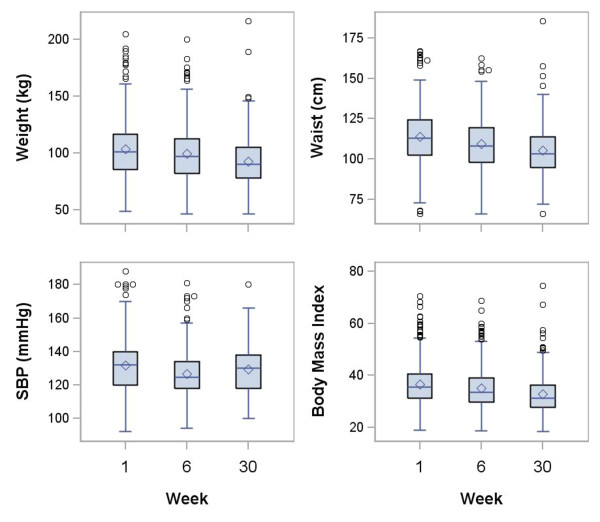
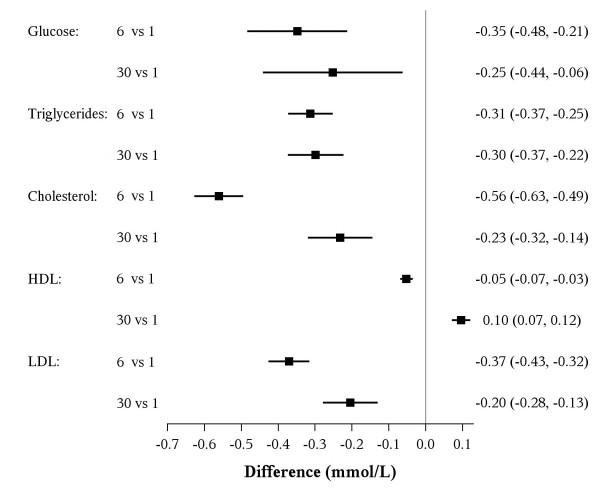
Changes in biometric (weight, height, waist circumference, resting heart rate and blood pressure) and laboratory variables (fasting lipid panel, blood glucose, insulin, hemoglobin A1c, ultra sensitive C-reactive protein) at 6 months were compared with baseline (pre-post analysis). At week 30, biometric and laboratory data were available for 244 (57%) and 299 (70%) participants, respectively. These had a mean ± SD reduction in weight (6.8 ± 6.9 kg, P < 0.001), waist circumference (6.1 ± 7.3 cm, P < 0.001), glucose (4.5 ± 29.6 mg/dL or 0.25 ± 1.64 mmol/L, P = 0.009), triglycerides (26.4 ± 58.5 mg/dL or 0.30 ± 0.66 mmol/L, P < 0.001), low-density lipoprotein cholesterol (LDL) (7.9 ± 25.1 mg/dL or 0.2 ± 0.65 mmol/L, P < 0.001), hemoglobin A1c (HgbA1c) (0.20 ± 0.64%, P = 0.001), insulin (3.8 ± 11 microU/ml or 26.6 ± 76.4 ρmol, P < 0.001) and ultra sensitive C-reactive protein (US - CRP) (0.9 ± 4.8 mg/dL or 7.3 ± 40.2 nmol/L, P = 0.012), an increase in mean high-density lipoprotein cholesterol (HDL) (3.7 ± 8.4 mg/dL or 0.1 ± 0.22, P < 0.001), and decreased use of medications.
Implementation of a comprehensive lifestyle modification program among adults with common chronic conditions results in significant and clinically meaningful improvements in biometric and laboratory outcomes after 6 months.
不良生活方式选择是导致可预防的慢性疾病发生和进展的关键因素。本研究旨在设计并测试一种方案,以减轻慢性疾病的身体和经济后果。
在这里,我们报告了 429 名患有一种或多种慢性疾病(包括肥胖症、高血压、高血脂和糖尿病)的参与者的结果,其中许多人未能通过传统疾病管理计划,他们参加了全面的生活方式干预。生活方式 180 计划整合了营养、身体活动和压力管理干预措施,并在美国克利夫兰诊所的健康研究所进行。一个为期 6 周的密集浸入式课程,每周有 8 小时的小组指导,随后是 3 次随访,每次 4 小时,持续 6 个月。
在 6 个月时,与基线(前后分析)相比,生物标志物(体重、身高、腰围、静息心率和血压)和实验室变量(空腹血脂谱、血糖、胰岛素、糖化血红蛋白、超敏 C 反应蛋白)的变化。在第 30 周时,有 244 名(57%)和 299 名(70%)参与者分别获得了生物标志物和实验室数据。这些人的体重(6.8 ± 6.9 公斤,P < 0.001)、腰围(6.1 ± 7.3 厘米,P < 0.001)、血糖(4.5 ± 29.6 毫克/分升或 0.25 ± 1.64 毫摩尔/升,P = 0.009)、甘油三酯(26.4 ± 58.5 毫克/分升或 0.30 ± 0.66 毫摩尔/升,P < 0.001)、低密度脂蛋白胆固醇(LDL)(7.9 ± 25.1 毫克/分升或 0.2 ± 0.65 毫摩尔/升,P < 0.001)、糖化血红蛋白(HgbA1c)(0.20 ± 0.64%,P = 0.001)、胰岛素(3.8 ± 11 微单位/毫升或 26.6 ± 76.4 皮摩尔,P < 0.001)和超敏 C 反应蛋白(US-CRP)(0.9 ± 4.8 毫克/分升或 7.3 ± 40.2 纳摩尔/升,P = 0.012)的平均值增加,高密度脂蛋白胆固醇(HDL)(3.7 ± 8.4 毫克/分升或 0.1 ± 0.22,P < 0.001)的平均值增加,以及药物使用减少。
在患有常见慢性疾病的成年人中实施全面的生活方式改变方案可在 6 个月后显著改善生物标志物和实验室结果,并具有临床意义。