Faculty of Medicine and Health Sciences, University of East Anglia, Norwich Research Park, Norwich, Norfolk, NR4 7TJ, UK.
Trials. 2011 Nov 28;12:251. doi: 10.1186/1745-6215-12-251.
Pharmacological intervention is essential for managing the symptoms of Parkinson's disease. Adherence to medication regimens however is a major problem. Poor adherence leads to significant motor deterioration and inadequate symptom control. This results in poor quality of life. Whilst interventions to improve medication adherence have shown considerable benefit in other chronic conditions, the efficacy of such treatments in Parkinson's disease is less well researched. Many people with Parkinson's disease require substantial support from spouse/caregivers. This often extends to medication taking. Consequently, spouse/caregiver's support for timely medication management is paramount. We aim to investigate the benefit of a novel intervention, Carer Assisted Adherence Therapy, for improving medication adherence and quality of life in people with Parkinson's disease. Adherence therapy may help to optimise the efficacy of anti-parkinsonian agents, subsequently improving clinical outcomes.
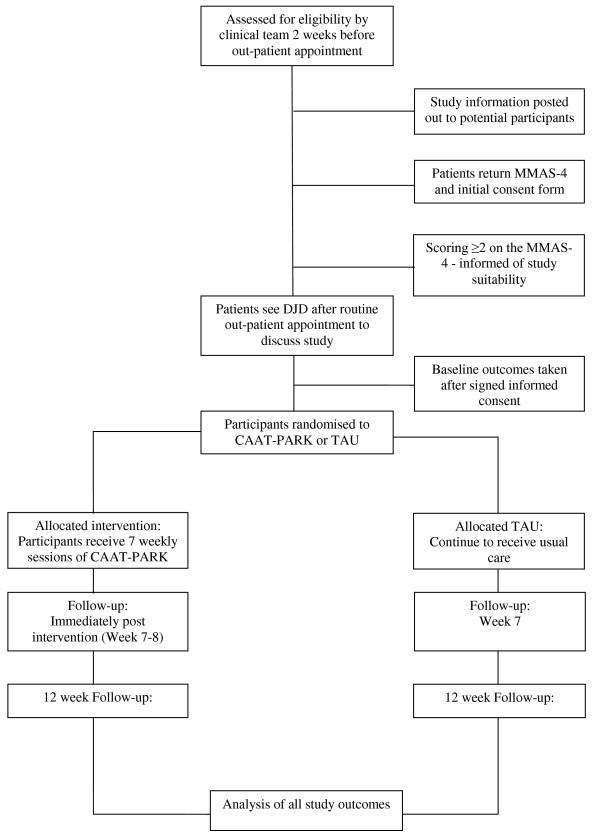
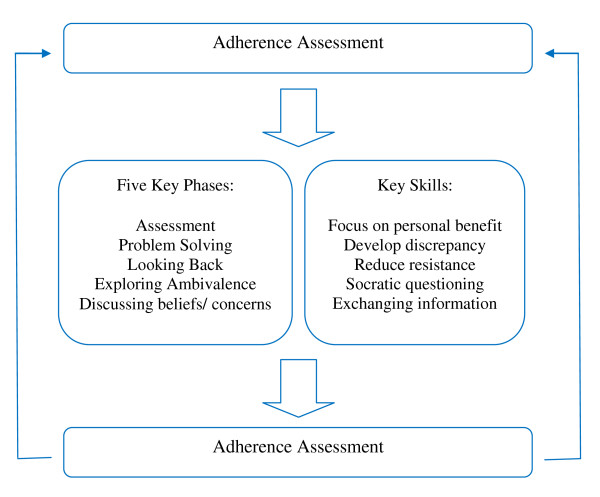
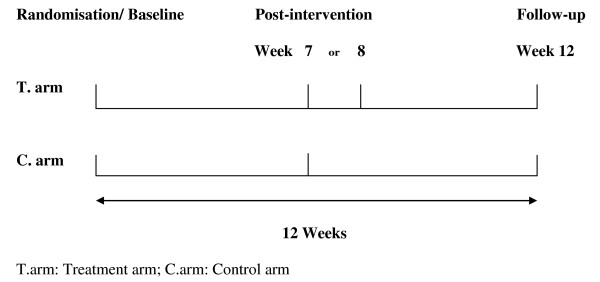
METHODS/DESIGN: A parallel, randomised controlled trial will be conducted to investigate whether carer assisted adherence therapy is effective for improving medication adherence and quality of life. We aim to recruit 40 patient/carer pairs into each group. Participants will be randomly assigned by the Clinical Research Trials Unit at the University of East Anglia. Adherence therapy is a brief cognitive-behavioural approach aimed at facilitating a process of shared decision making. The central theory is that when patients make shared choices with a professional they are more likely to continue with those choices because they are personally owned and meaningful. Outcomes will be rates of adherence and quality of life, determined by the Morisky Medication Adherence Scale-4 and the Parkinson's disease Questionnaire-39 respectively. Assessments will take place post randomisation, immediately post intervention and 12-weeks post randomisation. Primary outcomes are adherence and quality of life at 12-week follow-up. Efficacy will be determined using intention-to-treat analysis. Independent samples t-tests will compare mean changes between groups from baseline to follow-up. Per protocol analysis will be conducted based on individuals with no major protocol deviation. Where imbalances in baseline characteristics are identified, an adjusted analysis will be performed using a regression model. Analysis will be masked to treatment allocation.
ISRCTN: ISRCTN07830951.
药物干预对于管理帕金森病的症状至关重要。然而,患者对药物治疗方案的遵从性是一个主要问题。不遵从药物治疗会导致显著的运动恶化和症状控制不足,从而导致生活质量下降。虽然改善药物遵从性的干预措施在其他慢性疾病中显示出了相当大的益处,但这些治疗方法在帕金森病中的疗效研究较少。许多帕金森病患者需要配偶/照顾者提供大量支持。这通常包括药物服用。因此,配偶/照顾者及时进行药物管理的支持至关重要。我们旨在研究一种新的干预措施,即照顾者辅助遵从性治疗,以改善帕金森病患者的药物遵从性和生活质量。遵从性治疗可能有助于优化抗帕金森药物的疗效,从而改善临床结果。
方法/设计:将进行一项平行、随机对照试验,以研究照顾者辅助遵从性治疗是否能有效提高药物遵从性和生活质量。我们旨在每个组中招募 40 对患者/照顾者。参与者将通过东安格利亚大学的临床研究试验单位随机分配。遵从性治疗是一种简短的认知行为方法,旨在促进共同决策的过程。其核心理论是,当患者与专业人员共同做出选择时,他们更有可能继续这些选择,因为这些选择是他们自己拥有和有意义的。通过 Morisky 药物依从性量表-4 和帕金森病问卷-39 分别确定依从率和生活质量。评估将在随机分组后、干预后立即和随机分组后 12 周进行。主要结局是 12 周随访时的依从性和生活质量。使用意向治疗分析确定疗效。使用独立样本 t 检验比较组间从基线到随访的平均变化。基于无主要方案偏差的个体进行方案依从性分析。如果发现基线特征存在不平衡,将使用回归模型进行调整分析。分析将对治疗分配进行盲法。
ISRCTN:ISRCTN07830951。