Quantitative Imaging Center, Department of Radiology, Boston University School of Medicine, 820 Harrison Avenue, FGH Building, 3rd Floor, Boston, MA 02118, USA.
Arthritis Res Ther. 2011;13(6):247. doi: 10.1186/ar3488. Epub 2011 Nov 24.
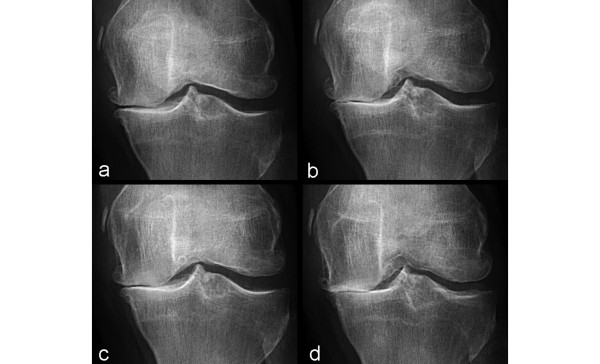
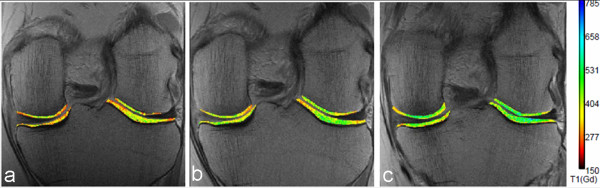
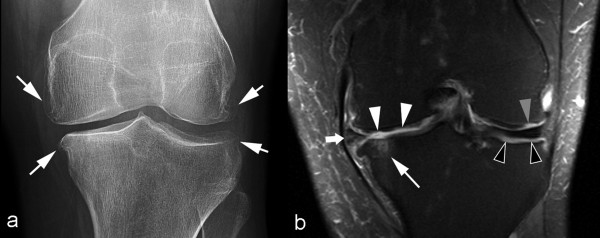
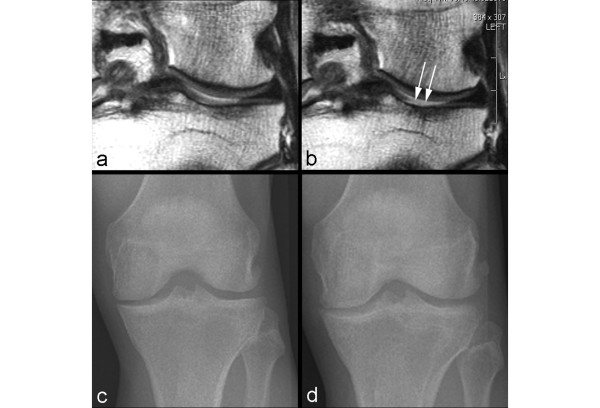
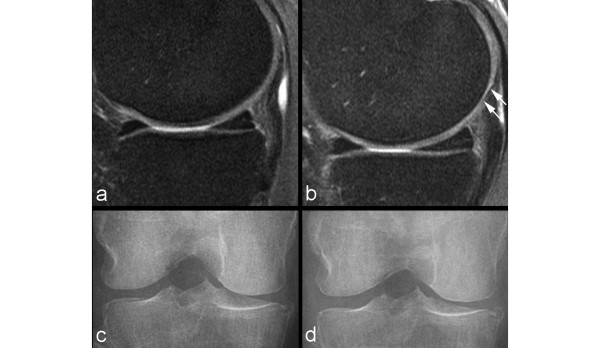
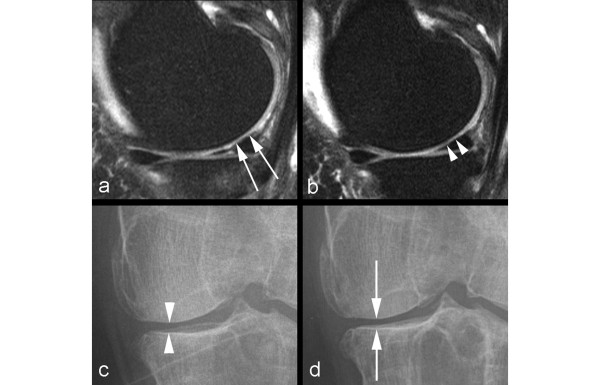
Imaging of cartilage has traditionally been achieved indirectly with conventional radiography. Loss of joint space width, or 'joint space narrowing', is considered a surrogate marker for cartilage thinning. However, radiography is severely limited by its inability to visualize cartilage, the difficulty of ascertaining the optimum and reproducible positioning of the joint in serial assessments, and the difficulty of grading joint space narrowing visually. With the availability of advanced magnetic resonance imaging (MRI) scanners, new pulse sequences, and imaging techniques, direct visualization of cartilage has become possible. MRI enables visualization not only of cartilage but also of other important features of osteoarthritis simultaneously. 'Pre-radiographic' cartilage changes depicted by MRI can be measured reliably by a semiquantitative or quantitative approach. MRI enables accurate measurement of longitudinal changes in quantitative cartilage morphology in knee osteoarthritis. Moreover, compositional MRI allows imaging of 'pre-morphologic' changes (that is, visualization of subtle intrasubstance matrix changes before any obvious morphologic alterations occur). Detection of joint space narrowing on radiography seems outdated now that it is possible to directly visualize morphologic and pre-morphologic changes of cartilage by using conventional as well as complex MRI techniques.
传统上,软骨的成像都是通过常规放射摄影术间接实现的。关节间隙变窄被认为是软骨变薄的替代标志物。然而,放射摄影术受到其无法可视化软骨、难以确定关节在连续评估中的最佳和可重复的定位以及难以直观地对关节间隙变窄进行分级等限制。随着先进磁共振成像(MRI)扫描仪、新脉冲序列和成像技术的出现,直接可视化软骨成为可能。MRI 不仅可以可视化软骨,还可以同时可视化骨关节炎的其他重要特征。MRI 可以通过半定量或定量方法可靠地测量“影像学前”软骨变化。MRI 可以准确测量膝关节骨关节炎定量软骨形态的纵向变化。此外,成分 MRI 允许对“前形态学”变化进行成像(即,在发生任何明显形态改变之前可视化细微的内部基质变化)。现在,通过使用常规和复杂的 MRI 技术,直接可视化软骨的形态学和前形态学变化,放射摄影术检测关节间隙变窄似乎已经过时。